Related Research Articles
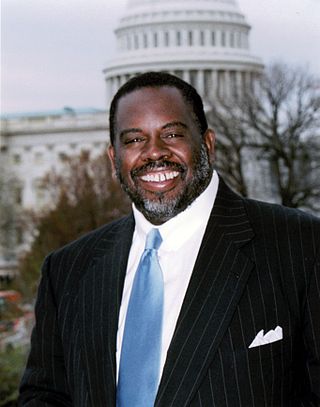
Albert Russell Wynn is an American lobbyist and former politician who served as a member of the United States House of Representatives, representing the 4th district of Maryland from 1993 to 2008. On February 13, 2008, Wynn was defeated in the Democratic primary by Donna Edwards, and resigned his office effective May 31, 2008.

The Calvert Cliffs Nuclear Power Plant (CCNPP) is a nuclear power plant located on the western shore of the Chesapeake Bay near Lusby, Calvert County, Maryland in the Mid-Atlantic United States. It is the only nuclear power plant in the state of Maryland.

Research reactors are nuclear fission-based nuclear reactors that serve primarily as a neutron source. They are also called non-power reactors, in contrast to power reactors that are used for electricity production, heat generation, or maritime propulsion.
The Maryland School of Public Policy is one of 14 schools at the University of Maryland, College Park. The school is located inside the Capital Beltway and ranks 16th nationally for schools of public policy according to U.S. News & World Report (2012).

The Pipeline and Hazardous Materials Safety Administration (PHMSA) is a United States Department of Transportation agency created in 2004, responsible for developing and enforcing regulations for the safe, reliable, and environmentally sound transportation of energy and other hazardous materials that are essential to the daily lives of the American people. It is in charge of overseeing the nation's approximately 3.4 million miles of pipelines - accounting for 65% of the energy consumed in the U.S. - and regulating the nearly 1 million daily shipments of hazardous materials by land, sea, and air. PHMSA's safety programs are housed in the Office of Pipeline Safety (OPS) and the Office of Hazardous Materials Safety (OHMS). PHMSA is headquartered in Washington, D.C.
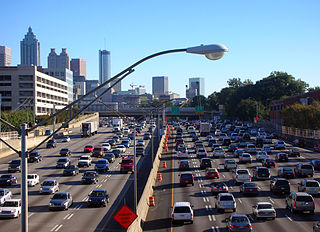
The United States produced 5.2 billion metric tons of carbon dioxide equivalent greenhouse gas (GHG) emissions in 2020, the second largest in the world after greenhouse gas emissions by China and among the countries with the highest greenhouse gas emissions per person. In 2019 China is estimated to have emitted 27% of world GHG, followed by the United States with 11%, then India with 6.6%. In total the United States has emitted a quarter of world GHG, more than any other country. Annual emissions are over 15 tons per person and, amongst the top eight emitters, is the highest country by greenhouse gas emissions per person. However, the IEA estimates that the richest decile in the US emits over 55 tonnes of CO2 per capita each year. Because coal-fired power stations are gradually shutting down, in the 2010s emissions from electricity generation fell to second place behind transportation which is now the largest single source. In 2020, 27% of the GHG emissions of the United States were from transportation, 25% from electricity, 24% from industry, 13% from commercial and residential buildings and 11% from agriculture. In 2021, the electric power sector was the second largest source of U.S. greenhouse gas emissions, accounting for 25% of the U.S. total. These greenhouse gas emissions are contributing to climate change in the United States, as well as worldwide.

Dereck Eugene Davis is an American politician serving as the Treasurer of Maryland since 2021. He is a former member of the Maryland House of Delegates from the 25th district.

The Ministry of Industry and Information Technology is the sixth-ranked executive department of the State Council of the People's Republic of China that is responsible for regulation and development of the postal service, Internet, wireless, broadcasting, communications, production of electronic and information goods, software industry and the promotion of the national knowledge economy.
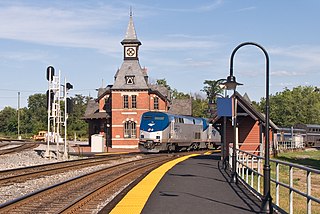
Point of Rocks is a historic passenger rail station on the MARC Brunswick Line between Washington, D.C., and Martinsburg, WV, located at Point of Rocks, Frederick County, Maryland, United States. The station was built by the Baltimore and Ohio Railroad in 1873, and designed by E. Francis Baldwin. It is situated at the junction of the B&O Old Main Line and the Metropolitan Branch. The Met Branch also opened in 1873 and became the principal route for passenger trains between Baltimore, Washington and points west.

At the end of 2015, the installed capacity of wind power in Washington was 3,075 megawatts (MW) with wind power accounting for 7,101 GWh. In 2016, it reached a generation of 8,041 GWh, comprising 7.1% of the electricity generated in the state. In 2023, it had a capacity of 3,407 MW, responsible for 7.75% of generation.

IGS Energy, also known as Interstate Gas Supply, Inc., is an independent retail natural gas and electric supplier based in Dublin, Ohio, United States. It serves more than 1,000,000 residential, commercial and industrial customers in the states of Ohio, Michigan, Kentucky, New York, Pennsylvania, Indiana, Virginia, Maryland, Texas, California and Illinois. The company was founded in 1989, and today employs more than 900 people across 18 states.
Bluewater Wind is an energy company on the North Atlantic Coast, United States, and in the Great Lakes Region, United States, developing offshore wind energy projects. Bluewater's staff has experience in the wind, energy, environmental, finance, public policy, and marine sectors. Bluewater Wind was part of the Babcock & Brown family of companies. and become part of NRG Energy.

A community solar project, farm or garden is a solar power installation that accepts capital from and provides output credit and tax benefits to multiple customers, including individuals, businesses, nonprofits, and other investors. Participants typically invest in or subscribe to a certain kW capacity or kWh generation of remote electrical production. The project's power output is credited to investors or subscribers in proportion to their investment, with adjustments to reflect ongoing changes in capacity, technology, costs and electricity rates. Community solar provides direct access to the renewable energy to customers who cannot install it themselves. Companies, cooperatives, governments or non-profits operate the systems.

Solar power in Massachusetts has been increasing rapidly, due to Section 1603 grants for installations that began before December 31, 2011, and the sale of SRECs for $0.30/kWh, which allows payback for the system within 5 or 6 years, and generates income for the life of the system. For systems installed after December 31, 2011, and before December 31, 2016, the 30% tax grant becomes a 30% tax credit. There has been an appeal to the Congress to extend the 1603 program, the grant program, for an additional year.

Solar power in Maryland is supported by the state's legislation regarding the Renewable Portfolio Standard and Solar Renewable Energy Credit (SREC) program. The target for renewable energy as of 2017 is 20% by 2020, including 2% from solar power.
Mark C. Walczyk is an American politician and US Army Reserve Engineer Officer from the state of New York. A Republican, Walczyk represents the 49th district of the New York State Senate. Walczyk won the seat in 2022, after serving in the New York State Assembly.
References
- ↑ Smith, Stacey (2022-08-04). "Maryland Energy Administration". RMI of Maryland. Retrieved 2023-08-02.
- ↑ "Maryland Energy Administration". Maryland Energy Administration. Retrieved 2023-08-02.