
Jean-Michel André Jarre is a French composer, performer and record producer. He is a pioneer in the electronic, ambient and new-age genres, and is known for organising outdoor spectacles featuring his music, accompanied by vast laser displays, large projections and fireworks.

Henri Émile Benoît Matisse was a French artist, known for both his use of colour and his fluid and original draughtsmanship. He was a draughtsman, printmaker, and sculptor, but is known primarily as a painter. Matisse is commonly regarded, along with Pablo Picasso, as one of the artists who best helped to define the revolutionary developments in the visual arts throughout the opening decades of the twentieth century, responsible for significant developments in painting and sculpture.

Ferdinand Victor Eugène Delacroix was a French Romantic artist regarded from the outset of his career as the leader of the French Romantic school.

Marcel Marceau was a French actor and mime artist most famous for his stage persona, "Bip the Clown". He referred to mime as the "art of silence" and he performed professionally worldwide for over 60 years. As a Jewish youth, he lived in hiding and worked with the French Resistance during most of World War II, giving his first major performance to 3,000 troops after the liberation of Paris in August 1944. Following the war, he studied dramatic art and mime in Paris.

Autun is a subprefecture of the Saône-et-Loire department in the Bourgogne-Franche-Comté region of central-eastern France. It was founded during the Principate era of the early Roman Empire by Emperor Augustus as Augustodunum to give a Roman capital to the Gallic people Aedui, who had Bibracte as their political centre. In Roman times the city may have been home to 30,000 to 100,000 people, according to different estimates. Nowadays, the commune has a population of about 15,000.
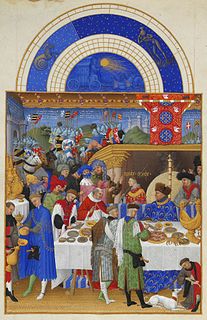
The Très Riches Heures du Duc de Berry or Très Riches Heures, is the most famous and possibly the best surviving example of manuscript illumination in the late phase of the International Gothic style. It is a book of hours: a collection of prayers to be said at the canonical hours. It was created between c. 1412 and 1416 for the extravagant royal bibliophile and patron John, Duke of Berry, by the Limbourg brothers. When the three painters and their sponsor died in 1416, possibly victims of plague, the manuscript was left unfinished. It was further embellished in the 1440s by an anonymous painter, who many art historians believe was Barthélemy d'Eyck. In 1485–1489, it was brought to its present state by the painter Jean Colombe on behalf of the Duke of Savoy. Acquired by the Duc d'Aumale in 1856, the book is now MS 65 in the Musée Condé, Chantilly, France.
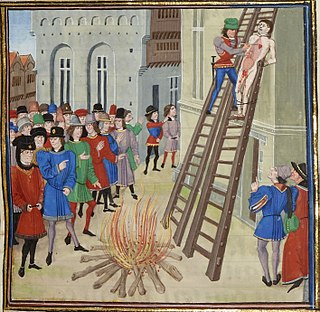
Froissart's Chronicles are a prose history of the Hundred Years' War written in the 14th century by Jean Froissart. The Chronicles open with the events leading up to the deposition of Edward II in 1326, and cover the period up to 1400, recounting events in western Europe, mainly in England, France, Scotland, the Low Countries and the Iberian Peninsula, although at times also mentioning other countries and regions such as Italy, Germany, Ireland, the Balkans, Cyprus, Turkey and North Africa.
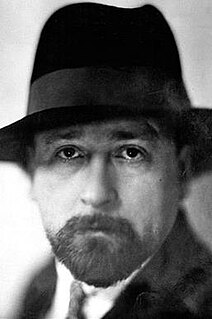
Albert Londres was a French journalist and writer. One of the inventors of investigative journalism, Londres not only reported news but created it, and reported it from a personal perspective. He criticized abuses of colonialism such as forced labour. Albert Londres gave his name to a journalism prize, the Prix Albert-Londres, for Francophone journalists.

Jean Hey, now generally identified with the artist formerly known as the Master of Moulins, was an Early Netherlandish painter working in France and the Duchy of Burgundy, and associated with the court of the Dukes of Bourbon.

Édouard-Henri Avril was a French painter and commercial artist. Under the pseudonym Paul Avril, he was an illustrator of erotic literature. His career saw collaboration with influential people like Octave Uzanne, Henry Spencer Ashbee and Friedrich Karl Forberg.

The Madonna of Chancellor Rolin is an oil painting by the Early Netherlandish master Jan van Eyck, dating from around 1435. It is kept in the Musée du Louvre, Paris, and was commissioned by Nicolas Rolin, aged 60, chancellor of the Duchy of Burgundy, whose votive portrait takes up the left side of the picture, for his parish church, Notre-Dame-du-Chastel in Autun, where it remained until the church burnt down in 1793. After a period in Autun Cathedral, it was moved to the Louvre in 1805.

Jean (Jehan) Rolin (1408–1483) was a French bishop and Cardinal.

The Dunois Master, also called Chief Associate of the Bedford Master was a French manuscript illuminator believed to have been active between about 1430 and about 1465. His name comes from a book of hours made for Jean de Dunois now in the British Library. He worked in association with the Bedford Master, in whose workshop he seems to have served; scholars consider him to be the most talented of the Bedford Master's assistants. He is usually assumed to have taken over the workshop when the Bedford Master ceased to be active, or to have set up his own with some of the artists. His style is characterized by soft modeling of forms, and a fondness for pale colors and shell gold.

Francisque Millet, also known as Jean-François Milée or Millet I, was a Flemish-French landscape painter of the Baroque era.
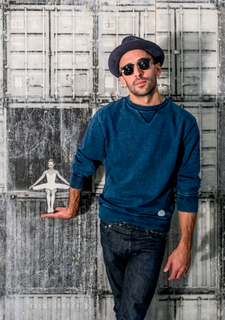
JR is the pseudonym of a French photographer and street artist whose identity is unconfirmed. Describing himself as a photograffeur, he flyposts large black-and-white photographic images in public locations. He states that the street is "the largest art gallery in the world." He started out on the streets of Paris. JR's work "often challenges widely held preconceptions and the reductive images propagated by advertising and the media."

The Boucicaut Master or Master of the Hours for Marshal Boucicaut was an anonymous French or Flemish miniaturist and illuminator active between 1400 and 1430 in Paris. He worked in the International Gothic style.
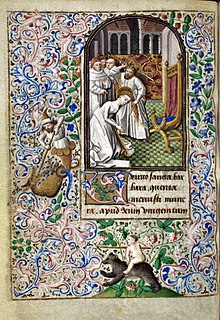
The Book of Hours of Simon de Varie is a French illuminated manuscript book of hours commissioned by the court official Simon de Varie, with miniatures attributed to at least four artists; hand A who may have been a workshop member of the Bedford Master, the anonymous illustrators known as the Master of Jean Rolin II, the Dunois Master and the French miniaturist Jean Fouquet. It was completed in 1455 and consists of 49 large miniatures and dozens of decorative vignettes and painted initials, which total over 80 decorations. Fouquet is known to have contributed six full leaf illuminations, including a masterwork Donor and Virgin diptych. A number of saints appear - Saint Simon is placed as usual alongside Saint Jude ; other pages feature saints Bernard of Menthon, James the Greater and Guillaume de Bourges.

The Pseudo-Jacquemart was an anonymous master illuminator active in Paris and Bourges between 1380 and 1415. He owed his name to his close collaboration with painter Jacquemart de Hesdin.
Jean VI Rolin or Rollin, often referred to as Jean II Rolin to differentiate him from his father Jean Rolin or Rollin in the succession of the offices of Bishop of Autun, abbot of the Abbey of St. Martin, Autun, and prior of the Abbey of Saint-Marcel-lès-Chalon, was a French bishop.


