
Sufism is a mystic body of religious practice found within Islam which is characterized by a focus on Islamic purification, spirituality, ritualism, and asceticism.
A tariqa is a religious order of Sufism, or specifically a concept for the mystical teaching and spiritual practices of such an order with the aim of seeking haqiqa, which translates as "ultimate truth".

The Chishti order is a Sufi order of Sunni Islam named after the town of Chisht where it was initiated by Abu Ishaq Shami. The order was brought to South Asia by Mu'in al-Din Chishti in the city of Ajmer.
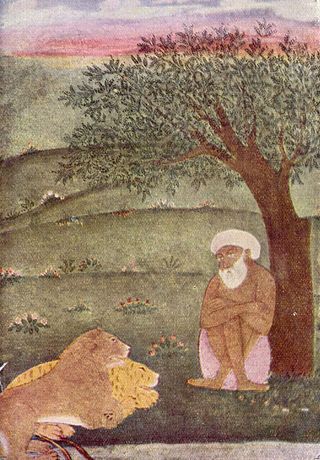
Dervish, Darvesh, or Darwīsh in Islam can refer broadly to members of a Sufi fraternity (tariqah), or more narrowly to a religious mendicant, who chose or accepted material poverty. The latter usage is found particularly in Persian and Turkish (derviş) as well as in Tamazight (Aderwic), corresponding to the Arabic term faqīr. Their focus is on the universal values of love and service, deserting the illusions of ego (nafs) to reach God. In most Sufi orders, a dervish is known to practice dhikr through physical exertions or religious practices to attain the ecstatic trance to reach God. Their most popular practice is Sama, which is associated with the 13th-century mystic Rumi. In folklore and with adherents of Sufism, dervishes are often credited with the ability to perform miracles and ascribed supernatural powers. Historically, the term Dervish has also been used more loosely, as the designation of various Islamic political movements or military entities.

Sufi whirling is a form of physically active meditation which originated among certain Sufi groups, and which is still practiced by the Sufi Dervishes of the Mevlevi order and other orders such as the Rifa'i-Marufi. It is a customary meditation practice performed within the sema, or worship ceremony, through which dervishes aim to reach greater connection with Allah. This is sought through abandoning one's nafs, ego or personal desires, by listening to the music, focusing on God, and spinning one's body in repetitive circles, which has been seen as a symbolic imitation of planets in the Solar System orbiting the Sun.
The Khalwati order is an Islamic Sufi brotherhood (tariqa). Along with the Naqshbandi, Qadiri, and Shadhili orders, it is among the most famous Sufi orders. The order takes its name from the Arabic word khalwa, meaning “method of withdrawal or isolation from the world for mystical purposes.”
Sufism is the mystical branch of Islam in which Muslims seek divine love and truth through direct personal experience of God. This mystic tradition within Islam developed in several stages of growth, emerging first in the form of early asceticism, based on the teachings of Hasan al-Basri, before entering the second stage of more classical mysticism of divine love, as promoted by al-Ghazali and Attar of Nishapur, and finally emerging in the institutionalized form of today's network of fraternal Sufi orders, based on Sufis such as Rumi and Yunus Emre. At its core, however, Sufism remains an individual mystic experience, and a Sufi can be characterized as one who seeks the annihilation of the ego in God.

Shah Inayat Qadri Shattari was a Punjabi Muslim Sufi scholar, saint and philosopher of the Qadri Shattari silsila (lineage). He mostly wrote his philosophical works in Persian. Shah Inayat Qadiri is famous as the spiritual guide of the universal Punjabi poets Bulleh Shah and Waris Shah.
A Sufi lodge is a building designed specifically for gatherings of a Sufi brotherhood or tariqa and is a place for spiritual practice and religious education. They include structures also known as khānaqāh, zāwiya, ribāṭ, dargāh and takya depending on the region, language and period. In Shia Islam, the Husayniyya has a similar function.

Mawlawi Tawagozi, pen name Maʿdumi, better known as Mawlawi was a Kurdish poet and leading Kurdish literary figure in the 19th century. He wrote in Gorani, Arabic and Persian.

Silsila is an Arabic word meaning chain, link, connection often used in various senses of lineage. In particular, it may be translated as "spiritual genealogy" where one Sufi Master transfers his khilafat to his khalîfa, or spiritual descendant. In Urdu, silsila means saga.
Mawlawi, rendered in English as Molvi, is an Islamic religious title given to Muslim religious scholars, or ulama, preceding their names, similar to the titles Mawlānā, Mullah, or Sheikh. Mawlawi generally means a highly qualified Islamic scholar, usually one who has completed full studies in a madrasa or darul uloom. It is commonly used in Iran, Central Asia, South Asia, South East Asia and East Africa. The word Mawlawi is derived from the Arabic word mawla, which has several meanings, including "lord".
The Ba'Alawi tariqa, also known as the Tariqa Ba Alawiyya is a Sufi order centered in Hadhramawt, Yemen, but now spread across the Indian Ocean rim along with the Hadhrami diaspora. The order is closely tied to the Ba'Alawi sadah family.
Sharaf al-Din and Sharif al-Din are two related male Muslim given names. The Turkish form of the name is Şerafettin. They may refer to:
Nizam al-Din, spelled variously Nizamuddin or Nizamüddin or etc. may refer to:
Akbari Sufism or Akbarism is a branch of Sufi metaphysics based on the teachings of Ibn Arabi, an Andalusian Sufi who was a gnostic and philosopher. The word is derived from Ibn Arabi's nickname, "Shaykh al-Akbar," meaning "the greatest master." 'Akbariyya' or 'Akbaris' have never been used to indicate a specific Sufi group or society. It is now used to refer to all historical or contemporary Sufi metaphysicians and Sufis influenced by Ibn Arabi's doctrine of Wahdat al-Wujud. It is not to be confused with Al Akbariyya, a secret Sufi society founded by Swedish Sufi 'Abdu l-Hadi Aguéli.

Shaykh Mehmet 'Ádil was born on 29 March 1957 in Damascus, Shām. He is the successor and oldest son of Sultan-ul 'Awliyá Sheikh Muhammad Nazim 'Ádil al-Haqqání and Hajjah Amina 'Ádil Sultan Hánim, and the current spiritual leader (grandshaykh) of the Haqqani branch of the Naqshbandi Sufi order.
Persecution of Sufis over the course of centuries has included acts of religious discrimination, persecution, and violence both by Sunni and Shia Muslims, such as destruction of Sufi shrines, tombs and mosques, suppression of Sufi orders, murder, and terrorism against adherents of Sufism in a number of Muslim-majority countries. The Republic of Turkey banned all Sufi orders and abolished their institutions in 1925, after Sufis opposed the new secular order. The Islamic Republic of Iran has harassed Sufis, reportedly for their lack of support for the government doctrine of "governance of the jurist".
Niazi Mawlawi Baghdadi was a nineteenth century Iraqi painter, decorator and calligrapher, regarded as the first Iraqi artist to combine traditional practices within a modern style of art.
