See also

Wikimedia Commons has media related to Charters from Serbia .
Medieval Serbian charters includes mainly royal chrysobulls (hrisovulje), legal codes for state and church, and charters (povelje) determining the legal status of endowments and regulation of the population, their rights and obligations of the monastic estates. As of 1989, there were 165 preserved monastery charters, a few royal chrysobulls, and one city charter. [1]
| Work | Date | Type | Description |
|---|---|---|---|
| Charter of Hilandar (1st) | 1198–99 | monastery charter | Stefan Nemanja for Hilandar. Founding charter. |
| Charter of Hilandar (2nd) | 1200–01 | monastery charter | Stefan the First-Crowned for Hilandar. |
| Zakonopravilo | 1219 | code of law | Sava for state and church. |
| Charter of Žiča | 1220 | monastery charter | Stefan the First-Crowned for Žiča. Founding charter. |
| Charter of Skoplje | 1299–1300 | monastery charter | Stefan Milutin for Monastery of St. George. |
| St. Stephen Chrysobull | 1314–16 | monastery charter | Stefan Milutin for Banjska. Founding charter. |
| Charter of Gračanica | 1321 | monastery charter | Stefan Milutin for Gračanica. Founding charter. |
| Dečani chrysobulls | 1330 | monastery charter | Stefan Dečanski for Visoki Dečani. Founding charters. |
| Charter of Treskavac | 1331–45 | monastery charter | Stefan Dušan for Treskavac. |
| Charter of Ston | 1331–45 | charter | Stefan Dušan for Ston. |
| Charter of Kroja | 1343 | city charter | Stefan Dušan for Krujë. |
| Dušan's Code | 1349 | code of law | Stefan Dušan for state and church. |
| Holy Archangels' Chrysobull | 1348–52 | monastery charter | Stefan Dušan for Monastery of the Holy Archangels. |
| Prilep Chrysobull | 1346–55 | charter | Stefan Dušan for Karyes. |
| Arhiljevica Chrysobull | 1354 | charter | Stefan Dušan for Arhiljevica. |
| Charter of Ravanica | 1381 | monastery charter | Lazar for Ravanica. Founding charter. |
| Mining Code | 1412 | code of law | Stefan Lazarević for Novo Brdo. |
| St. Paul's Decree | 1430 | monastery charter | Đurađ Branković for St. Paul's Monastery. |

Dušan Code is a compilation of several legal systems that was enacted by Stefan Uroš IV Dušan of Serbia in 1349. It drew upon Roman law, Byzantine law, as well as elements of customary and canon law. It was used in the Serbian Empire and the succeeding Serbian Despotate. It is considered an early constitution, or close to it; an advanced set of laws which regulated all aspects of life such as family relations, property rights, contracts, and crimes.
Maleševci was a historical Vlach katun of Herzegovina that existed in the Late Middle Ages.
Dražeta, in some English sources also Drazeta, is a fairly rare South Slavic surname and archaic personal name, originally found in five places on the territory of former Yugoslavia: Mošorin (Serbia), Stari Banovci (Serbia), Ivoševci (Croatia), Hodilje (Croatia), and Jajce. People with this surname who live in Mošorin, Stari Banovci, and Ivoševci are Orthodox Serbs, while those who live in Hodilje and Jajce are Catholic Croats. The family slava of Orthodox Dražeta is Saint Stephen. There is information claiming that some Muslim Bosniaks with this surname live in western Bosnia near Prijedor, but this is not confirmed.
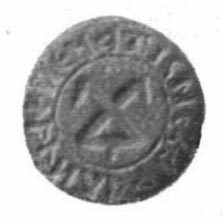
Radič Sanković was a powerful Bosnian nobleman and magnate, with a title of vojvoda (duke) in the Kingdom of Bosnia during the reign of Stephen Dabiša (1391-1395) and Queen Helen (1395-1398). He allied himself with usurper Stephen Ostoja (1398-1404) during the civil wars, until his death in 1404. With the title of vojvoda, he held territories in present-day Herzegovina, including Župa Valley with Glavatičevo as its center, Nevesinje, parts of Popovo Polje and most of Konavle.

Rade Mihaljčić was a Serbian historian and academic. Most of his works deal with medieval Serbia, especially the Serbian empire and the Battle of Kosovo.

Stojan Novaković was a Serbian politician, historian, diplomat, writer, bibliographer, literary critic, literary historian, and translator. He held the post of Prime Minister of the Kingdom of Serbia on two occasions, post of minister of education on three occasions, minister of interior on one occasion and leading the foremost liberal political party of that time in Serbia, the Progressive Party. He was also one of the most successful and skilled Serbian diplomats, holding the post of envoy to Constantinople, Paris, Vienna and Saint Petersburg.
Baldovin was a Serbian knez (duke) and kaznac that served King Stefan Uroš III. He held the province around Vranje.
In the medieval Serbian states, the privileged class consisted of nobility and clergy, distinguished from commoners, part of the feudal society. The Serbian nobility were roughly grouped into magnates, the upper stratum, and the lesser nobility (vlasteličići). Serbia followed the government model established by the Byzantine Empire.
Ivaniš Berislavić was the Despot of the Kingdom of Serbia from 1504 to 1514. He was married to Jelena Jakšić who was the daughter of Stefan Jakšić, member of the powerful House of Jakšić.
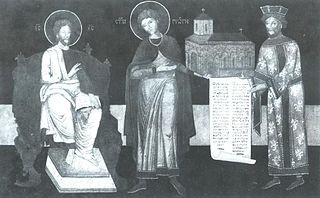
Radič also known as Radich Postupovich was a Serbian nobleman that had the title of Grand Čelnik, the highest dignitary after the Serbian monarch. He began his service under Prince, later Despot, Stefan Lazarević as čelnik, then was elevated to Grand Čelnik during the rule of Despot Đurađ Branković. He was very wealthy, and held the silver mines in Novo Brdo of the Serbian Despotate. Radič founded and renovated several churches and monasteries which still exist, including the notable Vraćevšnica and Kastamonitou. He took monastic vows and became a monk in Kastamonitou where he spent his last years.

The House of Dejanović or House of Dragaš originates from a medieval noble family that served the Serbian Empire of Dušan the Mighty and Uroš the Weak, and during the fall of the Serbian Empire, after the Battle of Maritsa (1371), it became an Ottoman vassal. The family was one of the most prominent during these periods. The family held a region roughly centered where the borders of Serbia, Bulgaria and North Macedonia meet. The last two Byzantine Emperors were maternal descendants of the house.

Charter of Hilandar is the founding charter of the Hilandar monastery, the cradle of the Serbian Orthodox Church and main endowment of Stefan Nemanja and Saint Sava. It was written in 1198, while the second revision, of Stefan the First-Crowned in 1200–01.

The Dečani chrysobulls alternatively known as the Dečani charters are chrysobulls dating to 1330–1345 which contain a detailed list of landholdings and tax farming rights which the monastery of Visoki Dečani held over settlements and communities in the Kingdom of Serbia, in an area which spanned from present-day southern Serbia, Kosovo, Montenegro and parts of northern Albania. The chrysobulls were signed by Stefan Dečanski, the King of Serbia, who confirmed the existing rights and gave new ones to the monastery.
The Albanian nobility was an elite hereditary ruling class in Albania, parts of the western Balkans and later in parts of the Ottoman world. The Albanian nobility was composed of landowners of vast areas, often in allegiance to states like the Byzantine Empire, various Serbian states, the Republic of Venice, the Ottoman Empire and the Kingdom of Naples in addition to the Albanian principalities. They often used Byzantine, Latin or Slavic titles, such as sebastokrator, despot, dux, conte and zupan.
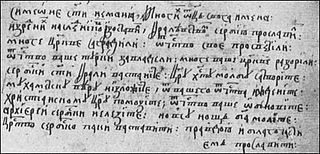
The Cetinje Chronicle is a collection of manuscripts compiled by Vasilije Petrović who added some of his own writings to it. It contains 81 leaves of dimensions 32 cm x 21,5 cm. It is kept in Cetinje monastery. There are other versions of this collection which are not identical to the original because the original texts were transcribed by different people at different times. The first scholar who used this chronicle as source for his works was Vasilije Petrović who used it for his work on history of Montenegro, published in Moscow in 1754.
Ivaniš was a Serbian magnate (velikaš) who served Emperor Stefan Dušan as despot. He is mentioned in Emperor Dušan's charter of the Monastery of the Holy Archangels near Prizren, dated 1348, in which he calls Ivaniš a "parent of my Empire". Not much is known about him, though his high dignitary title and the fact that Dušan called him "his parent" without a doubt shows that he was a close relative with the royal family. Ivaniš had possessions in the Toplica region and granted one of his villages to the Monastery. Ivaniš and then his son, Altoman, held a province in Toplica, evidently near the core of the future province of Lazar Hrebeljanović.

Gradislav Borilović was a Serbian magnate in the service of Stefan Uroš III Dečanski and Stefan Dušan, having the titles of vojvoda (general), kaznac, and tepčija. Gradislav led the Serbian army that fought the Ottoman emirate at the Battle of Demotika in October 1352. The battle was fought between the allies of the two rival Byzantine Emperors, John V Palaiologos and John VI Kantakouzenos, and it was the first major battle of the Ottomans on European soil, which ended in a Serbian defeat. Greek sources spoke of Gradislav as "truly one of the most respectable among the Serbs".
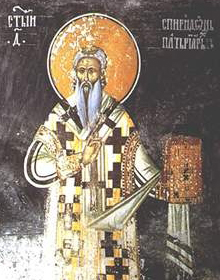
Spiridon was the Patriarch of the Serbian Patriarchate of Peć from 1380 to 1389. He held office during the reign of Prince Lazar, who was recognized by the Serbian Church as the legitimate ruler of the Serbian lands, and with whom he closely cooperated.

The St. Stephen Chrysobull or Banjska Chrysobull was a chrysobull, charter, issued in 1314–1316 by Serbian king Stefan Milutin. It was held at the Banjska monastery founded by Milutin. It is currently held at the Topkapi library in Istanbul.
Đorđe Trifunović is a Serbian literary scholar and literary historian of the University of Belgrade.
{{cite book}}: CS1 maint: location missing publisher (link){{cite journal}}: Cite journal requires |journal= (help){{cite book}}: CS1 maint: location missing publisher (link){{cite journal}}: Cite journal requires |journal= (help)