
Wine is a free and open-source compatibility layer to allow application software and computer games developed for Microsoft Windows to run on Unix-like operating systems. Developers can compile Windows applications against WineLib to help port them to Unix-like systems. Wine is predominantly written using black-box testing reverse-engineering, to avoid copyright issues. No code emulation or virtualization occurs. Wine is primarily developed for Linux and macOS.
A patch is a set of changes to a computer program or its supporting data designed to update or repair it. This includes bugfixes or bug fixes to remove security vulnerabilities and correct bugs (errors). Patches are often written to improve the functionality, usability, or performance of a program. The majority of patches are provided by software vendors for operating system and application updates.
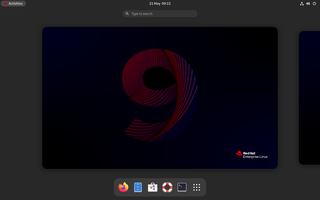
Red Hat Enterprise Linux (RHEL) is a commercial open-source Linux distribution developed by Red Hat for the commercial market. Red Hat Enterprise Linux is released in server versions for x86-64, Power ISA, ARM64, and IBM Z and a desktop version for x86-64. Fedora Linux and CentOS Stream serve as its upstream sources. All of Red Hat's official support and training, together with the Red Hat Certification Program, focuses on the Red Hat Enterprise Linux platform.

Cooperative Linux, abbreviated as coLinux, is software which allows Microsoft Windows and the Linux kernel to run simultaneously in parallel on the same machine.
Software versioning is the process of assigning either unique version names or unique version numbers to unique states of computer software. Within a given version number category, these numbers are generally assigned in increasing order and correspond to new developments in the software. At a fine-grained level, revision control is used for keeping track of incrementally-different versions of information, whether or not this information is computer software, in order to be able to roll any changes back.

Git is a distributed version control system that tracks changes in any set of computer files, usually used for coordinating work among programmers who are collaboratively developing source code during software development.
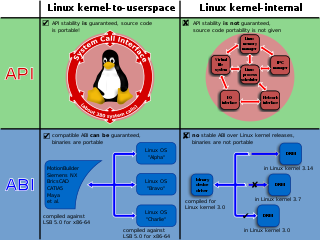
The Linux kernel provides multiple interfaces to user-space and kernel-mode code that are used for varying purposes and that have varying properties by design. There are two types of application programming interface (API) in the Linux kernel:
- the "kernel–user space" API; and
- the "kernel internal" API.

A free and open-source graphics device driver is a software stack which controls computer-graphics hardware and supports graphics-rendering application programming interfaces (APIs) and is released under a free and open-source software license. Graphics device drivers are written for specific hardware to work within a specific operating system kernel and to support a range of APIs used by applications to access the graphics hardware. They may also control output to the display if the display driver is part of the graphics hardware. Most free and open-source graphics device drivers are developed by the Mesa project. The driver is made up of a compiler, a rendering API, and software which manages access to the graphics hardware.

A Hackintosh is a computer that runs Apple's Macintosh operating system macOS on computer hardware that is not authorized for the purpose by Apple. This can also include running Macintosh software on hardware it is not originally authorized for. Benefits of "Hackintoshing" can include cost, ease of repair and piecemeal upgrade, and freedom to use customized choices of components that are not available in the branded Apple products. macOS can also be run on several non-Apple virtualization platforms, although such systems are not usually described as Hackintoshes. Hackintosh laptops are sometimes referred to as "Hackbooks".
The Oracle Cluster File System is a shared disk file system developed by Oracle Corporation and released under the GNU General Public License. The first version of OCFS was developed with the main focus to accommodate Oracle's database management system that used cluster computing. Because of that it was not a POSIX-compliant file system. With version 2 the POSIX features were included.
In computer security, executable-space protection marks memory regions as non-executable, such that an attempt to execute machine code in these regions will cause an exception. It makes use of hardware features such as the NX bit, or in some cases software emulation of those features. However, technologies that emulate or supply an NX bit will usually impose a measurable overhead while using a hardware-supplied NX bit imposes no measurable overhead.
Squashfs is a compressed read-only file system for Linux. Squashfs compresses files, inodes and directories, and supports block sizes from 4 KiB up to 1 MiB for greater compression. Several compression algorithms are supported. Squashfs is also the name of free software, licensed under the GPL, for accessing Squashfs filesystems.
ext4 is a journaling file system for Linux, developed as the successor to ext3.
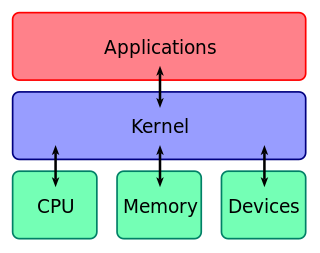
Kernel Patch Protection (KPP), informally known as PatchGuard, is a feature of 64-bit (x64) editions of Microsoft Windows that prevents patching the kernel. It was first introduced in 2005 with the x64 editions of Windows XP and Windows Server 2003 Service Pack 1.

Kernel-based Virtual Machine (KVM) is a free and open-source virtualization module in the Linux kernel that allows the kernel to function as a hypervisor. It was merged into the mainline Linux kernel in version 2.6.20, which was released on February 5, 2007. KVM requires a processor with hardware virtualization extensions, such as Intel VT or AMD-V. KVM has also been ported to other operating systems such as FreeBSD and illumos in the form of loadable kernel modules.
Con Kolivas is a Greek-Australian anaesthetist. He has worked as a computer programmer on the Linux kernel and on the development of the cryptographic currency mining software CGMiner. His Linux contributions include patches for the kernel to improve its desktop performance, particularly reducing I/O impact.

The Linux kernel is a free and open-source, monolithic, modular, multitasking, Unix-like operating system kernel. It was originally written in 1991 by Linus Torvalds for his i386-based PC, and it was soon adopted as the kernel for the GNU operating system, which was written to be a free (libre) replacement for Unix.

SCHED_DEADLINE is a CPU scheduler available in the Linux kernel since version 3.14, based on the earliest deadline first (EDF) and constant bandwidth server (CBS) algorithms, supporting resource reservations: each task scheduled under such policy is associated with a budget Q, and a period P, corresponding to a declaration to the kernel that Q time units are required by that task every P time units, on any processor. This makes SCHED_DEADLINE particularly suitable for real-time applications, like multimedia or industrial control, where P corresponds to the minimum time elapsing between subsequent activations of the task, and Q corresponds to the worst-case execution time needed by each activation of the task.
Long-term support (LTS) is a product lifecycle management policy in which a stable release of computer software is maintained for a longer period of time than the standard edition. The term is typically reserved for open-source software, where it describes a software edition that is supported for months or years longer than the software's standard edition.
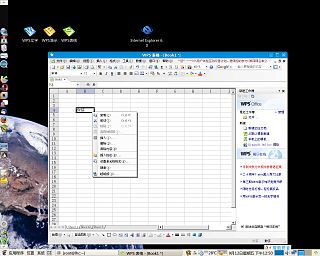
Longene is a Linux-based operating system kernel intended to be binary compatible with application software and device drivers made for Microsoft Windows and Linux. As of 1.0-rc2, it consists of a Linux kernel module implementing aspects of the Windows kernel and a modified Wine distribution designed to take advantage of the more native interface. Longene is written in the C programming language and is free and open source software. It is licensed under the terms of the GNU General Public License version 2 (GPLv2).

