
The Arctic Archipelago, also known as the Canadian Arctic Archipelago, is an archipelago lying to the north of the Canadian continental mainland, excluding Greenland and Iceland.
The Prince Olav Mountains is a mountain group in the Queen Maud Mountains in Antarctica stretching from Shackleton Glacier to Liv Glacier at the head of the Ross Ice Shelf.
The Deep Freeze Range is a rugged mountain range, over 80 nautical miles long and about 10 nautical miles wide, rising between Priestley and Campbell Glaciers in Victoria Land, Antarctica, and extending from the edge of the polar plateau to Terra Nova Bay. It is southwest of the Southern Cross Mountains, south of the Mesa Range and northeast of the Eisenhower Range of the Prince Albert Mountains.
Ketchum Glacier is an eastward flowing glacier at the base of Palmer Land, Antarctica, about 50 nautical miles (90 km) long, descending between the Latady Mountains and the Scaife Mountains into Gardner Inlet. It was discovered by the Ronne Antarctic Research Expedition (RARE), 1947–48, under Finn Ronne, who named it for Commander Gerald Ketchum, U.S. Navy, commander of the icebreaker USS Burton Island (AG-88) which broke the ice to free the RARE from Marguerite Bay for the return home.
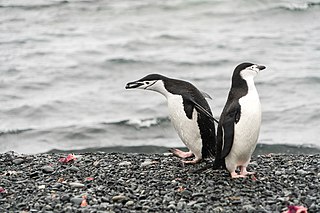
Cape Hooker is the south-eastern point of Low Island, in the South Shetland Islands of Antarctica. The feature was roughly charted by nineteenth century sealers; it was further charted by Commander Henry Foster in 1829 but shown as the north-eastern point of the island. Following air photography by the Falkland Islands and Dependencies Aerial Survey Expedition in 1956, the charted shape of the island was drastically altered and the name Cape Hooker was applied to its south-eastern point as originally described.

The Camarinal Sill is the sill separating the Mediterranean Sea and the Atlantic Ocean. This threshold is the shallowest seafloor pass between the Iberian Peninsula and Africa. It is located approximately 25 km west of the narrowest section of the Strait of Gibraltar and 20 km east of the Espartel Sill, at 35°56′N5°45′W, at a depth of 280 m.

An iceport is a more-or-less permanent indentation in the front of an ice shelf, that can serve as a natural ice harbour. Though useful, they are not always reliable, as calving of surrounding ice shelves can render an iceport temporarily unstable and unusable.
Poção de Pedras is a municipality in the state of Maranhão in the Northeast region of Brazil.
Coronel Hilario Lagos is a village and rural locality (municipality) in La Pampa Province in Argentina.
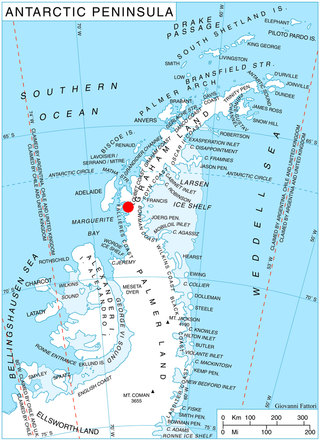
Bagshawe Glacier is a glacier which drains the northeast slopes of Mount Theodore and discharges into Lester Cove, Andvord Bay west of Mount Tsotsorkov, on the west coast of Graham Land, Antarctica.
Watson Escarpment is a major escarpment in the Queen Maud Mountains, trending northward along the east margin of Scott Glacier, then eastward to Reedy Glacier where it turns southward along the glacier's west side. Somewhat arcuate, the escarpment is nearly 100 nautical miles long, rises 3,550 metres (11,650 ft) above sea level, and 1,000 to 1,500 metres above the adjacent terrain.
Patience Rocks is a group of rocks lying 1.5 nautical miles (2.8 km) northwest of Avian Island, close off the south end of Adelaide Island. Named by the United Kingdom Antarctic Place-Names Committee (UK-APC) for Leading Engineer Mechanic Donald Patience, a member of the Royal Navy Hydrographic Survey Unit which charted this area in 1963.
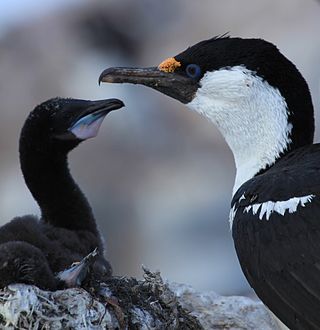
The Pearl Rocks are a group of rocks covering an area 6 km (3.7 mi) by 4 km (2.5 mi) close to the west coast of Tower Island in the Palmer Archipelago of Antarctica. The name was given by Falkland Islands and Dependencies Aerial Survey Expedition (FIDASE) (1955–57) and is descriptive of the numerous snow-covered rocks in the group.
Miethe Glacier is a glacier 3 nautical miles (6 km) long, flowing northwest into Gerlache Strait to the south of Mount Banck, on the west coast of Graham Land, Antarctica. The glacier appears on an Argentine government chart of 1952. It was named by the UK Antarctic Place-Names Committee in 1960 for Adolf Miethe, a German chemist who introduced the first panchromatic emulsion for photographic plates in 1903.
German submarine U-205 was a Type VIIC U-boat of the Kriegsmarine during World War II. The submarine was laid down on 19 June 1940 by the Friedrich Krupp Germaniawerft yard at Kiel as yard number 634; launched on 20 March 1941; and commissioned on 3 May 1941 under the command of Franz-Georg Reschke.
German submarine U-661 was a Type VIIC U-boat built for Nazi Germany's Kriegsmarine for service during World War II. She was laid down on 12 March 1941 by Howaldtswerke, Hamburg as yard number 810, launched on 11 December 1941 and commissioned on 12 February 1942 under Oberleutnant zur See Erich von Lilienfeld.
German submarine U-654 was a Type VIIC U-boat that was built for Nazi Germany's Kriegsmarine for service during World War II. She was laid down on 1 June 1940 by Howaldtswerke, Hamburg as yard number 803, launched on 3 May 1941 and commissioned on 5 July 1941 under Korvettenkapitän Hans-Joachim Hesse.

German submarine U-1170 was a Type VIIC/41 U-boat of Nazi Germany's Kriegsmarine during World War II.

German submarine U-983 was a Type VIIC U-boat of Nazi Germany's Kriegsmarine during World War II.

 Argentina
  La Pampa