
Jalāl al-Dīn Muḥammad Rūmī, also known as Jalāl al-Dīn Muḥammad Balkhī, Mevlânâ/Mawlānā and Mevlevî/Mawlawī, but more popularly known simply as Rumi, was a 13th-century Persian poet, Hanafi faqih, Islamic scholar, Maturidi theologian and Sufi mystic originally from Greater Khorasan in Greater Iran. Rumi's influence transcends national borders and ethnic divisions: Iranians, Tajiks, Turks, Greeks, Pashtuns, other Central Asian Muslims, as well as Muslims of the Indian subcontinent have greatly appreciated his spiritual legacy for the past seven centuries. His poems have been widely translated into many of the world's languages and transposed into various formats. Rumi has been described as the "most popular poet" and the "best selling poet" in the United States.

Sufism, also known as Tasawwuf, is a mystic body of religious practice, found mainly within Sunni Islam but also within Shia Islam which is characterized by a focus on Islamic spirituality, ritualism, asceticism and esotericism. It has been variously defined as "Islamic mysticism", "the mystical expression of Islamic faith", "the inward dimension of Islam", "the phenomenon of mysticism within Islam", the "main manifestation and the most important and central crystallization" of mystical practice in Islam, and "the interiorization and intensification of Islamic faith and practice".
A tariqa is a school or order of Sufism, or specifically a concept for the mystical teaching and spiritual practices of such an order with the aim of seeking haqiqa, which translates as "ultimate truth".

The Mevlevi Order or Mawlawiyya is a Sufi order that originated in Konya and which was founded by the followers of Jalaluddin Muhammad Balkhi Rumi, a 13th-century Persian poet, Sufi mystic, and Islamic theologian. The Mevlevis are also known as the "whirling dervishes" due to their famous practice of whirling as a form of dhikr. Dervish is a common term for an initiate of the Sufi path; whirling is part of the formal sema ceremony and the participants are properly known as semazens.
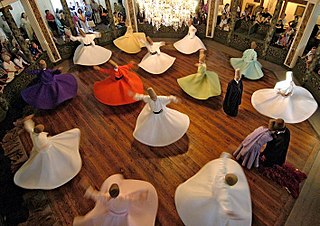
Sama is a Sufi ceremony performed as part of the meditation and prayer practice dhikr. Sama means "listening", while dhikr means "remembrance". These performances often include singing, playing instruments, dancing, recitation of poetry and prayers, wearing symbolic attire, and other rituals. Sama is a particularly popular form of worship in Sufism.
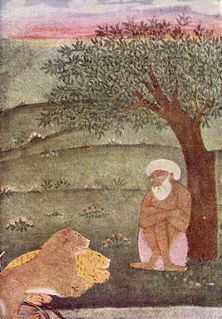
Dervish, Darvesh, or Darwīsh in Islam can refer broadly to members of a Sufi fraternity (tariqah), or more narrowly to a religious mendicant, who chose or accepted material poverty. The latter usage is found particularly in Persian and Turkish (derviş), corresponding to the Arabic term faqīr. Their focus is on the universal values of love and service, deserting the illusions of ego to reach God. In most Sufi orders, a dervish is known to practice dhikr through physical exertions or religious practices to attain the ecstatic trance to reach God. Their most common practice is Sama, which is associated with the 13th-century mystic Rumi. In folklore, dervishes are often credited with the ability to perform miracles and ascribed supernatural powers. Historically, the term Dervish has also been used more loosely, as the designation of various Islamic political movements or military entities.
Sufi whirling is a form of physically active meditation which originated among certain Sufi groups, and which is still practiced by the Sufi Dervishes of the Mevlevi order and other orders such as the Rifa'i-Marufi. It is a customary meditation practice performed within the sema, or worship ceremony, through which dervishes aim to reach the source of all perfection, or dharma. This is sought through abandoning one's nafs, ego or personal desires, by listening to the music, focusing on God, and spinning one's body in repetitive circles, which has been seen as a symbolic imitation of planets in the Solar System orbiting the sun.

Divan-i Kebir, also known as Divan i Shams, is a collection of poems written by the Persian poet and Sufi mystic Mawlānā Jalāl-ad-Dīn Muhammad Balkhī, also known as Rumi. A compilation of lyric poems written in the Persian language, it contains more than 40,000 verses and over 3,000 ghazals. While following the long tradition of Sufi poetry as well as the traditional metrical conventions of ghazals, the poems in the Divan showcase Rumi’s unique, trance-like poetic style. Written in the aftermath of the disappearance of Rumi’s beloved spiritual teacher, Shams-i Tabrizi, the Divan is dedicated to Shams and contains many verses praising him and lamenting his disappearance. Although not a didactic work, the Divan still explores deep philosophical themes, particularly those of love and longing.

Haji Bektash Veli or Wali was a Muslim mystic, saint, Sayyid and philosopher from Khorasan who lived and taught in Anatolia. He is revered among Alevis for an Islamic understanding that is esoteric (spiritual), rational, progressive, and humanistic. Alevi and Bektashi Muslims believe the path of Haji Bektash is the path of ʿAli ibn Abu Talib, since Ali was the source of Bektash's teachings. His original name was "Sayyid Muhammad ibn Sayyid Ibrāhim Ātā". He was one of the figures who flourished in the Sultanate of Rum and had an important influence on the Turkish nomads of Asia Minor. He is also referred to as the Sultan of Hearts and the Derwish of the Derwishes. Haji Bektash Veli was a descendant of Musa Kazim, the Seventh Imam of the Athnā‘ashariyyah Shi'a Muslim sect.

Reshad Feild was an English mystic, author, spiritual teacher, and musician, who, as Tim Feild, originally came to prominence as a founder member of folk-pop group The Springfields. He was later the author of more than a dozen books about spirituality, and Sufism in particular.
Asaf Halet Çelebi was a Turkish mystical poet. Although not very widely known, due to his erudite and often foreign-influenced style, he is considered to be Turkey's first surrealist poet.
Dynamic meditation is a form of meditation in which physical actions are involved. The term appears in the early 1970s when Osho's descriptions of his "Rajneesh Dhyan Yoga," developed at meditation camps in the Indian mountains, were translated into English. His prototypical method is still named "Dynamic Meditation."

The Mevlâna Museum, in Konya, Turkey, started life as the dervish lodge (tekke) of the Mevlevi order, better known as the whirling dervishes. It houses the mausoleum of Jalal ad-Din Muhammad Rumi, a Persian Sufi mystic.
Baha al-Din Muhammad-i Walad, more popularly known as Sultan Walad was the eldest son of Jalal Al-Din Rumi, Persian poet, Sufi, Hanafi Maturidi Islamic scholar and one of the founders of the Mawlawiya order.
Çelebi is a Turkish title meaning "gentleman", "well-mannered" or "courteous". Çelebi also means “man of God”, as a i-suffixed derivative from çalab, which means "God" in old Turkish. German linguist and Turkologist Marcel Erdal, citing Baron Tiesenhausen, traces çalab back to Arabic jallāb "importer, trader" > "importer of slaves and animals, slave merchant, master of slaves" > "(foreign) merchants" and "high social positions"; jallāb is derived from root j-l-b "to have brought, to import", ultimately from West Semitic root g-l-b "to catch, to fetch".

Abdülbaki Gölpınarlı (1900—1982) was a Turkish literary historian of Azerbaijani descent, known for his works on Sufism, Divan literature and Iranian literature. He was a translator and educator, "an outstanding interpreter of Sufism, especially the Mawlaviyya and Bektashiyya schools", as well as "one of the greatest scholars of Turkish Sufism".

The Madrasa of Amir Sunqur Sa'di, also commonly known as the Mausoleum of (Sheikh) Hasan Sadaqa, is a medieval Mamluk-era madrasa structure and mausoleum in Cairo, Egypt. It was originally built between 1315 and 1321 CE by amir Sunqur Sa'di. Sunqur was forced to leave Egypt in his lifetime and was never buried there, but a sheikh known as Hasan Sadaqa was later buried in it and therefore the building is often known by his name. From the 17th century onward the complex was converted into Mevlevi Sufi lodge and is open today as the Mawlawiyya Museum or Museo Mevlevi.

Şefik Can was a Turkish spiritual leader and the last Sufi master in the Mevlevi Sufi tradition in Turkey.
Shems Friedlander is an American Islamic scholar, Sufi master, visual artist, filmmaker, author and an emeritus professor of practice at the American University in Cairo. He is best known for his works on mystical traditions of Islam, especially the Mevlevi Sufi tradition founded after the name of Mevlana Jalāl ad-Dīn Muhammad Rūmī.
