Related Research Articles
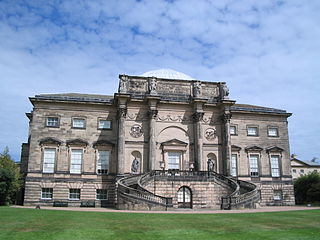
Kedleston Hall is a neo-classical manor house owned by the National Trust, and seat of the Curzon family, located in Kedleston, Derbyshire, approximately 4 miles (6 km) north-west of Derby. The medieval village of Kedleston was moved in 1759 by Nathaniel Curzon to make way for the manor. All that remains of the original village is the 12th century All Saints Church, Kedleston.

Robert Adam was a British neoclassical architect, interior designer and furniture designer. He was the son of William Adam (1689–1748), Scotland's foremost architect of the time, and trained under him. With his older brother John, Robert took on the family business, which included lucrative work for the Board of Ordnance, after William's death.

Sir Charles BarryFRS RA was a British architect, best known for his role in the rebuilding of the Palace of Westminster in London during the mid-19th century, but also responsible for numerous other buildings and gardens. He is known for his major contribution to the use of Italianate architecture in Britain, especially the use of the Palazzo as basis for the design of country houses, city mansions and public buildings. He also developed the Italian Renaissance garden style for the many gardens he designed around country houses.

Lyme Park is a large estate south of Disley, Cheshire, England, managed by the National Trust and consisting of a mansion house surrounded by formal gardens and a deer park in the Peak District National Park. The house is the largest in Cheshire, and is recorded in the National Heritage List for England as a designated Grade I listed building.

Horse Guards Road is a road in the City of Westminster, London. Located in post code SW1A 2HQ, it runs south from The Mall down to Birdcage Walk, roughly parallel with Whitehall and Parliament Street.

Hardwick Hall in Derbyshire is an architecturally significant country house from the Elizabethan era, a leading example of the Elizabethan prodigy house. Built between 1590 and 1597 for Bess of Hardwick, it was designed by the architect Robert Smythson, an exponent of the Renaissance style. Hardwick Hall is one of the earliest examples of the English interpretation of this style, which came into fashion having slowly spread from Florence. Its arrival in Britain coincided with the period when it was no longer necessary or legal to fortify a domestic dwelling.
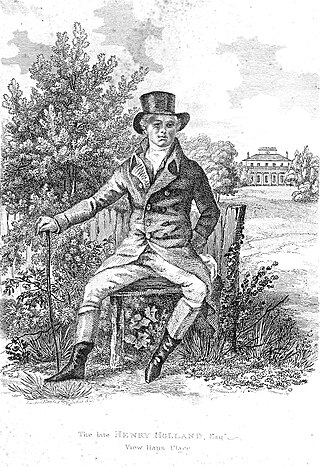
Henry Holland was an architect to the English nobility.
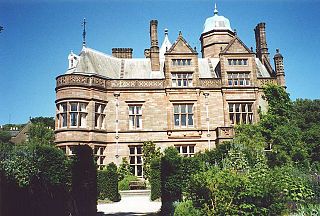
Holker Hall is a privately owned country house located about 2 km to the southwest of the village of Cartmel in the ceremonial county of Cumbria and historic county of Lancashire, England. It is "the grandest [building] of its date in Lancashire ...by the best architects then living in the county." The building dates from the 16th century, with alterations, additions, and rebuilding in the 18th and 19th centuries. The 19th century rebuilding was by George Webster in Jacobean Revival style and subsequent renovations were by E. G. Paley. Hubert Austin had a joint practice with Paley by the 1870s and they both rebuilt the west wing after it was destroyed by a major fire in 1871, only a decade after Paley's previous work on the structure. The fire also destroyed a number of notable artworks. Holker Hall is Paley and Austin's "most important country house commission." The architectural historian Nikolaus Pevsner expressed the opinion that the west wing is the "outstanding domestic work" of Paley and Austin. In 1970 the hall itself, together with its terrace wall, were designated Grade II* Listed buildings. The house stands in an estate of about 80 hectares, and is surrounded by formal gardens, parkland and woodland. Within the grounds are six structures listed at Grade II.
William Emes was an English landscape gardener.

Fairfax House is a Georgian townhouse located at No. 27, Castlegate, York, England, near Clifford's Tower and York Castle Museum. It was probably built in the early 1740s for a local merchant and in 1759 it was purchased by Charles Gregory Fairfax, 9th Viscount Fairfax of Emley, who arranged for the interior to be remodelled by John Carr (architect). Fairfax was the widower of heiress Elizabeth Clifford, daughter of Hugh Clifford, 2nd Baron Clifford of Chudleigh: his inheritance from her death enabled him to purchase the house, which he intended as a home for his daughter from his first marriage, Ann Fairfax.
Bridget Cherry is a British architectural historian who was series editor of the Pevsner Architectural Guides from 1971 until 2002, and is the author or co-author of several volumes in the series.

Ince Blundell Hall is a former country house near the village of Ince Blundell, in the Metropolitan Borough of Sefton, Merseyside, England. It was built between 1720 and 1750 for Robert Blundell, the lord of the manor, and was designed by Henry Sephton, a local mason-architect. Robert's son, Henry, was a collector of paintings and antiquities, and he built impressive structures in the grounds of the hall in which to house them. In the 19th century the estate passed to the Weld family. Thomas Weld Blundell modernised and expanded the house, and built an adjoining chapel. In the 1960s the house and estate were sold again, and have since been run as a nursing home by the Canonesses of St. Augustine of the Mercy of Jesus.

The Queen Eleanor Memorial Cross is a memorial to Eleanor of Castile erected in the forecourt of Charing Cross railway station, London, in 1864–1865. It is a fanciful reconstruction of the medieval Eleanor cross at Charing, one of twelve memorial crosses erected by Edward I of England in memory of his first wife. The Victorian monument was designed by Edward Middleton Barry, also the architect of the railway station, and includes multiple statues of Queen Eleanor by the sculptor Thomas Earp. It does not occupy the original site of the Charing Cross, which is now occupied by Hubert Le Sueur's equestrian statue of Charles I.

Chartered Accountants' Hall is a Grade II* listed building located at 1 Moorgate Place in the City of London. It is the headquarters of the Institute of Chartered Accountants in England & Wales (ICAEW). The Hall is one of the richest examples of late Victorian architecture in the City and has been praised for its seamless integration of sculpture.

Leonard Shuffrey was a British architect and architectural designer of the late Victorian and Edwardian period. He was a leading figure of the aesthetic movement that had a significant impact on the development of buildings and their interiors and their settings, both across London and the South of England. Noted for his wallpaper, fireplaces and ornate plasterwork, Shuffrey was thought the equal of William Morris in his creativity and skill as a craftsman. His output is often found in decorative schemes with William Morris, Edward Ould, William De Morgan, and other preeminent Arts & Crafts and late Pre-Raphaelite decorative artists of the day.
Kedleston is a civil parish in the Amber Valley district of Derbyshire, England. The parish contains 19 listed buildings that are recorded in the National Heritage List for England. Of these, four are listed at Grade I, the highest of the three grades, eight are at Grade II*, the middle grade, and the others are at Grade II, the lowest grade. The parish contains the village of Kedleston and the surrounding area. The major building in the parish is Kedleston Hall, which is listed together with associated structures, including a church, and buildings in the gardens and surrounding park. The listed buildings outside the park are a rectory, a smithy converted into a private house, and a milepost.

The Admiralty buildings complex lies between Whitehall, Horse Guards Parade and The Mall and includes five inter-connected buildings.
Quarndon is a civil parish in the Amber Valley district of Derbyshire, England. The parish contains ten listed buildings that are recorded in the National Heritage List for England. Of these, one is listed at Grade II*, the middle of the three grades, and the others are at Grade II, the lowest grade. The parish contains the village of Quarndon and the surrounding countryside. The listed buildings consist of the remains of a former church, a current church and items in the churchyard, a hotel, an iron screen, a barn, houses, a well house and a milepost.
References
- ↑ Pevsner, Nikolaus; Bradley, Simon (2003). The Buildings of England. London 6: Westminster. Yale University Press. p. 622. ISBN 0300095953.
- ↑ Pevsner, Nikolaus; Bradley, Simon (2003). The Buildings of England. London 6: Westminster. Yale University Press. p. 251. ISBN 0300095953.
- ↑ "The Dining Room fireplace". National Trust Collections. National Trust. Retrieved 8 June 2023.
- ↑ "The Drawing Room fireplace". National Trust Collections. National Trust. Retrieved 8 June 2023.
- ↑ "The Music Room fireplace". National Trust Collections. National Trust. Retrieved 8 June 2023.
- ↑ "England" . The Scots Magazine. Scotland. 3 May 1762. Retrieved 8 June 2023– via British Newspaper Archive.
| International | |
|---|---|
| Artists | |
