
The Hubble Space Telescope is a space telescope that was launched into low Earth orbit in 1990 and remains in operation. It was not the first space telescope, but it is one of the largest and most versatile, renowned both as a vital research tool and as a public relations boon for astronomy. The Hubble telescope is named after astronomer Edwin Hubble and is one of NASA's Great Observatories, along with the Compton Gamma Ray Observatory (1991–2000), the Chandra X-ray Observatory (1999–present), and the Spitzer Space Telescope (2003–2020). The Space Telescope Science Institute (STScI) selects Hubble's targets and processes the resulting data, while the Goddard Space Flight Center (GSFC) controls the spacecraft.
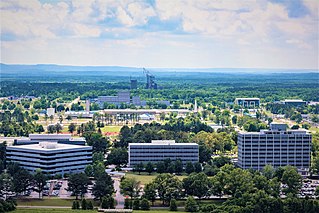
The George C. Marshall Space Flight Center (MSFC), located in Huntsville, Alabama, is the U.S. government's civilian rocketry and spacecraft propulsion research center. As the largest NASA center, MSFC's first mission was developing the Saturn launch vehicles for the Apollo program. Marshall has been the lead center for the Space Shuttle main propulsion and external tank; payloads and related crew training; International Space Station (ISS) design and assembly; computers, networks, and information management; and the Space Launch System (SLS). Located on the Redstone Arsenal near Huntsville, MSFC is named in honor of General of the Army George C. Marshall.

The Goddard Space Flight Center (GSFC) is a major NASA space research laboratory located approximately 6.5 miles (10.5 km) northeast of Washington, D.C. in Greenbelt, Maryland, United States. Established on May 1, 1959 as NASA's first space flight center, GSFC employs approximately 10,000 civil servants and contractors. It is one of ten major NASA field centers, named in recognition of American rocket propulsion pioneer Robert H. Goddard. GSFC is partially within the former Goddard census-designated place; it has a Greenbelt mailing address.

Scott Douglas "Scooter" Altman is a retired United States Navy Captain and naval aviator, engineer, test pilot and former NASA astronaut. He is a veteran of four Space Shuttle missions. His fourth mission on STS-125 was the last servicing mission to the Hubble Space Telescope. He was also the president at ASRC federal, space group.
Ball Aerospace is an American manufacturer of spacecraft, components, and instruments for national defense, civil space and commercial space applications. The company is a wholly owned subsidiary of Ball Corporation, with primary offices in Boulder and facilities in Broomfield and Westminster in Colorado, with smaller offices in New Mexico, Ohio, Northern Virginia, Missouri and Maryland.

Steven Alan Hawley is a former NASA astronaut who flew on five U.S. Space Shuttle flights. He is professor of physics and astronomy and director of engineering physics at the University of Kansas.
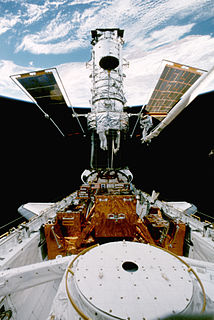
STS-82 was the 22nd flight of the Space Shuttle Discovery and the 82nd mission of the Space Shuttle program. It was NASA's second mission to service the Hubble Space Telescope, during which Discovery's crew repaired and upgraded the telescope's scientific instruments, increasing its research capabilities. Discovery launched from Kennedy Space Center, Florida, on 11 February 1997, returning to Earth on 21 February 1997 at Kennedy Space Center.

Jeffrey Alan Hoffman is an American former NASA astronaut and currently a professor of aeronautics and astronautics at MIT.
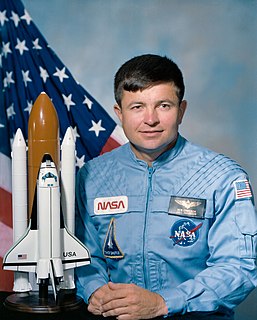
Kenneth Donald Cameron, , is a retired American naval aviator, test pilot, engineer, U.S. Marine Corps officer, and NASA astronaut.
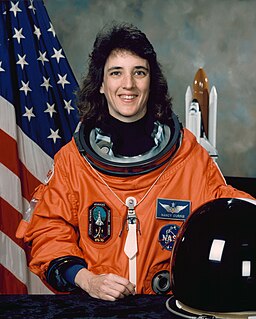
Nancy Jane Currie-Gregg is an American engineer, United States Army officer and a NASA astronaut. Currie-Gregg has served in the United States Army for over 22 years and holds the rank of colonel. With NASA, she has participated in four space shuttle missions: STS-57, STS-70, STS-88, and STS-109, accruing 1,000 hours in space. She currently holds an appointment as a professor of practice in the Department of Industrial & Systems Engineering at Texas A&M University.

John Mace Grunsfeld is an American physicist and a former NASA astronaut. He is a veteran of five Space Shuttle flights and has served as NASA Chief Scientist. His academic background includes research in high energy astrophysics, cosmic ray physics and the emerging field of exoplanet studies with specific interest in future astronomical instrumentation. After retiring from NASA in 2009, he served as the Deputy Director of the Space Telescope Science Institute in Baltimore, Maryland. In January 2012, he returned to NASA and served as associate administrator of NASA's Science Mission Directorate (SMD). Grunsfeld announced his retirement from NASA in April 2016.

Paul William Richards is an American engineer and a former NASA Astronaut. He flew aboard one Space Shuttle mission in 2001.
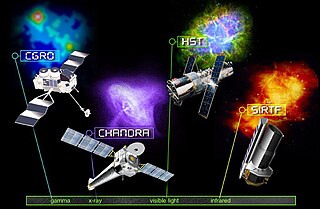
NASA's series of Great Observatories satellites are four large, powerful space-based astronomical telescopes launched between 1990 and 2003. They were built with different technology to examine specific wavelength/energy regions of the electromagnetic spectrum: gamma rays, X-rays, visible and ultraviolet light, and infrared light.

STS-125, or HST-SM4, was the fifth and final Space Shuttle mission to the Hubble Space Telescope (HST) and the last solo flight of the Space Shuttle Atlantis. The launch of the Space Shuttle Atlantis occurred on 11 May 2009 at 2:01 pm EDT. Landing occurred on 24 May at 11:39 am EDT, with the mission lasting a total of just under 13 days.
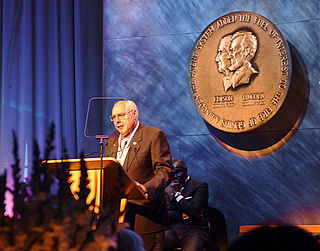
Frank J. "Cepi" Cepollina (born December 6, 1936 in Castro Valley, California is an American engineer and inventor. He was officially inducted to the National Inventors Hall of Fame for his pioneering concept of in-orbit satellite servicing in May 2003. His organizational leadership style has been compared to that of Al Davis of the National Football League's Oakland Raiders.
Goddard Space Flight Center is NASA's first, and oldest, space center. It is named after Dr. Robert H. Goddard, the father of modern rocketry. Throughout its history, the center has managed, developed, and operated many notable missions, including the Cosmic Background Explorer, the Hubble Space Telescope, the Tracking and Data Relay Satellite System (TDRSS), the Lunar Reconnaissance Orbiter, and the Solar Dynamics Observatory.

Swales Aerospace was an employee-owned, small business aerospace engineering firm. The company offered a full range of aerospace engineering services. It was the global leader in the development and manufacture of two-phase thermal solutions for spaceflight applications, and it was a small satellite mission provider. In 2007, it was acquired by Alliant Techsystems.

Space research is scientific study carried out in outer space, and by studying outer space. From the use of space technology to the observable universe, space research is a wide research field. Earth science, materials science, biology, medicine, and physics all apply to the space research environment. The term includes scientific payloads at any altitude from deep space to low Earth orbit, extended to include sounding rocket research in the upper atmosphere, and high-altitude balloons.

Anne L. Kinney is an American space scientist and educator. Kinney is currently the Deputy Center Director at NASA Goddard Space Flight Center. Previously, she held positions as the head of the Directorate for Mathematical and Physical Sciences (MPS) for the National Science Foundation (NSF), the Chief Scientist of the W.M. Keck Observatory, Director of the Solar System Exploration Division at NASA Goddard Space Flight Center, Director of the Origins Program at NASA Jet Propulsion Laboratory, and Director of the Universe Division at NASA Headquarters. She earned a bachelor's degree in astronomy and physics from the University of Wisconsin-Madison and a doctorate in astrophysics from New York University, and has published more than 80 papers on extragalactic astronomy. She was an instrument scientist for the Faint Object Spectrograph that flew on the Hubble Space Telescope.
