
Jacint Rigau-Ros i Serra, known in French as Hyacinthe Rigaud, was a Spanish-French baroque painter most famous for his portraits of Louis XIV and other members of the French nobility.

Moïse Kisling was a Polish-born French painter. Born in Kraków, then part of Austria-Hungary, to Jewish parents, Kisling studied at the Academy of Fine Arts. He left for Paris in 1910 at the age of 19. After moving to Montmartre, Kisling became a member of the Parisian avant-garde known also as the School of Paris, and developed close professional relationships with painters Amedeo Modigliani and Jules Pascin, among others. Kisling gained recognition for portraying the female form and completed numerous nudes and portraits during his career.

Robert Delaunay was a French artist of the School of Paris movement; who, with his wife Sonia Delaunay and others, co-founded the Orphism art movement, noted for its use of strong colours and geometric shapes. His later works were more abstract. His key influence related to bold use of colour and a clear love of experimentation with both depth and tone.

Jean-Paul Riopelle, was a Canadian painter and sculptor from Quebec. He had one of the longest and most important international careers of the sixteen signatories of the Refus Global, the 1948 manifesto that announced the Quebecois artistic community's refusal of clericalism and provincialism. He is best known for his abstract painting style, in particular his "mosaic" works of the 1950s when he famously abandoned the paintbrush, using only a palette knife to apply paint to canvas, giving his works a distinctive sculptural quality. He became the first Canadian painter since James Wilson Morrice to attain widespread international recognition and high praise, both during his career and after his death. He was a leading artist of French Lyrical Abstraction.
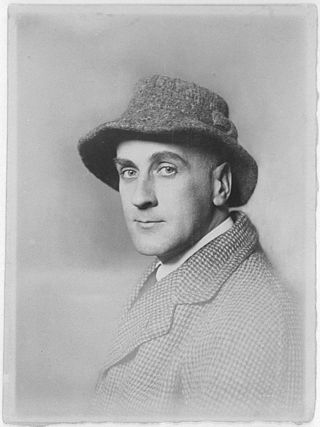
Wilhelm Uhde was a German art collector, dealer, author, and critic, an early collector of modernist painting, and a significant figure in the career of Henri Rousseau.

Séraphine Louis, known as Séraphine de Senlis, was a French painter in the Outsider art. Self-taught, she was inspired by her religious faith and by stained-glass church windows and other religious art. The intensity of her images, both in colour and replicative design, is sometimes interpreted as a reflection of her own psyche, walking a tightrope between ecstasy and mental illness.

The Painter and His Model is a work by Henri Matisse painted late 1916, early 1917. It is currently in the collection of the Musée National d'Art Moderne, Centre Georges Pompidou, Paris. In this work Matisse depicted himself in his studio on the fourth floor of 19 Quai Saint-Michel, at work on his painting Laurette in a Green Robe (1916).

Charles André Mare (1885–1932), or André-Charles Mare, was a French painter and textile designer, and co-founder of the Company of French Art in 1919. He was a designer of colorful textiles, and was one of the founders of the Art Deco movement.
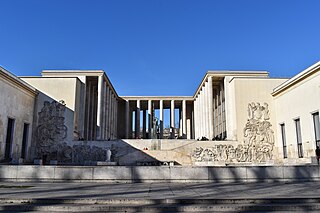
Musée d'Art Moderne de Paris or MAM Paris, is a major municipal museum dedicated to modern and contemporary art of the 20th and 21st centuries, including monumental murals by Raoul Dufy, Gaston Suisse, and Henri Matisse. It is located at 11, Avenue du Président Wilson in the 16th arrondissement of Paris.

The Île de la Jatte or Île de la Grande Jatte is an island in the river Seine, located in the department of Hauts-de-Seine, and shared between the two communes of Neuilly-sur-Seine and Levallois. It is situated at the very gates of Paris, being 7 km distant from the towers of Notre Dame and 3 km from the Place de l'Étoile. The island, which has about 4,000 inhabitants, is nearly 2 km long and almost 200 m wide at its widest point. Its name translates as "Island of the Bowl" or "Island of the Big Bowl".

The Musée de la Chartreuse is an art museum in a former Carthusian monastery in Douai, France. It is the 'musée des Beaux-Arts' for the city.

Jean Messagier was a French painter, sculptor, printmaker and poet. Jean Messagier had his first solo exhibition in Paris at Galerie Arc-en-Ciel in 1947. From 1945 to 1949 the artist worked under the influence of Pablo Picasso, André Masson, Paul Klee and François Desnoyer, his professor at École nationale supérieure des arts décoratifs in Paris. Messagier again was revealed to the public at an exhibition organized by Charles Estienne at the Galerie de Babylone in 1952, entitled "La Nouvelle École de Paris". The following year, Messagier deliberately broke away from his expressionistic form of Post-Cubism; his inspirations now focused on Jean Fautrier and Pierre Tal-Coat to develop a personal vision in which he renders "light...approached abstractly." Jean Messagier is often associated with Lyrical abstraction, Tachisme, Nuagisme, Art informel and paysagisme abstrait, though the artist himself had never accepted any labels, and had always refused the distinction between abstraction and figuration. From 1962 until the year of his death Jean Messagier exhibited in France and abroad, taking part in some major international events as a representative of new trends in French painting.
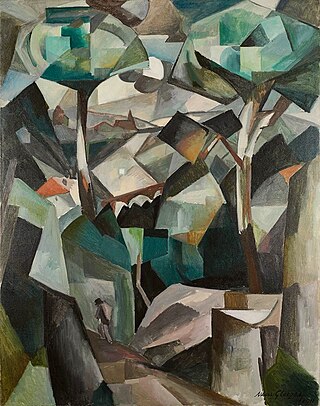
Le Chemin, Paysage à Meudon also known as Paysage avec personage, is an oil on canvas painted in 1911 by the artist, theorist and writer Albert Gleizes. The work was exhibited at the Salon des Indépendants during the spring of 1911, Paris; Les Indépendants, Musée moderne de Bruxelles, 1911; Galeries Dalmau, Exposicio d'art cubista, Barcelona, 1912; Galerie La Boétie, Salon de La Section d'Or, 1912. The painting was reproduced in the journal Le Siècle (1912) in an article titled Enquête sur le Cubisme, by Olivier Hourcade.

The Société Normande de Peinture Moderne, also known as Société de Peinture Moderne, or alternatively, Normand Society of Modern Painting, was a collective of eminent painters, sculptors, poets, musicians and critics associated with Post-Impressionism, Fauvism, Cubism and Orphism. The Société Normande de la Peinture Moderne was a diverse collection of avant-garde artists; in part a subgrouping of the Cubist movement, evolving alongside the so-called Salon Cubist group, first independently then in tandem with the core group of Cubists that emerged at the Salon d'Automne and Salon des Indépendants between 1909 and 1911. Historically, the two groups merged in 1912, at the Section d'Or exhibition, but documents from the period prior to 1912 indicate the merging occurred earlier and in a more convoluted manner.

Georges Valmier was a French painter. His work encompassed the great movements in the modern history of painting, starting with Impressionism in his early years, then Cubism which he discovered when he was around 25 years old, and finally Absstractionism from 1921. He also designed sets and costumes for theater and ballet, and models for fabrics, carpets, and other objects. His oil paintings do not exceed 300 in number, since Valmier died prematurely at the age of 51. His paintings were the culmination of many preparatory drafts in gouaches, multiple versions of which are works in themselves and reflect his penchant for colors and inventive shapes. Valmier was also a musician. He performed the works of Debussy, Ravel, Fauré, and Satie at major concerts and in churches, and had a decisive influence on the career of André Jolivet.
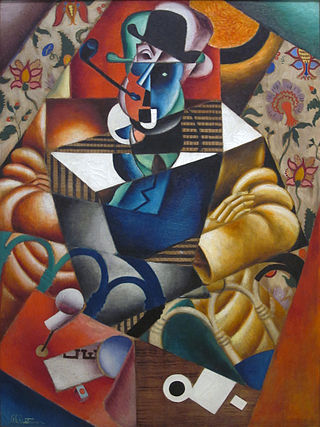
Man with Pipe is a Cubist painting by the French artist Jean Metzinger. It has been suggested that the sitter depicted in the painting represents either Guillaume Apollinaire or Max Jacob. The work was exhibited in the spring of 1914 at the Salon des Indépendants, Paris, Champ-de-Mars, March 1–April 30, 1914, no. 2289, Room 11. A photograph of Le Fumeur was published in Le Petit Comtois, 13 March 1914, for the occasion of the exhibition. In July 1914 the painting was exhibited in Berlin at Herwarth Walden’s Galerie Der Sturm, with works by Albert Gleizes, Raymond Duchamp-Villon and Jacques Villon.
Adelheid Wagner or Adelaïde Salles-Wagner (1825–1890) was a German-born painter active in France. She was a pupil of Claude Jacquand in Lyon, and Joseph Bernhardt in Munich or Paris.
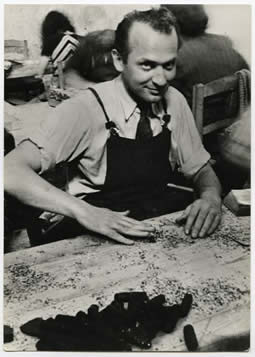
Jacques Hérold was a prominent surrealist painter born in Piatra Neamț, Romania.
Pierre Roy was a French surrealist painter. He is known for his realistically painted compositions of ordinary objects in unexpected arrangements.
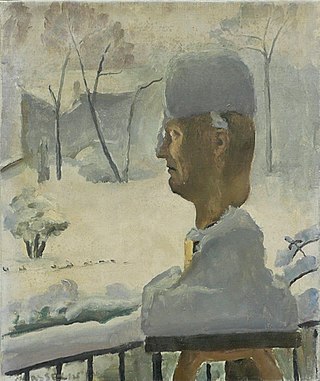
Maurice Paul Jean Asselin was a French painter, watercolourist, printmaker, lithographer, engraver and illustrator, associated with the School of Paris. He is best known for still lifes and nudes. Other recurring themes in his work are motherhood, and the landscapes and seascapes of Brittany. He also worked as a book illustrator, particularly in the 1920s. His personal style was characterised by subdued colours, sensitive brushwork and a strong sense of composition and design.


