Related Research Articles

Euxenite, or euxenite-(Y), is a brownish black mineral with a metallic luster.
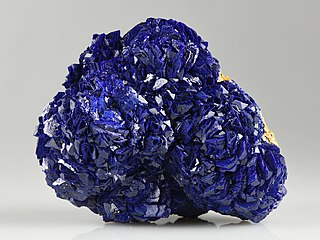
Azurite is a soft, deep-blue copper mineral produced by weathering of copper ore deposits. During the early 19th century, it was also known as chessylite, after the type locality at Chessy-les-Mines near Lyon, France. The mineral, a basic carbonate with the chemical formula Cu3(CO3)2(OH)2, has been known since ancient times, and was mentioned in Pliny the Elder's Natural History under the Greek name kuanos (κυανός: "deep blue," root of English cyan) and the Latin name caeruleum. Copper (Cu2+) gives it its blue color.

Smoky quartz is a brownish grey, translucent variety of quartz that ranges in clarity from almost complete transparency to an almost-opaque brownish-gray or black crystals. The color of smoky quartz is produced when natural radiation, emitted from the surrounding rock, activates color centers around aluminum impurities within the crystalline quartz.

Proustite is a sulfosalt mineral consisting of silver sulfarsenide, Ag3AsS3, known also as light red silver or ruby silver ore, and an important source of the metal. It is closely allied to the corresponding sulfantimonide, pyrargyrite, from which it was distinguished by the chemical analyses of Joseph L. Proust (1754–1826) in 1804, after whom the mineral received its name.

Amateur geology or rock collecting is the non-professional study and hobby of collecting rocks and minerals or fossil specimens from the natural environment. In Australia, New Zealand and Cornwall, the activities of amateur geologists are called fossicking. The first amateur geologists were prospectors looking for valuable minerals and gemstones for commercial purposes. Eventually, however, more people have been drawn to amateur geology for recreational purposes, mainly for the beauty that rocks and minerals provide.

Dioptase is an intense emerald-green to bluish-green copper cyclosilicate mineral. It is transparent to translucent. Its luster is vitreous to sub-adamantine. Its formula is Cu6Si6O18·6H2O (also reported as CuSiO2(OH)2). It has a hardness of 5, the same as tooth enamel. Its specific gravity is 3.28–3.35, and it has two perfect and one very good cleavage directions. Additionally, dioptase is very fragile, and specimens must be handled with great care. It is a trigonal mineral, forming 6-sided crystals that are terminated by rhombohedra.
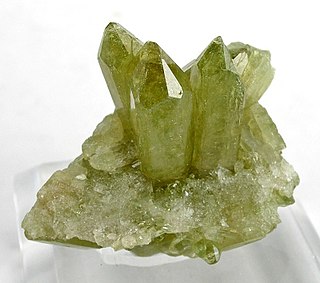
Vesuvianite, also known as idocrase, is a green, brown, yellow, or blue silicate mineral. Vesuvianite occurs as tetragonal crystals in skarn deposits and limestones that have been subjected to contact metamorphism. It was first discovered within included blocks or adjacent to lavas on Mount Vesuvius, hence its name. Attractive-looking crystals are sometimes cut as gemstones. Localities which have yielded fine crystallized specimens include Mount Vesuvius and the Ala Valley near Turin, Piedmont.

Stephanite is a silver antimony sulfosalt mineral with formula: Ag5SbS4. It is composed of 68.8% silver, and sometimes is of importance as an ore of this metal.

Frank Christopher Hawthorne is a Canadian mineralogist, crystallographer and spectroscopist. He works at the University of Manitoba, Winnipeg, Manitoba, Canada, and is currently Distinguished Professor Emeritus. By combining Graph Theory, Bond-Valence Theory and the moments approach to the electronic energy density of solids he has developed Bond Topology as a rigorous approach to understanding the atomic arrangements, chemical compositions and paragenesis of complex oxide and oxysalt minerals.

The mineral zektzerite is a member of the tuhualite group and was first found in 1966 by Seattle mineralogist Benjamin Bartlett "Bart" Cannon. It was discovered in the Willow creek basin below Silver Star mountain in miarolitic cavities within the alkaline arfvedsonite granite phase of the Golden Horn batholith, Okanogan County, Washington. It is named for Jack Zektzer, mathematician and mineral collector of Seattle, Washington.

Pabstite is a barium tin titanium silicate mineral that is found in contact metamorphosed limestone. It belongs to the benitoite group of minerals. The chemical formula of pabstite is Ba(Sn,Ti)Si3O9. It is found in Santa Cruz, California. The crystal system of the mineral is hexagonal.

Jeremejevite is an aluminium borate mineral with variable fluoride and hydroxide ions. Its chemical formula is Al6B5O15(F,OH)3. It is considered as one of the rarest, thus one of the most expensive stones. For nearly a century, it was considered as one of the rarest gemstones in the world.

The Pikes Peak region is renowned for its rare mineral specimens. It is a favorite collecting area for amateur and serious rock hounds. Scientists from around the world come to Colorado to study the minerals of this region. Because the granite covers a large portion of the Colorado Front Range, there are good mineral collecting areas scattered all over the Pikes Peak region. The collecting localities range from near Colorado Springs on the south to just west of Denver on the north.

Mineral collecting is the hobby of systematically collecting, identifying and displaying mineral specimens. Mineral collecting can also be a part of the profession of mineralogy and allied geologic specialties. Individual collectors often specialize in certain areas, for example collecting samples of several varieties of the mineral calcite from locations spread throughout a region or the world, or of minerals found in pegmatites.
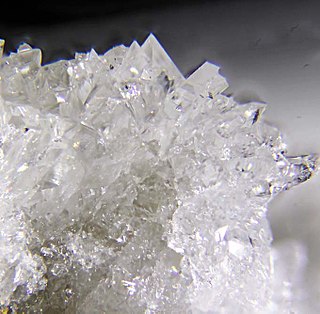
Amicite is a silicate mineral of the zeolite family. It has a general formula of K2Na2Al4Si4O16·5(H2O). Amicite was described in 1979 from specimens obtained at the Höwenegg quarry in Immendingen, Hegau, in the German state of Baden-Württemberg, which is consequently its type locality. The name is in honor of Giovanni Battista Amici (1786–1863) a botanist, physicist, optician, and inventor of microscope optical elements.

Millerite is a nickel sulfide mineral, NiS. It is brassy in colour and has an acicular habit, often forming radiating masses and furry aggregates. It can be distinguished from pentlandite by crystal habit, its duller colour, and general lack of association with pyrite or pyrrhotite.
Joseph (Joe) Anthony Mandarino OC, FRSC was an American-Canadian mineralogist and crystallographer.
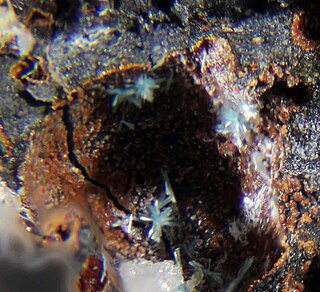
Mammothite is a mineral found in the Mammoth mine in Tiger, Arizona and also in Laurium, Attika, Greece. This mineral was named in 1985 by Donald R. Peacor, Pete J. Dunn, G. Schnorrer-Köhler, and Richard A. Bideaux, for the Mammoth vein (one of the two main veins in the mine) and the town of Mammoth, Arizona, which was named for the mine. The mammothite that is found in Arizona exist as euhedral crystals imbedded in micro granular, white colored anglesite with a saccharoidal texture. The associated minerals include phosgenite, wulfenite, leadhillite and caledonite. In Greece, the mammothite exists as small euhedral crystals and also as microscopic rock cavities lined with projecting crystals within the slags. The associated minerals here are cerussite, phosgenite and matlockite. The ideal chemical formula for mammothite is Pb6Cu4AlSb5+O2(OH)16Cl4(SO4)2.
Microtechnique is an aggregate of methods used to prepare micro-objects for studying. It is currently being employed in many fields in life science. Two well-known branches of microtechnique are botanical (plant) microtechnique and zoological (animal) microtechnique.

Malhmoodite is a phosphate mineral first discovered at a mine called Union Carbide in Wilson Springs, Arkansas, United States. This mine is 10 km west of Magnet Cove, an alkaline igneous complex, and Union Carbide is in a contact region of alkalic igneous rocks and surrounding sedimentary rocks. The mineral has been approved by the Commission on New Minerals and Mineral Names, IMA, to be named for the late Bertha K. Malhmood, the Administrative Assistant of the Branch of Analytical Laboratories, U.S. Geological Survey.
References
 | This mineralogy article is a stub. You can help Wikipedia by expanding it. |