Peer pressure is the direct influence on people by peers, or the effect on an individual who is encouraged and wants to follow their peers by changing their attitudes, values or behaviors to conform to those of the influencing group or individual. For the individual, this can result in either a positive or negative effect, or both. Social groups affected include both membership groups - in which individuals are "formally" members - and cliques - in which membership is not clearly defined. However, a person does not need to be a member or be seeking membership of a group to be affected by peer pressure. Researchers have studied the effects of peer pressure on children and on adolescents, and in popular discourse the term "peer pressure" occurs mostly with reference to those age-groups. For children, the common themes for study regard their abilities for independent decision-making; for adolescents, peer pressure's relationship with sexual intercourse and substance abuse have been significantly researched. Peer pressure can affect individuals of all ethnicities, genders and ages, however. Peer pressure has expanded from strictly face-to-face interaction to digital interaction as well. Social media offers opportunities for adolescents and adults alike to instil and/or experience pressure every day. Research suggests that not just individuals but also organizations, such as large corporations, are susceptible to peer pressures, such as pressures from other firms in their industry or from headquarters.

Risperidone, sold under the brand name Risperdal among others, is an atypical antipsychotic used to treat schizophrenia and bipolar disorder. It is taken either by mouth or by injection into a muscle. The injectable version is long-acting and lasts for about two weeks.

Drug Abuse Resistance Education (D.A.R.E.) is an education program that seeks to prevent use of controlled drugs, membership in gangs, and violent behavior. It was founded in Los Angeles in 1983 as a joint initiative of then-LAPD chief Daryl Gates and the Los Angeles Unified School District as a demand-side drug control strategy of the American War on Drugs. The program's mascot is Daren the Lion.

Preventive healthcare, or prophylaxis, consists of measures taken for disease prevention. Disease and disability are affected by environmental factors, genetic predisposition, disease agents, and lifestyle choices, and are dynamic processes which begin before individuals realize they are affected. Disease prevention relies on anticipatory actions that can be categorized as primal, primary, secondary, and tertiary prevention.
Drug education is the planned provision of information, resources, and skills relevant to living in a world where psychoactive substances are widely available and commonly used for a variety of both medical and non-medical purposes, some of which may lead to harms such as overdose, injury, infectious disease, or addiction.

Substance abuse prevention, also known as drug abuse prevention, is a process that attempts to prevent the onset of substance use or limit the development of problems associated with using psychoactive substances. Prevention efforts may focus on the individual or their surroundings. A concept that is known as "environmental prevention" focuses on changing community conditions or policies so that the availability of substances is reduced as well as the demand. Individual Substance Abuse Prevention, also known as drug abuse prevention involves numerous amounts of different sessions depending on the individual to help cease or reduce the use of substances. The time period to help a specific individual can vary based upon many aspects of an individual. The type of Prevention efforts should be based upon the individual's necessities which can also vary.
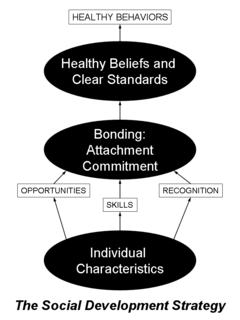
Communities That Care (CTC) is a program of the Center for Substance Abuse Prevention (CSAP) in the office of the United States Government's Substance Abuse and Mental Health Services Administration (SAMHSA). CTC is a coalition-based prevention operating system that uses a public health approach to prevent youth problem behaviors such as violence, delinquency, school drop out and substance abuse. Using strategic consultation, training, and research-based tools, CTC is designed to help community stakeholders and decision makers understand and apply information about risk and protective factors, and programs that are proven to make a difference in promoting healthy youth development, in order to most effectively address the specific issues facing their community's youth.

Depression is a mental disorder characterized by prolonged unhappiness or irritability, accompanied by a constellation of somatic and cognitive signs and symptoms such as fatigue, apathy, sleep problems, loss of appetite, loss of engagement; low self-regard or worthlessness; difficulty concentrating or indecisiveness; or recurrent thoughts of death or suicide. Depression in childhood and adolescence is similar to adult major depressive disorder, although young sufferers may exhibit increased irritability or behavioral dyscontrol instead of the more common sad, empty, or hopeless feelings seen with adults. Children who are under stress, experiencing loss, have attention, learning, behavioral, or anxiety disorders are at a higher risk for depression. Childhood depression is often comorbid with mental disorders outside of other mood disorders; most commonly anxiety disorder and conduct disorder. Depression also tends to run in families. In a 2016 Cochrane review cognitive behavior therapy (CBT), third wave CBT and interpersonal therapy demonstrated small positive benefits in the prevention of depression. Psychologists have developed different treatments to assist children and adolescents suffering from depression, though the legitimacy of the diagnosis of childhood depression as a psychiatric disorder, as well as the efficacy of various methods of assessment and treatment, remains controversial.

Benocyclidine, also known as benzothiophenylcyclohexylpiperidine (BTCP), is a psychoactive recreational drug of the arylcyclohexylamine class which is related to phencyclidine (PCP). It was first described in a patent application naming Marc Caron and colleagues at Duke University in 1997.
Peer education is an approach to health promotion, in which community members are supported to promote health-enhancing change among their peers. Peer education is the teaching or sharing of health information, values and behavior in educating others who may share similar social backgrounds or life experiences.

Smokingamong youth and adolescents is an issue that affects countries worldwide. While the extent to which smoking is viewed as a negative health behavior may vary across different nations, it remains an issue regardless of how it is perceived by different societies. The United States has taken numerous measures, ranging from changes in national policy surrounding youth cigarette access to changes in media campaigns, in attempts to eliminate the use of tobacco products among teenagers. Approximately 90% of smokers begin smoking prior to the age of 18. In efforts to reduce the total number of smokers and negative effects smoking has on society, it is necessary to reduce the number of youth and adolescents who begin smoking.
Cannabis use disorder (CUD), also known as cannabis addiction or marijuana addiction, is defined in the fifth revision of the Diagnostic and Statistical Manual of Mental Disorders (DSM-5) and ICD-10 as the continued use of cannabis despite clinically significant impairment.
Deborah Prothrow-Stith, M.D. is Dean and Professor at Charles R. Drew University College of Medicine in Los Angeles, CA.. She advised top-tier healthcare institutions on leadership as a principal at Spencer Stuart and she served as the Henry Pickering Walcott Professor of Public Health Practice and Associate Dean for Diversity at Harvard School of Public Health where she created the Division of Public Health Practice and secured over $14 million in grant funding for health programs. While working in inner-city Boston, she broke new ground with efforts to define youth violence as a health problem. She developed The Violence Prevention Curriculum for Adolescents, a forerunner of violence prevention curricula for schools and authored or co-authored Deadly Consequences ; Murder Is No Accident ; Sugar and Spice and No Longer Nice, ; a high school textbook, Health ; and, over 100 articles. In 1987, Governor Michael Dukakis appointed her Commissioner of Public Health for Massachusetts where she led a department with 3,500 employees, 8 hospitals and a budget of $350 million. She and her family lived in Tanzania during her husband’s tenure as U.S. Ambassador. Dr. Prothrow-Stith is a graduate of Spelman College and Harvard Medical School and a diplomate of the American Board of Internal Medicine. In 2003, she was elected to the prestigious National Academy of Medicine. She has received ten honorary doctorates and in 2017, she was named Woman of the Year for the 2nd District by the LA County Board of Supervisors.

Adapromine is an antiviral drug of the adamantane group related to amantadine (1-aminoadamantane), rimantadine, and memantine (1-amino-3,5-dimethyladamantane) that is marketed in Russia for the treatment and prevention of influenza. It is an alkyl analogue of rimantadine and is similar to rimantadine in its antiviral activity but possesses a broader spectrum of action, being effective against influenza viruses of both type A and B. Strains of type A influenza virus with resistance to adapromine and rimantadine and the related drug deitiforine were encountered in Mongolia and the Soviet Union in the 1980s.
Treatment as prevention (TasP) is a concept in public health that promotes treatment as a way to prevent and reduce the likelihood of HIV illness, death and transmission from an infected individual to others. Expanding access to earlier HIV diagnosis and treatment as a means to address the global epidemic by preventing illness, death and transmission was first proposed in 2000 by Garnett et al. The term is often used to talk about treating people that are currently living with human immunodeficiency virus (HIV) and acquired immune deficiency syndrome (AIDS) to prevent illness, death and transmission. Although some experts narrow this to only include preventing infections, treatment prevents illnesses such as tuberculosis and has been shown to prevent death. The dual impact on well being and its 100% effectiveness in reducing transmission makes TasP the most important element in the HIV prevention toolkit. In relation to HIV, antiretroviral therapy (ART) is a three or more drug combination therapy that is used to decrease the viral load, or the measured amount of virus, in an infected individual. Such medications are used as a preventative for infected individuals to not only spread the HIV virus to their negative partners but also improve their current health to increase their lifespans. Other names for ART include highly active antiretroviral therapy (HAART), combination antiretroviral therapy (cART), triple therapy and triple drug cocktail. When taken correctly, ART is able to diminish the presence of the HIV virus in the bodily fluids of an infected person to a level of undetectability. Undetectability ensures that infection does not necessarily have an effect on a person's general health, and that there is no longer a risk of passing along HIV to others. Consistent adherence to an ARV regimen, monitoring, and testing are essential for continued confirmed viral suppression. Treatment as prevention rose to great prominence in 2011, as part of the HPTN 052 study, which shed light on the benefits of early treatment for HIV positive individuals.
Guided self-change (GSC) treatment has been accepted by American Psychological Association Division 12, Society of Clinical Psychology, as an empirically supported treatment.
School-based prevention programs are initiatives implemented into school settings that aim to increase children's academic success and reduce high-risk problem behaviors.
Wendee M. Wechsberg is an American social science researcher. Wechsberg's research focuses on developing and testing the efficacy of HIV prevention interventions among key populations of substance abusers globally. She is a recognized expert in the fields of substance abuse, gender inequality, and HIV. She developed the Women's CoOp intervention, a woman-focused behavioral HIV intervention that incorporates gender- and culture-specific skills training. Wechsberg is a Principal Researcher and Director of the Substance Use, Gender, and Applied Research (SUGAR) Program at RTI International and Director of the RTI Global Gender Center. She is also Adjunct Professor at the University of North Carolina at Chapel Hill (UNC) Gillings School of Global Public Health, Adjunct Professor of Psychology at North Carolina State University (NCSU), and Adjunct Professor in Psychiatry and Behavioral Sciences at Duke University School of Medicine.

Exposure to nicotine, from conventional or electronic cigarettes during adolescence can impair the developing human brain. E-cigarette use is recognized as a substantial threat to adolescent behavioral health. The use of tobacco products, no matter what type, is almost always started and established during adolescence when the developing brain is most vulnerable to nicotine addiction. Young people's brains build synapses faster than adult brains. Because addiction is a form of learning, adolescents can get addicted more easily than adults. The nicotine in e-cigarettes can also prime the adolescent brain for addiction to other drugs such as cocaine. Exposure to nicotine and its great risk of developing an addiction, are areas of significant concern.

Delta-8-tetrahydrocannabinol is a psychoactive cannabinoid found in the Cannabis plant. It is an isomer of delta-9-tetrahydrocannabinol, the compound commonly known as THC. ∆8-THC has antiemetic, anxiolytic, orexigenic, analgesic, and neuroprotective properties.

