The Palatine of Hungary was the highest-ranking office in the Kingdom of Hungary from the beginning of the 11th century to 1848. Initially, Palatines were representatives of the monarchs, later the vice-regent (viceroy). In the early centuries of the kingdom, they were appointed by the king, and later were elected by the Diet of the Kingdom of Hungary.
The Hungarian nobility consisted of a privileged group of people, most of whom owned landed property, in the Kingdom of Hungary. Initially, a diverse category of people were mentioned as noblemen, but from the late 12th century only the high-ranking royal officials were regarded nobles. Most aristocrats claimed a late-9th-century Magyar leader for their ancestor; others were descended from foreign knights; and local Slavic chiefs were also integrated in the nobility. Less illustrious individuals, known as castle warriors, also held landed property and served in the royal army. Most privileged laymen called themselves royal servants to emphasize their direct contact to the monarchs from the 1170s. The Golden Bull of 1222 enacted their liberties, especially their tax-exemption and the limitation of their military obligations. From the 1220s, the royal servants were associated with the nobility and the highest-ranking officials were known as barons of the realm. Only those who owned allods – lands free of obligations – were regarded true noblemen, but other privileged groups of landowners, known as conditional nobles, also existed.

Gesta Hungarorum, or The Deeds of the Hungarians, is the first extant Hungarian book about history. Its genre is not chronicle, but gesta, meaning "deeds" or "acts", which is a medieval entertaining literature. It was written by an unidentified author who has traditionally been called Anonymus in scholarly works. According to most historians, the work was completed between around 1200 and 1230. The Gesta exists in a sole manuscript from the second part of the 13th century, which was for centuries held in Vienna. It is part of the collection of Széchényi National Library in Budapest.
The ispán or count was the leader of a castle district in the Kingdom of Hungary from the early 11th century. Most of them were also heads of the basic administrative units of the kingdom, called counties, and from the 13th century the latter function became dominant. The ispáns were appointed and dismissed by either the monarchs or a high-ranking royal official responsible for the administration of a larger territorial unit within the kingdom. They fulfilled administrative, judicial and military functions in one or more counties.

The Voivode of Transylvania was the highest-ranking official in Transylvania within the Kingdom of Hungary from the 12th century to the 16th century. Appointed by the monarchs, the voivodes – themselves also the heads or ispáns of Fehér County – were the superiors of the ispáns of all the other counties in the province.

Anonymus Bele regis notarius or Master P. was the notary and chronicler of a Hungarian King, probably Béla III. Little is known about him, but his latinized name began with P, as he referred to himself as "P. dictus magister".

The judge royal, also justiciar, chief justice or Lord Chief Justice, was the second-highest judge, preceded only by the palatine, in the Kingdom of Hungary between around 1127 and 1884. After 1884, the judge royal was only a symbolic function, but it was only in 1918 — with the end of Habsburgs in the Kingdom of Hungary — that the function ceased officially.
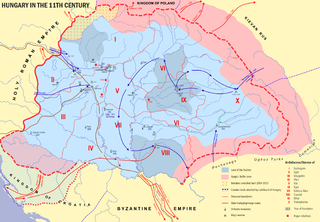
A castle warrior was a landholder obliged to provide military services to the ispán or head of a royal castle district in the medieval Kingdom of Hungary. Castle warriors "formed a privileged, elite class that ruled over the mass of castle folk" from the establishment of the kingdom around 1000 AD. Due to the disintegration of the system of castle districts, many castle warriors became serfs working on the lands of private landholders in the 13th and 14th centuries; however, some of them were granted a full or "conditional noble" status.

A conditional noble or predialist was a landowner in the Kingdom of Hungary who was obliged to render specific services to his lord in return for his landholding, in contrast with a "true nobleman of the realm" who held his estates free of such services. Most conditional nobles lived in the border territories of the kingdom, including Slavonia and Transylvania, but some of their groups possessed lands in estates of Roman Catholic prelates. Certain groups of conditional nobility, including the "ecclesiastic nobles" and the "nobles of Turopolje" preserved their specific status until the 19th century.
A perpetual count was a head or an ispán of a county in the Kingdom of Hungary whose office was either hereditary or attached to the dignity of a prelate or of a great officer of the realm. The earliest examples of a perpetual ispánate are from the 12th century, but the institution flourished between the 15th and 18th centuries. Although all administrative functions of the office were abolished in 1870, the title itself was preserved until the general abolition of noble titles in Hungary in 1946.
The Master of the horse was one of the high officials of the royal household in the Kingdom of Hungary. Masters of the Horse were included among the "true barons" of the realm from around 1220.
The master of the cupbearers or master of the cup-bearers was one of the high officials of the royal household in the Kingdom of Hungary. Masters of the cupbearers were included among the "true barons" of the realm from around 1220.

The Kingdom of Hungary came into existence in Central Europe when Stephen I, Grand Prince of the Hungarians, was crowned king in 1000 or 1001. He reinforced central authority and forced his subjects to accept Christianity. Although all written sources emphasize only the role played by German and Italian knights and clerics in the process, a significant part of the Hungarian vocabulary for agriculture, religion and state was taken from Slavic languages. Civil wars and pagan uprisings, along with attempts by the Holy Roman Emperors to expand their authority over Hungary, jeopardized the new monarchy. The monarchy stabilized during the reigns of Ladislaus I (1077–1095) and Coloman (1095–1116). These rulers occupied Croatia and Dalmatia with the support of a part of the local population. Both realms retained their autonomous position. The successors of Ladislaus and Coloman—especially Béla II (1131–1141), Béla III (1176–1196), Andrew II (1205–1235), and Béla IV (1235–1270)—continued this policy of expansion towards the Balkan Peninsula and the lands east of the Carpathian Mountains, transforming their kingdom into one of the major powers of medieval Europe.
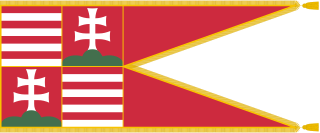
In the Late Middle Ages, the Kingdom of Hungary, a country in Central Europe, experienced a period of interregnum in the early 14th century. Royal power was restored under Charles I (1308–1342), a scion of the Capetian House of Anjou. Gold and silver mines opened in his reign produced about one third of the world's total production up until the 1490s. The kingdom reached the peak of its power under Louis the Great (1342–1382) who led military campaigns against Lithuania, southern Italy and other faraway territories.
The udvornici, also udvarniks or royal serving people, was a class of half-free people who were obliged to provide well-specified services to the royal court in the medieval Kingdom of Hungary. They seem to have been descended from the Slavic population which was subjugated during the Hungarian conquest of the Carpathian Basin. Their lord was the monarch, but they were administered by the Palatine.
The castle folk formed a class of freemen who were obliged to provide well-specified services to a royal castle and its ispán, or count, in the medieval Kingdom of Hungary. They were peasants living in villages formed in the lands pertaining to the royal castle. They tilled their estates collectively.
Prefection, also promotion of a daughter to a son, was a royal prerogative in the Kingdom of Hungary, whereby the sovereign granted the status of a son to a nobleman's daughter, authorizing her to inherit her father's landed property.
Scholarly theories about the origin of the Székelys can be divided into four main groups. Medieval chronicles unanimously stated that the Székelys were descended from the Huns and settled in the Carpathian Basin centuries before the Hungarians conquered the territory in the late 9th century. This theory is refuted by most modern specialists. According to a widely accepted modern hypothesis, the Székelys were originally a Turkic people who joined the Magyars in the Pontic steppes. Other scholars say, the Székelys were descended from the border guards of the Kingdom of Hungary who settled in the easternmost region of the Carpathian Basin and preserved their special privileges for centuries. According to a fourth theory, the Székelys' origin can be traced back to the Late Avar population of the Carpathian Basin.
The daughters' quarter, also known as filial quarter, was the legal doctrine that regulated the right of a Hungarian nobleman's daughter to inherit her father's property.
The banderium was a military unit which was distinguished by the banner of a high-ranking clergyman or nobleman in the medieval Kingdom of Hungary. Its name derrived from the Latin or Italian words for banner.