Related Research Articles

The European Organization for Nuclear Research, known as CERN, is an intergovernmental organization that operates the largest particle physics laboratory in the world. Established in 1954, it is based in Meyrin, western suburb of Geneva, on the France–Switzerland border. It comprises 24 member states. Israel, admitted in 2013, is the only non-European full member. CERN is an official United Nations General Assembly observer.
A barn is a metric unit of area equal to 10−28 m2 (100 fm2). Originally used in nuclear physics for expressing the cross sectional area of nuclei and nuclear reactions, today it is also used in all fields of high-energy physics to express the cross sections of any scattering process, and is best understood as a measure of the probability of interaction between small particles. A barn is approximately the cross-sectional area of a uranium nucleus. The barn is also the unit of area used in nuclear quadrupole resonance and nuclear magnetic resonance to quantify the interaction of a nucleus with an electric field gradient. While the barn never was an SI unit, the SI standards body acknowledged it in the 8th SI Brochure due to its use in particle physics.

The Tevatron was a circular particle accelerator in the United States, at the Fermi National Accelerator Laboratory, east of Batavia, Illinois, and was the highest energy particle collider until the Large Hadron Collider (LHC) of the European Organization for Nuclear Research (CERN) was built near Geneva, Switzerland. The Tevatron was a synchrotron that accelerated protons and antiprotons in a 6.28 km (3.90 mi) circumference ring to energies of up to 1 TeV, hence its name. The Tevatron was completed in 1983 at a cost of $120 million and significant upgrade investments were made during its active years of 1983–2011.

The Compact Muon Solenoid (CMS) experiment is one of two large general-purpose particle physics detectors built on the Large Hadron Collider (LHC) at CERN in Switzerland and France. The goal of the CMS experiment is to investigate a wide range of physics, including the search for the Higgs boson, extra dimensions, and particles that could make up dark matter.
The Large Hadron Collider (LHC) is the world's largest and highest-energy particle accelerator. It was built by the European Organization for Nuclear Research (CERN) between 1998 and 2008 in collaboration with over 10,000 scientists and hundreds of universities and laboratories across more than 100 countries. It lies in a tunnel 27 kilometres (17 mi) in circumference and as deep as 175 metres (574 ft) beneath the France–Switzerland border near Geneva.
ATLAS is the largest general-purpose particle detector experiment at the Large Hadron Collider (LHC), a particle accelerator at CERN in Switzerland. The experiment is designed to take advantage of the unprecedented energy available at the LHC and observe phenomena that involve highly massive particles which were not observable using earlier lower-energy accelerators. ATLAS was one of the two LHC experiments involved in the discovery of the Higgs boson in July 2012. It was also designed to search for evidence of theories of particle physics beyond the Standard Model.

H1 was a particle detector operated at the HERA collider at the German national laboratory DESY in Hamburg. The first studies for the H1 experiment were proposed in 1981. The H1 detector began operating together with HERA in 1992 and took data until 2007. It consisted of several different detector components, measured about 12 m × 15 m × 10 m and weighed 2800 tons. It was one of four detectors along the HERA accelerator.

The Large Electron–Positron Collider (LEP) was one of the largest particle accelerators ever constructed. It was built at CERN, a multi-national centre for research in nuclear and particle physics near Geneva, Switzerland.
A collider is a type of particle accelerator that brings two opposing particle beams together such that the particles collide. Compared to other particle accelerators in which the moving particles collide with a stationary matter target, colliders can achieve higher collision energies. Colliders may either be ring accelerators or linear accelerators.

ALICE is one of nine detector experiments at the Large Hadron Collider at CERN. The experiment is designed to study the conditions that are thought to have existed immediately after the Big Bang by measuring the properties of quark-gluon plasma.
Event generators are software libraries that generate simulated high-energy particle physics events. They randomly generate events as those produced in particle accelerators, collider experiments or the early universe. Events come in different types called processes as discussed in the Automatic calculation of particle interaction or decay article.
The High Luminosity Large Hadron Collider is an upgrade to the Large Hadron Collider, operated by the European Organization for Nuclear Research (CERN), located at the French-Swiss border near Geneva. From 2011 to 2020, the project was led by Lucio Rossi. In 2020, the lead role was taken up by Oliver Brüning.
The LHCf is a special-purpose Large Hadron Collider experiment for astroparticle physics, and one of nine detectors in the LHC accelerator at CERN. LHCf is designed to study the particles generated in the forward region of collisions, those almost directly in line with the colliding proton beams.
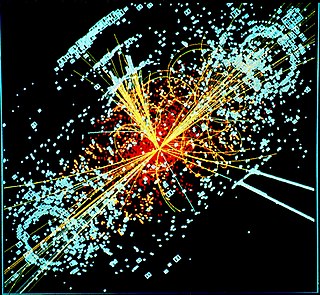
The safety of high energy particle collisions was a topic of widespread discussion and topical interest during the time when the Relativistic Heavy Ion Collider (RHIC) and later the Large Hadron Collider (LHC)—currently the world's largest and most powerful particle accelerator—were being constructed and commissioned. Concerns arose that such high energy experiments—designed to produce novel particles and forms of matter—had the potential to create harmful states of matter or even doomsday scenarios. Claims escalated as commissioning of the LHC drew closer, around 2008–2010. The claimed dangers included the production of stable micro black holes and the creation of hypothetical particles called strangelets, and these questions were explored in the media, on the Internet and at times through the courts.
MoEDAL is a particle physics experiment at the Large Hadron Collider (LHC).

The search for the Higgs boson was a 40-year effort by physicists to prove the existence or non-existence of the Higgs boson, first theorised in the 1960s. The Higgs boson was the last unobserved fundamental particle in the Standard Model of particle physics, and its discovery was described as being the "ultimate verification" of the Standard Model. In March 2013, the Higgs boson was officially confirmed to exist.
In particle physics, underlying event (UE) refers to the additional interactions of two particle beams at a collision point beyond the main collision under study. Specifically, the term is used for hadron collider events which do not originate from the primary hard scattering (high energy, high momentum impact) process. The term was first defined in 2002.

UA8 experiment was a high-energy physics experiment at the Proton-Antiproton Collider at CERN. The proposal for the experiment was done by physicists at the University of California, and it was approved in April 1985. Its spokesperson was Peter Schlein.
The Scattering and Neutrino Detector (SND) at the Large Hadron Collider (LHC), CERN, is an experiment built for the detection of the collider neutrinos. The primary goal of SND is to measure the p+p --> +X process and search for the feebly interacting particles. It will be operational from 2022, during the LHC-Run 3 (2022-2024). SND will be installed in an empty tunnel- TI18 that links the LHC and Super Proton Synchrotron, 480m away from the ATLAS experiment interaction point in the fast forward region and along the beam collision axis.
References
- ↑ Rick Field (2011). "Min-Bias and the Underlying Event at the LHC". arXiv: 1110.5530 . Bibcode:2011arXiv1110.5530F.
{{cite journal}}: Cite journal requires|journal=(help)