Related Research Articles

Amyntas III was king of the ancient Greek kingdom of Macedonia from 393/2 to 388/7 BC and again from 387/6 to 370 BC. He was a member of the Argead dynasty through his father Arrhidaeus, a son of Amyntas, one of the sons of Alexander I. His most famous son is Philip II, father of Alexander the Great.
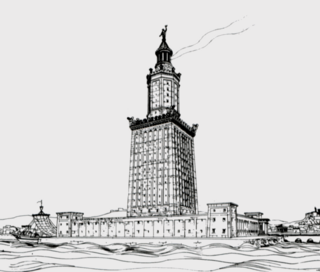
The Lighthouse of Alexandria, sometimes called the Pharos of Alexandria, was a lighthouse built by the Ptolemaic Kingdom of Ancient Egypt, during the reign of Ptolemy II Philadelphus. It has been estimated to have been at least 100 metres (330 ft) in overall height. One of the Seven Wonders of the Ancient World, for many centuries it was one of the tallest man-made structures in the world.

The Ptolemaic dynasty was a Macedonian Greek royal house which ruled the Ptolemaic Kingdom in Ancient Egypt during the Hellenistic period. Reigning for 275 years, the Ptolemaic was the longest and last dynasty of ancient Egypt from 305 BC until its incorporation into the Roman Republic in 30 BC.

Arsinoë II was a Ptolemaic queen and co-regent of the Ptolemaic Kingdom of ancient Egypt. She was given the Egyptian title "King of Upper and Lower Egypt", making her pharaoh as well.
Ptolemy Philadelphus was a Ptolemaic prince and was the youngest and fourth child of Greek Ptolemaic Queen Cleopatra VII of Egypt, and her third with Roman Triumvir Mark Antony.
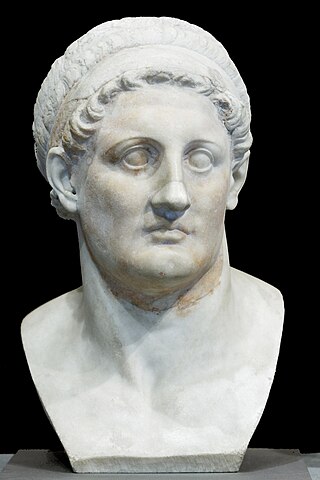
Ptolemy I Soter was a Macedonian Greek general, historian, and successor of Alexander the Great who went on to found the Ptolemaic Kingdom centered on Egypt and led by his progeny from 305 BC – 30 BC. Ptolemy was basileus and pharaoh of Ptolemaic Egypt from 305/304 BC to his death, during which time Egypt became a thriving bastion of Hellenistic civilization and Alexandria a great seat of Greek culture.
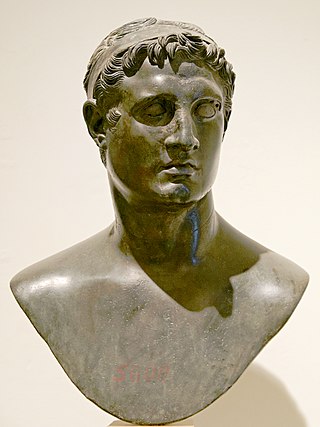
Ptolemy II Philadelphus was the pharaoh of Ptolemaic Egypt from 284 to 246 BC. He was the son of Ptolemy I, the Macedonian Greek general of Alexander the Great who founded the Ptolemaic Kingdom after the death of Alexander, and Queen Berenice I, originally from Macedon in northern Greece.

Berenice I was Queen of Egypt by marriage to Ptolemy I Soter. She became the second queen, after Eurydice, of the Ptolemaic dynasty of Egypt.
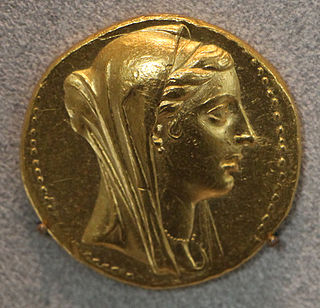
Berenice II Euergetis was queen regnant of Cyrenaica from 258 to 246 BCE and co-regent queen of Ptolemaic Egypt from 246 to 222 BCE as the wife of Ptolemy III.

Arsinoe III Philopator was Queen of Ptolemaic Egypt in 220 – 204 BC. She was a daughter of Ptolemy III and Berenice II and spouse of her brother Ptolemy IV. She was the first Ptolemaic queen to bear her brother's child.
Sotades was an Ancient Greek poet.

The Mouseionof Alexandria, which arguably included the Library of Alexandria, was an institution said to have been founded by Ptolemy I Soter and his son Ptolemy II Philadelphus. Originally, the word mouseion meant any place that was dedicated to the Muses, often related to the study of music or poetry, but later associated with sites of learning such as Plato's Academy and Aristotle's Lyceum.
Cleopatra of Macedonia, or Cleopatra of Epirus was an ancient Macedonian princess and later queen regent of Epirus. The daughter of Philip II of Macedon and Olympias of Epirus, she was the only full sibling of Alexander the Great. Her other siblings include half sisters Thessalonike and Cynane, and half-brother Philip III of Macedon.
Eurydice was an Ancient Macedonian queen and wife of king Amyntas III of Macedon.

Faiyum is a city in Middle Egypt. Located 100 kilometres southwest of Cairo, in the Faiyum Oasis, it is the capital of the modern Faiyum Governorate. Originally called Shedet in Egyptian, the Greeks called it in Koinē Greek: Κροκοδειλόπολις, romanized: Krokodilópolis, and later Medieval Greek: Ἀρσινόη, romanized: Arsinoë. It is one of Egypt's oldest cities due to its strategic location.

The Ptolemaic Kingdom or Ptolemaic Empire was an Ancient Greek polity based in Egypt during the Hellenistic period. It was founded in 305 BC by the Macedonian general Ptolemy I Soter, a companion of Alexander the Great, and ruled by the Ptolemaic dynasty until the death of Cleopatra VII in 30 BC. Reigning for nearly three centuries, the Ptolemies were the longest and final dynasty of ancient Egypt, heralding a distinctly new era for religious and cultural syncretism between Greek and Egyptian culture.
Bilistiche or Belistiche was a Hellenistic courtesan of Ptolemy II Philadelphus and winner of the 264 BC Olympic Games in tethrippon and synoris.
Apollonius was the dioiketes or chief finance minister of Egypt during the reign of Ptolemy II Philadelphus. Little is known about his personal life; in ancient documents, he is called simply "Apollonius the dioiketes" without recording his home city or his father's name. But a great amount of information has survived about his public role, in the archive of papyri kept by his assistant Zenon.

Coinage of the Ptolemaic kingdom was struck in Phoenician weight, also known as Ptolemaic weight. This standard, which was not used elsewhere in the Hellenistic world, was smaller than the dominant Attic weight. Consequentially, Ptolemaic coins are smaller than other Hellenistic coinage. In terms of art, the coins, which were made of silver, followed the example set by contemporary Greek currencies, with dynastic figures being typically portrayed. The Ptolemaic coin making process often resulted in a central depression, similar to what can be found on Seleucid coinage.
References
- ↑ Lindner, Martin (2009). Tempelprostitution im Altertum: Fakten und Fiktionen (in German). Verlag Antike. ISBN 978-3-938032-26-8.
- ↑ Hazzard, R. A. (2000-01-01). Imagination of a Monarchy: Studies in Ptolemaic Propaganda. University of Toronto Press. ISBN 978-0-8020-4313-9.
- ↑ Strootman, Rolf (2020), "Women and dynasty at the Hellenistic imperial courts", The Routledge Companion to Women and Monarchy in the Ancient Mediterranean World, Routledge, pp. 333–345, doi:10.4324/9780429434105-33, ISBN 978-0-429-43410-5 , retrieved 2024-03-11
- ↑ McKechnie, Paul R.; Guillaume, Philippe (2008). Ptolemy the second Philadelphus and his world. BRILL. ISBN 978-90-04-17089-6.
 | This ancient Roman biographical article is a stub. You can help Wikipedia by expanding it. |