Related Research Articles
A tachi is a type of sabre-like traditionally made Japanese sword (nihonto) worn by the samurai class of feudal Japan. Tachi and uchigatana generally differ in length, degree of curvature, and how they were worn when sheathed, the latter depending on the location of the mei (銘), or signature, on the tang. The tachi style of swords preceded the development of the katana, which was not mentioned by name until near the end of the twelfth century. Tachi were the mainstream Japanese swords of the Kotō period between 900 and 1596. Even after the Muromachi period (1336–1573), when katana became the mainstream, tachi were often worn by high-ranking samurai.
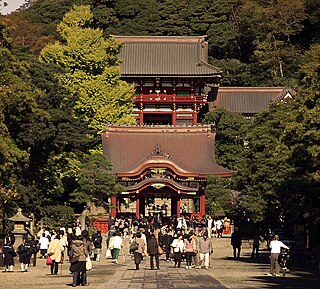
Kamakura officially Kamakura City is a city of Kanagawa Prefecture in Japan. It is located in the Kanto region on the island of Honshu. The city has an estimated population of 172,929 and a population density of 4,359 persons per km² over the total area of 39.67 km2 (15.32 sq mi). Kamakura was designated as a city on 3 November 1939.
The Kamakura shogunate was the feudal military government of Japan during the Kamakura period from 1185 to 1333.

The Kamakura period is a period of Japanese history that marks the governance by the Kamakura shogunate, officially established in 1192 in Kamakura by the first shōgun Minamoto no Yoritomo after the conclusion of the Genpei War, which saw the struggle between the Taira and Minamoto clans. The period is known for the emergence of the samurai, the warrior caste, and for the establishment of feudalism in Japan.
The courts of England and Wales, supported administratively by His Majesty's Courts and Tribunals Service, are the civil and criminal courts responsible for the administration of justice in England and Wales.

The Kenmu Restoration was a three-year period of Imperial rule in Japanese history between the Kamakura period and the Muromachi period from 1333 to 1336. The Kenmu Restoration was an effort made by Emperor Go-Daigo to overthrow the ruling Kamakura Shogunate and restore the Imperial House to power in Japan, returning to civilian government after 148 years of de facto military government from Kamakura. Go-Daigo launched the Genkō War in 1331 against the Kamakura Shogunate but was defeated and forced to exile to the Oki Islands. Go-Daigo launched a second uprising, and with the assistance of the defected Kamakura general Ashikaga Takauji and rebel leader Nitta Yoshisada, defeated the Kamakura Shogunate at the siege of Kamakura in 1333. The Imperial House was restored to power but Go-Daigo's policies failed to satisfy his major samurai supporters and most Japanese people. The Kenmu Restoration was ultimately overthrown when Takauji became Shōgun and founded the Ashikaga Shogunate in 1336, beginning the "Northern and Southern Courts" period and the Muromachi period.

The District Court of New South Wales is the intermediate court in the judicial hierarchy of the Australian state of New South Wales. It is a trial court and has an appellate jurisdiction. In addition, the Judges of the Court preside over a range of tribunals. In its criminal jurisdiction, the Court may deal with all serious criminal offences except murder, treason and piracy. The Court's civil jurisdiction is generally limited to claims less than A$750,000.

Zuirokusan Engaku Kōshō Zenji (瑞鹿山円覚興聖禅寺), or Engaku-ji (円覚寺), is one of the most important Zen Buddhist temple complexes in Japan and is ranked second among Kamakura's Five Mountains. It is situated in the city of Kamakura, in Kanagawa Prefecture to the south of Tokyo.

Kenchō-ji (建長寺) is a Rinzai Zen temple in Kamakura, Kanagawa Prefecture, Japan, which ranks first among Kamakura's so-called Five Great Zen Temples and is the oldest Zen training monastery in Japan. These temples were at the top of the Five Mountain System, a network of Zen temples started by the Hōjō Regents. Still very large, it originally had a full shichidō garan and 49 subtemples.
Tahoe-Sierra Preservation Council, Inc. v. Tahoe Regional Planning Agency, 535 U.S. 302 (2002), is one of the United States Supreme Court's more recent interpretations of the Takings Clause of the Fifth and Fourteenth Amendments. The case dealt with the question of whether a moratorium on construction of individual homes imposed by the Tahoe Regional Planning Agency fell under the Takings Clause of the United States Constitution and whether the landowners therefore should receive just compensation as required by that clause. The Tahoe Regional Planning Agency was represented by future Chief Justice John Roberts. Justice John Paul Stevens wrote the opinion of the Court, finding that the moratorium did not constitute a taking. It reasoned that there was an inherent difference between the acquisition of property for public use and the regulation of property from private use. The majority concluded that the moratorium at issue in this case should be classified as a regulation of property from private use and therefore no compensation was required.

Kōzan-ji (高山寺), officially Toganōsan Kōsan-ji (栂尾山高山寺), is a Buddhist temple of the Omuro sect of Shingon Buddhism in Umegahata Toganōchō, Ukyō Ward, Kyoto, Japan. Kōzan-ji is also known as Kōsan-ji and Toganō-dera. The temple was founded by the Shingon scholar and monk Myōe and is renowned for its numerous national treasures and important cultural properties. The Chōjū-jinbutsu-giga, a group of ink paintings from the 12th and 13th centuries, are among the most important treasures of Kōzan-ji. The temple celebrates Biyakkōshin, Zenmyōshin and Kasuga Myōjin, as well as the temple's tutelary Shintō deity. In 1994, it was registered as part of the UNESCO World Heritage Site "Historic Monuments of Ancient Kyoto".

The Genkō War, also known as the Genkō Incident, was a civil war fought in Japan between the Emperor Go-Daigo and the Kamakura Shogunate from 1331 to 1333. The Genkō War was named after Genkō, the Japanese era corresponding to the period of 1331 to 1334 when the war occurred.

Kamakura is a fictional character from the G.I. Joe: A Real American Hero toyline, comic books and animated series. He is the first character created by Devil's Due Publishing to be made into a G.I. Joe figure, and later brought into the new animated series.

A hōkyōintō (宝篋印塔) is a Japanese pagoda, so called because it originally contained the Karaṇḍamudrā Dhāraṇī Sūtra (宝篋印陀羅尼経). A Chinese variant of the Indian stūpa, it was originally conceived as a cenotaph of the King of Wuyue – Qian Liu.

Ishiizan Chōshō-ji (石井山長勝寺) is a Buddhist temple of the Nichiren Shū in Kamakura, Kanagawa, Japan. It's one of a group of three built near the site in Matsubagayatsu (Valley of Pine Needles where Nichiren, founder of the Buddhist sect that bears his name, is supposed to have had his hut. The first part of its name is derived from the founder's last name, the second is an alternative reading of the characters for Nagakatsu, the founder's first name.

Kinryūzan Shakuman-in Endon Hōkai-ji (金龍山釈満院円頓宝戒寺) is a Buddhist temple in Kamakura, Kanagawa Prefecture, Japan. Often called Hagidera (萩寺), or "bush-clover temple", because those flowers are numerous in its garden, its existence is directly linked to a famous tragedy that on July 4, 1333 wiped out almost the entire Hōjō clan, ruler of Japan for 135 years. The temple was founded expressly to enshrine the souls of the 870 members of the clan who, in accordance with the samurai code of honor, committed suicide on that day at their family temple (bodaiji) of Tōshō-ji to escape defeat. Together with ancient Sugimoto-dera, Hōkai-ji is the only temple of the Tendai denomination in Kamakura. Formerly a branch temple of the great Kan'ei-ji, after its destruction it became a branch of Enryaku-ji.

The Kamakura Museum of National Treasures or Kamakura Museum or Kamakura National Treasure House is a museum located on the grounds of Tsurugaoka Hachiman-gū in Yukinoshita, Kamakura, Kanagawa Prefecture, Japan. The museum houses around 4800 objects from the Kamakura region including sculptures, paintings and industrial art objects. Most of these works originate from the Kamakura and Muromachi periods, spanning from the 12th to the 16th century. Some of the items were produced in China and imported to Japan.
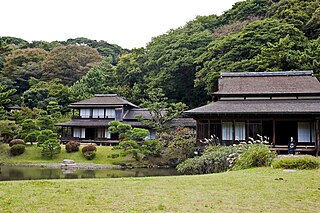
An Important Cultural Property is an item officially classified as Tangible Cultural Property by the Japanese government's Agency for Cultural Affairs and judged to be of particular importance to the history, arts, and culture of the Japanese people.

Rokuharamitsu-ji (六波羅蜜寺) is a Buddhist temple in Kyoto, Japan. Founded by Kūya in 951, the Hondō was burned during the wars at the end of the Heian period. Its replacement of 1363, damaged during the Shintō revival at the beginning of the Meiji period, was restored in 1969. The temple house a number of statues of the Heian and Kamakura periods that have been designated Important Cultural Properties, including a Kamakura period image of its founder Kūya, as well as a Heian Jūichimen Kannon that is a National Treasure.
References
- ↑ Deal, William E. (2016). Handbook to Life in Medieval and Early Modern Japan. Oxford University Press. p. 92.
  | This Japanese history–related article is a stub. You can help Wikipedia by expanding it. |