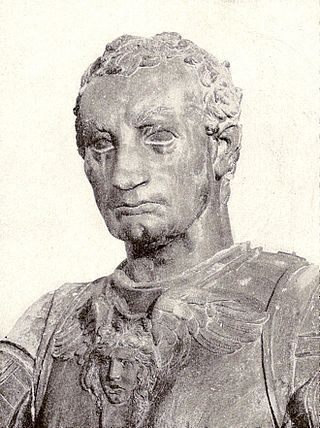
Erasmo Stefano of Narni, better known by his nickname of Gattamelata, was an Italian condottiero of the Renaissance. He was born in Narni, and served a number of Italian city-states: he began with Braccio da Montone, served the Papal States and Florence, as well as the Republic of Venice in 1434 in the battles with the Visconti of Milan.

Mentana is a town and comune, former bishopric and present Latin Catholic titular see in the Metropolitan City of Rome, Lazio, central Italy. It is located 29 kilometres (18 mi) north-east of Rome and has a population of about 23,000.

The Battle of Mentana was fought on November 3, 1867, near the village of Mentana, located north-east of Rome, between French-Papal troops and the Italian volunteers led by Giuseppe Garibaldi. Garibaldi and his troops were attempting to capture Rome, then the main center of the peninsula still outside of the newly unified Kingdom of Italy. The battle ended in a victory by the French-Papal troops.
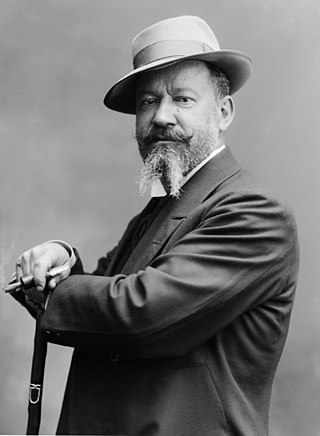
Raffaello Romanelli was an Italian sculptor, born in Florence, Italy.

Augusto Rivalta was an Italian sculptor.
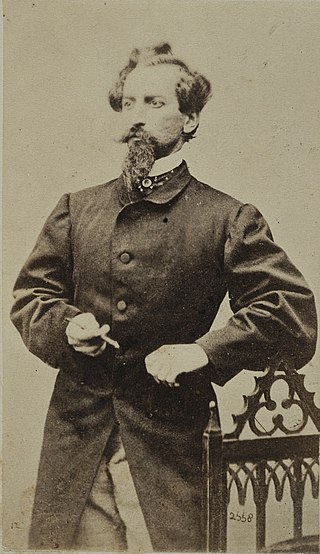
Francesco Nullo was an Italian patriot, military officer and merchant, and a close friend and confidant of Giuseppe Garibaldi. He supported independence movements in Italy and Poland. He was a participant in the Five Days of Milan and other events of the revolutions of 1848 in the Italian states, Sicilian Expedition of the Thousand in 1860 and the Polish January Uprising in 1863. His military career ended with him receiving the rank of general in Poland, shortly before his death in the Battle of Krzykawka.
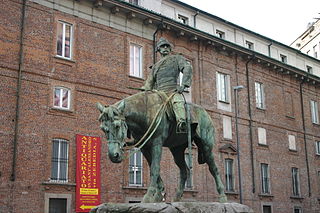
Giuseppe Missori was an Italian patriot, military leader during the Italian unification, and politician. He served under Garibaldi during the Second Italian War of Independence, the Expedition of the Thousand, and the Third Italian War of Independence. After the unification of Italy, he was twice a member of the City Council of Milan.

The FL1 is a regional rail route forming part of the Lazio regional railways network, which is operated by Trenitalia, and converges on the city of Rome, Italy.

Dante Sodini was an Italian sculptor, mainly of religious subjects and funereal monuments.
Giovanni Battista Tassara was an Italian sculptor.
Luigi Melchiorre was an Italian sculptor.

Modesto Parlatore was an Italian sculptor and architect.

Giuseppe De Nigris was an Italian painter, who depicted genre scenes and still-lifes in a style known as Neo-Pompeian.

The Equestrian monument to Vittorio Emanuele II is an equestrian statue of the former King Vittorio Emanuele II, located in the Piazza Vittorio Veneto, a small green spot at the east end of the Parco delle Cascine, located along the Arno River, just west of central Florence, region of Tuscany, Italy.

The Encounter of Teano is a bronze monumental equestrian statuary group depicting the encounter of King Vittorio Emanuele II and Garibaldi, both on horseback, at a bridge in Teano on October 26, 1860. The monument is present in the piazza Mino da Fiesole, in front of the Palazzo Pretorio in Fiesole, Tuscany, Italy.
The Carabinieri of Fiesole were three Italian soldiers who were killed by Nazis on August 12, 1944. On August 11, the three Carabinieri - Alberto La Rocca, Vittorio Marandola and Fulvio Sbarretti (with their commanding officer Francesco Naclerio received orders to leave their barracks in Fiesole, so to be able to collaborate in the liberation of the nearby city of Florence from German occupation. All four, together with the commander of the barracks, Giuseppe Amico, participated actively in the Italian resistance movement.

Ercole Rosa was an Italian sculptor.

The Monument to the Cairoli Brothers is a prominent patriotic statuary group on the Pincian Hill in Rome. It is located along the Pincian Hill, on a terrace overlooking the center of Rome. The statue is located just below the Terrazza Viale del Belvedere, and can be accessed by walking north from the summit of the Spanish Steps, past the Villa Medici.
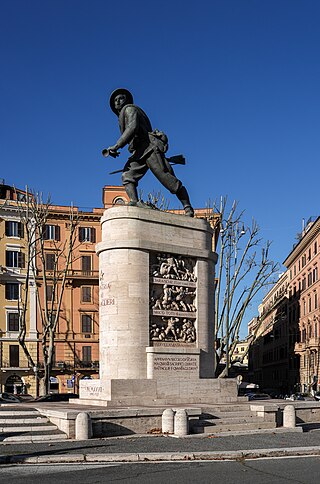
The Monument to the Bersagliere is a statuary monument located in Piazzale di Porta Pia, near the spot, where Italian soldiers were able to breach the city walls of Rome in 1870, thus leading to the integration of Rome into the Kingdom of Italy. The monument stands to the north of the gate, outside the walls. Attached to the gate buildings, designed by Michelangelo, that once represented Porta Pia, is a Museum of the History of the Bersaglieri, established here in 1921.
Angelo Bassini was an Italian patriot and soldier who served during the unification of Italy, including duty as a colonello (colonel) during the Expedition of the Thousand.
