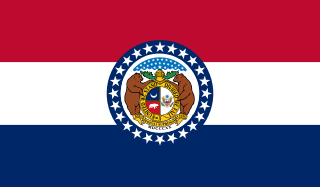
Missouri is a doubly landlocked state in the Midwestern region of the United States. Ranking 21st in land area, it borders Iowa to the north, Illinois, Kentucky and Tennessee to the east, Arkansas to the south and Oklahoma, Kansas, and Nebraska to the west. In the south are the Ozarks, a forested highland, providing timber, minerals, and recreation. The Missouri River, after which the state is named, flows through the center and into the Mississippi River, which makes up the eastern border. With over six million residents, it is the 18th-most populous state of the country. The largest urban areas are St. Louis, Kansas City, Springfield, and Columbia. The capital is Jefferson City.

The Missouri Valley Football Conference (MVFC), formerly the Gateway Football Conference, is a collegiate athletic conference which operates in the Midwestern United States. It participates in the NCAA's Division I Football Championship Subdivision (FCS) as a football-only conference.

Collinsville is a city located mainly in Madison County and partially in St. Clair County, Illinois, United States. As of the 2020 census, the city had a population of 24,366. Collinsville is approximately 14 miles (23 km) east of St. Louis, Missouri, and is part of that city's Metro East area.

East St. Louis is a city in St. Clair County, Illinois, United States. It is directly across the Mississippi River from downtown St. Louis, Missouri, and the Gateway Arch National Park. East St. Louis is in the Metro East region of Southern Illinois. Once a bustling industrial center, like many cities in the Rust Belt, East St. Louis was severely affected by the loss of jobs due to the flight of the population to the suburbs during the riots of the late 1960s. In 1950, East St. Louis was the fourth-largest city in Illinois when its population peaked at 82,366. As of the 2020 census, the city had a population of 18,469, less than one-quarter of the 1950 census and a decline of almost one third since 2010.

Cahokia Mounds is the site of a pre-Columbian Native American city directly across the Mississippi River from present-day St. Louis. The state archaeology park lies in south-western Illinois between East St. Louis and Collinsville. The park covers 2,200 acres (890 ha), or about 3.5 square miles (9 km2), and contains about 80 manmade mounds, but the ancient city was much larger. At its apex around 1100 CE, the city covered about 6 square miles (16 km2), included about 120 earthworks in a wide range of sizes, shapes, and functions, and had a population of between 15,000 and 20,000 people.

Southern Illinois is a region of the U.S. state of Illinois comprising the southern third of the state, principally south of Interstate 70. Part of downstate Illinois, it is bordered by the two most voluminous rivers in the United States: the Mississippi below its connection with the Missouri River to the west and the Ohio River to the east and south, with the tributary Wabash River, extending the southeastern border. Some areas of Southern Illinois are known historically as Little Egypt.

Greater St. Louis is the 21st-largest metropolitan statistical area (MSA) in the United States, the largest in Missouri, and the second-largest in Illinois. Its core city—St. Louis, Missouri—sits in the geographic center of the metro area, on the west bank of the Mississippi River. The river bisects the metro area geographically between Illinois and Missouri, although the latter portion is much more populous. The MSA includes St. Louis County, which is independent of the City of St. Louis; their two populations are generally tabulated separately.
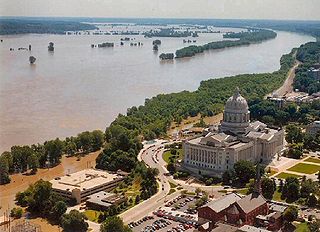
The Great Flood of 1993 was a flood that occurred in the Midwestern United States, along the Mississippi and Missouri rivers and their tributaries, from April to October 1993.
Crook is another name for criminal.
Roosevelt High School may refer to:
Central High School may refer to any of these institutions of secondary education:
Orpheum is a name often used for theatres or other entertainment venues. It may refer to:
The Metro East is an urban area in Southern Illinois, United States that contains the eastern and northern urban, suburban, and exurban areas across the Mississippi River from St. Louis, Missouri. It encompasses eight counties in the Greater St. Louis area and constitutes the second-most populous metropolitan area in Illinois.

The American Bottom is the flood plain of the Mississippi River in the Metro East region of Southern Illinois, extending from Alton, Illinois, south to the Kaskaskia River. It is also sometimes called "American Bottoms". The area is about 175 square miles (450 km2), mostly protected from flooding in the 21st century by a levee and drainage canal system. Immediately across the river from St. Louis, Missouri, are industrial and urban areas, but nearby marshland, swamps, and the Horseshoe Lake are reminders of the Bottoms' riparian nature.
Grace Episcopal Church, or variants thereof, may refer to the following:
Mount Hope Cemetery may refer to:
The history of South Dakota describes the history of the U.S. state of South Dakota over the course of several millennia, from its first inhabitants to the recent issues facing the state.

Sugarloaf Mound is the sole remaining Mississippian culture platform mound in St. Louis, Missouri, a city commonly referred to in its earlier years as "Mound City" for its approximately 40 Native American earthen structures.
The history of St. Louis, Missouri, from prehistory to 1762 was marked by the presence of the Moundbuilder indigenous culture, the explorations of Europeans, and the establishment of French trading posts along the Mississippi River.
