The Community Development Block Grant (CDBG), one of the longest-running programs of the U.S. Department of Housing and Urban Development, funds local community development activities with the stated goal of providing affordable housing, anti-poverty programs, and infrastructure development. CDBG, like other block grant programs, differ from categorical grants, made for specific purposes, in that they are subject to less federal oversight and are largely used at the discretion of the state and local governments and their subgrantees.
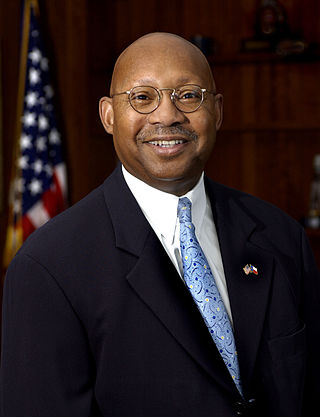
Alphonso R. Jackson served as the 13th United States Secretary of Housing and Urban Development (HUD). He was nominated by President George W. Bush on August 28, 2004, and confirmed by the Senate on August 31, 2004. Jackson announced his resignation on March 31, 2008.
Section 8 of the Housing Act of 1937, often called Section 8, as repeatedly amended, authorizes the payment of rental housing assistance to private landlords on behalf of low-income households in the United States. 68% of total rental assistance in the United States goes to seniors, children, and those with disabilities. The U.S. Department of Housing and Urban Development manages Section 8 programs.

The Office of Public and Indian Housing (PIH) is an agency of the U.S. Department of Housing and Urban Development. Its mission is to ensure safe, decent, and affordable housing, create opportunities for residents' self-sufficiency and economic independence, and assure the fiscal integrity of all program participants.
HOPE VI is a program of the United States Department of Housing and Urban Development. It is intended to revitalize the worst public housing projects in the United States into mixed-income developments. Its philosophy is largely based on New Urbanism and the concept of defensible space.

Public housing in Puerto Rico is a subsidized system of housing units, mostly consisting of housing projects, which are provided for low-income families in Puerto Rico. The system is mainly financed with programs from the US Department of Housing and Urban Development (HUD) and the US Department of Agriculture USDA Rural Development. As of 2020, there were 325 public housing developments in Puerto Rico.
In the United States, federal assistance, also known as federal aid, federal benefits, or federal funds, is defined as any federal program, project, service, or activity provided by the federal government that directly assists domestic governments, organizations, or individuals in the areas of education, health, public safety, public welfare, and public works, among others.
The HOME Investment Partnerships Program (HOME) is a type of United States federal assistance that the U.S. Department of Housing and Urban Development (HUD) provides to states to create decent and affordable housing, particularly housing for low and very low income Americans. It is the largest Federal block grant to states and local governments designed exclusively to create affordable housing for low-income families, providing approximately US$2 billion each year.

The Housing Act of 1937, formally the "United States Housing Act of 1937" and sometimes called the Wagner–Steagall Act, provided for subsidies to be paid from the United States federal government to local public housing agencies (LHAs) to improve living conditions for low-income families.

In the United States, subsidized housing is administered by federal, state and local agencies to provide subsidized rental assistance for low-income households. Public housing is priced much below the market rate, allowing people to live in more convenient locations rather than move away from the city in search of lower rents. In most federally-funded rental assistance programs, the tenants' monthly rent is set at 30% of their household income. Now increasingly provided in a variety of settings and formats, originally public housing in the U.S. consisted primarily of one or more concentrated blocks of low-rise and/or high-rise apartment buildings. These complexes are operated by state and local housing authorities which are authorized and funded by the United States Department of Housing and Urban Development (HUD). In 2020, there were 1 million public housing units. In 2022, about 5.2 million American households that received some form of federal rental assistance.
Carl R. Greene was the executive director of the Philadelphia Housing Authority (PHA), the fourth largest public housing authority in the nation. On his departure, PHA provided approximately 14,000 units of affordable housing for 80,000 Philadelphia residents and managed the city’s Housing Choice Voucher program. Before heading PHA, Greene held a similar position with the Detroit Housing Commission. He also held senior positions with housing authorities in Atlanta and Washington, DC.
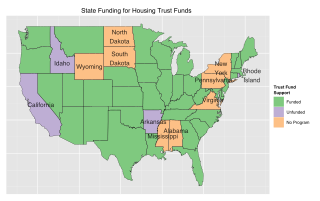
Housing trust funds are established sources of funding for affordable housing construction and other related purposes created by governments in the United States (U.S.). Housing Trust Funds (HTF) began as a way of funding affordable housing in the late 1970s. Since then, elected government officials from all levels of government in the U.S. have established housing trust funds to support the construction, acquisition, and preservation of affordable housing and related services to meet the housing needs of low-income households. Ideally, HTFs are funded through dedicated revenues like real estate transfer taxes or document recording fees to ensure a steady stream of funding rather than being dependent on regular budget processes. As of 2016, 400 state, local and county trust funds existed across the U.S.
Non-profit housing developers build affordable housing for individuals under-served by the private market. The non-profit housing sector is composed of community development corporations (CDC) and national and regional non-profit housing organizations whose mission is to provide for the needy, the elderly, working households, and others that the private housing market does not adequately serve. Of the total 4.6 million units in the social housing sector, non-profit developers have produced approximately 1.547 million units, or roughly one-third of the total stock. Since non-profit developers seldom have the financial resources or access to capital that for-profit entities do, they often use multiple layers of financing, usually from a variety of sources for both development and operation of these affordable housing units.

Howard County Housing is the umbrella organization for the Howard County Department of Housing and Community Development and the Howard County Housing Commission. The Department is Howard County Government’s housing agency, and the Commission is a public housing authority and non-profit. Both have boards that meet monthly.

Queen Lane Apartments opened in 1955 as one of several Post-War public housing hi-rise complexes in Philadelphia, Pennsylvania which were built and maintained by the Philadelphia Housing Authority (PHA). The PHA demolished the Queen Lane high-rise on September 13, 2014. The PHA replaced it with 55 new, affordable rental units for individuals and families. The first of the new 55 units were opened on December 15, 2015. Mayor Michael Nutter, City Council President Darrell L. Clarke, City Councilwoman Cindy Bass, PHA President/CEO Kelvin Jeremiah, residents of the nine new units, and other dignitaries joined together to cut the ribbon.
The Rental Assistance Demonstration is a federal housing program that was enacted as part of the Consolidated and Further Continuing Appropriations Act, 2012, and is administered by the U.S. Department of Housing & Urban Development (HUD). Broadly, the purpose of the Rental Assistance Demonstration is to provide a set of tools to address the unmet capital needs of deeply affordable, federally assisted rental housing properties in order to maintain both the viability of the properties and their long-term affordability. It also simplifies the administrative oversight of the properties by the federal government. Specifically, RAD authorizes the conversion of a property's federal funding from one form to another, where the initial form presents structural impediments to private capital investment and the new form is not only familiar to lenders and investors but, since its enactment in 1974, has leveraged billions in private investment for the development and rehabilitation of deeply affordable rental housing.

Kelvin A. Jeremiah is President and CEO of the Philadelphia Housing Authority (PHA). He oversees the day-to-day operations of the 4th largest housing authority in the country. His approach to housing communities expands beyond affordable housing. Jeremiah has an interest in creating communities that provide access to good education and are crime free.

The Holyoke Housing Authority (HHA) is a public agency of the city of Holyoke, Massachusetts that provides subsidized public housing to low- and moderate-income families and individuals.
The San Francisco Housing Authority is a local public housing authority for the City and County of San Francisco that was established in 1938 after the Housing Act of 1937 was enacted by the U.S. Federal Government. The agency is responsible for the management of public housing and Section 8 vouchers for primarily low-income housing. While the agency is based in and has jurisdiction over San Francisco, it is operated independent of the city's government and is chartered by the state government of California.
The Troy Housing Authority (THA) is a public agency of the city of Troy, New York that provides subsidized public housing to low- and moderate-income families and individuals, and is the pass-through agency for funding from various housing-related federal programs.
