Rostislavich (Ростиславич) or Rostislavovich (Ростиславович) is a Russian patronymic name. It may refer to one of the following persons.
Rostislav Mstislavich was Prince of Smolensk (1125–1160), Novgorod (1154) and Grand Prince of Kiev. He is the founder of the Rostislavichi branch of Rurikid princes in Smolensk. He was the son of Mstislav I of Kiev and Christina Ingesdotter of Sweden.
Roman Rostislavich was Prince of Smolensk, Grand Prince of Kiev, and Prince of Novgorod (1178–1179). He was the son of Rostislav Mstislavich.

Rurik Rostislavich, also spelt Riurik, was Prince of Novgorod (1170–1171), Belgorod (1173–1194), Grand Prince of Kiev, and Prince of Chernigov (1210–1214).
Sviatoslav III Vsevolodovich was Prince of Turov, Volhynia (1141–1146), Pinsk (1154), Novgorod-Seversk (1157–1164), Chernigov (1164–1177), Grand Prince of Kiev. He was the son of Vsevolod II Olgovich.
Ingvar Yaroslavich was Prince of Dorogobuzh, Prince of Lutsk (1180–1220), Grand Prince of Kiev, and Prince of Vladimir-Volynsk (1207). He was son of Yaroslav Izyaslavich, great-grandson of Vladimir II Monomakh.
Mstislav Romanovich the Old was Prince of Pskov (1179–?), Smolensk (1197–?), Belgorod (1206), Halych (?–?) and Grand Prince of Kiev (1212–1223). He was the son of Roman Rostislavich.

Mstislav Mstislavich, also called the Daring, the Bold or the Able, was a prince of Tmutarakan and Chernigov, one of the princes from Kievan Rus' in the decades preceding the Mongol invasions.
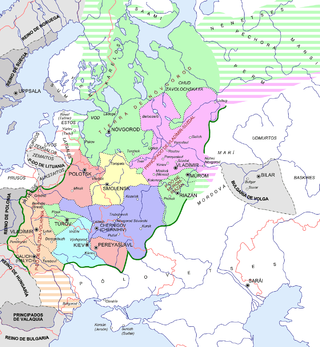
The inner Principality of Kiev was a medieval principality centered on the city of Kiev.
Mstislav Rostislavich, known as "the Brave", was Prince of Smolensk and Prince of Novgorod.
The Prince of Smolensk was the kniaz, the ruler or sub-ruler, of the Rus' Principality of Smolensk, a lordship based on the city of Smolensk. It passed between different groups of descendants of Grand Prince Iaroslav I of Kiev until 1125, when following the death of Vladimir Monomakh the latter's grandson Rostislav Mstislavich was installed in the principality, while the latter's father Mstislav I Vladimirovich became Grand Prince. It gained its own bishopric in 1136. It was Rostislav's descendants, the Rostaslavichi, who ruled the principality until the fifteenth-century. Smolensk enjoyed stronger western ties than most Rus' principalities.
Mstislav Rostislavich Bezokii was Prince of Rostov (1175–1176) and Prince of Novgorod the Great.

The Rurik dynasty, also known as the Rurikid or Riurikid dynasty, as well as simply Rurikids or Riurikids, was a noble lineage allegedly founded by the Varangian prince Rurik, who, according to tradition, established himself at Novgorod in the year 862. The Rurikids were the ruling dynasty of Kievan Rus' and its principalities following its disintegration.
Mstislav or Mścisław (Polish) - is a very old Slavic origin given name, consists of two elements: msti - "vengeance" and slav - "glory, fame". The feminine forms are Mstislava and Mścisława.

The House of Shakhovskoy is the name of a princely Russian and Ukrainian family descending from the Rurik Dynasty, and as such, one of the oldest noble families of the Russian Empire. Most members of the family fled the Russian Empire in 1917 during the Russian Revolution.
The Principality of Vitebsk was a Ruthenian principality centered on the city of Vitebsk in modern Belarus, that existed from its founding in 1101 until it was nominally inherited into the Grand Duchy of Lithuania in 1320. Vitebsk would later fall under the complete authority of Lithuania in 1508.
The Kievan Chronicle or Kyivan Chronicle is a chronicle of Kievan Rus'. It was written around 1200 in Vydubychi Monastery as a continuation of the Primary Chronicle. It is known from two manuscripts: a copy in the Hypatian Codex, and a copy in the Khlebnikov Codex ; in both codices, it is sandwiched between the Primary Chronicle and the Galician–Volhynian Chronicle. It covers the period from 1118, where the Primary Chronicle ends, until about 1200, although scholars disagree where exactly the Kievan Chronicle ends and the Galician–Volhynian Chronicle begins.

The sack of Kiev took place on 8–12 March 1169 when a coalition of 11 princes, assembled by prince Andrey Bogolyubsky of Vladimir-Suzdal, attacked the Kievan Rus' capital city of Kiev during the 1167–1169 Kievan succession crisis. The conflict, caused by the death of grand prince Rostislav I of Kiev, was between rival branches of the Monomakhovichi clan: the Iziaslavichi of Volhynia on the one hand, and the Rostislavichi of Smolensk, the Yurievichi, and the Olgovichi of Chernigov on the other. Prince Mstislav II of Kiev sought to defend Kiev against the Rostislavichi–Yurievichi–Olgovichi coalition.

The battle and siege of Vyshgorod took place in late 1173, during the 1171–1173 Kievan succession crisis. Commanding another broad coalition army, prince Andrey Bogolyubsky of Vladimir-Suzdal launched a second campaign against Kiev, capital city of Kievan Rus'. After the conquest and sack of Kiev in March 1169 by an earlier coalition assembled by Andrey, his brother Gleb of Pereyaslavl had been installed as the new grand prince, only to die under suspicious circumstances in January 1171. A series of princes briefly reigned in Kiev thereafter, with Andrey usually managing to put his preferred candidates on its throne, until his brother Vsevolod "the Big Nest" was driven out by the Rostislavichi of Smolensk in April 1172, enthroning Rurik Rostislavich. Andrey was most displeased when he heard about this, and assembled another coalition army under his son Yury to militarily enforce his will on Kiev.

The Suzdalian war of succession of 1174–1177 was a war of succession in Vladimir-Suzdal (Suzdalia), a complex of principalities in the northeast of Kievan Rus'. The casus belli was the assassination of prince Andrey Bogolyubsky on 28 June 1174 by his own boyars. Immediately, his surviving brothers, sons and other relatives started fighting amongst themselves about who had the right to succeed him. The conflict would not be resolved until Vsevolod Yurievich "the Big Nest" had defeated his other brothers and his nephes, and seized power across Suzdalia in 1177.
