
Pakistan Atomic Energy Commission (PAEC) is a federally funded independent governmental agency, concerned with research and development of nuclear power, promotion of nuclear science, energy conservation and the peaceful usage of nuclear technology.

Dr. Samar Mubarakmand, is a Pakistani nuclear physicist known for his research in gamma spectroscopy and experimental development of the linear accelerator.

The Pakistan Institute of Nuclear Science & Technology (PINSTECH) is a federally funded multiprogram science and technology research institute managed for the Ministry of Energy by the Pakistan Institute of Engineering and Applied Sciences (PIEAS).

Ishfaq Ahmad KhanSI, HI, NI, FPAS, was a Pakistani nuclear physicist, emeritus professor of high-energy physics at the National Centre for Physics, and former science advisor to the Government of Pakistan.
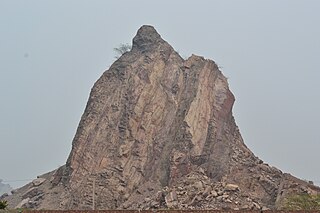
The Kirana Hills is a small and extensive rocky mountain range located in Rabwah and Sargodha, Pakistan. It is also a place of tourist attraction in Sargodha City. Locally known as "Black Mountains" due to its brownish landscape, its highest peak is about 980 feet (300 m).
The Karachi Institute of Power Engineering, commonly known as KINPOE, is a post-graduate applied science school of the Institute of Engineering and Applied Sciences. Established by the Pakistan Atomic Energy Commission (PAEC) in 1993 with cooperation with the NED University of Engineering and Technology in Karachi, the school grants the post-graduate degrees and training certifications in power engineering related disciplines. The school is located near the vicinity of the Karachi Nuclear Power Complex (KANUPP-II) near at Paradise Point in Karachi, Pakistan.
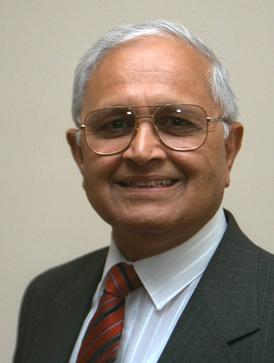
Munir Ahmad Khan, NI, HI, FPAS, was a Pakistani nuclear reactor physicist who is credited, among others, with being the "father of the atomic bomb program" of Pakistan for their leading role in developing their nation's nuclear weapons during the successive years after the war with India in 1971.

Parvez Butt, is a Pakistani mechanical engineer and public official who served as the chairman of the Pakistan Atomic Energy Commission from 2001 till 2006.
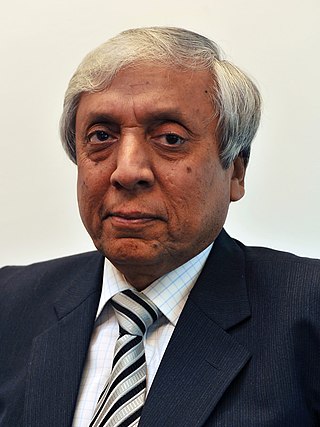
Ansar Pervaiz, also spelled as, HI, is a Pakistani scientist and a nuclear engineer who was the former chairman of the Pakistan Atomic Energy Commission (PAEC), and former chairman of the Board of Governors of International Atomic Energy Agency (IAEA). Pervaiz is widely given credit for establishing the nuclear engineering, nuclear physics and nuclear technology institutes within Pakistan.
Muhammad Hafeez Qureshi, SI, HI, known as Hafeez Qureshi, was a Pakistani nuclear scientist and a mechanical engineer, known for his classified work at WGS at the Pakistan Atomic Energy Commission (PAEC).

The Abdus Salam Centre for Physics, is a federally-funded research institute and national laboratory site managed by the Quaid-i-Azam University for the Ministry of Energy (MoE) of the Government of Pakistan.
Project-706, also known as Project-786 was the codename of a research and development program to develop Pakistan's first nuclear weapons. The program was initiated by Prime Minister Zulfiqar Ali Bhutto in 1974 in response to the Indian nuclear tests conducted in May 1974. During the course of this program, Pakistani nuclear scientists and engineers developed the requisite nuclear infrastructure and gained expertise in the extraction, refining, processing and handling of fissile material with the ultimate goal of designing a nuclear device. These objectives were achieved by the early 1980s with the first successful cold test of a Pakistani nuclear device in 1983. The two institutions responsible for the execution of the program were the Pakistan Atomic Energy Commission and the Kahuta Research Laboratories, led by Munir Ahmed Khan and Abdul Qadeer Khan respectively. In 1976 an organization called Special Development Works (SDW) was created within the Pakistan Army, directly under the Chief of the Army Staff (Pakistan) (COAS). This organization worked closely with PAEC and KRL to secretly prepare the nuclear test sites in Baluchistan and other required civil infrastructure.
The International Nathiagali Summer College on Physics and Contemporary Needs (INSC), was founded by Nobel laureate in Physics Dr. Abdus Salam (then-Science Advisor to the Prime minister) to promote physics and scientific research activities in Pakistan. Having suggested by Professor Abdus Salam to the Government of Pakistan, it was established by the Pakistan Atomic Energy Commission's chairman Mr. Munir Ahmad Khan.

The Pakistan Atomic Research Reactor or (PARR) are two nuclear research reactors and two other experimental neutron sources located in the PINSTECH Laboratory, Nilore, Islamabad, Pakistan.
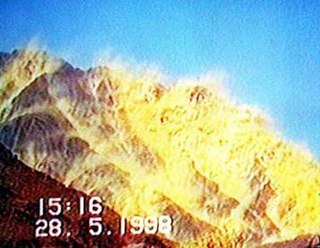
Chagai-II is the codename assigned to the second atomic test conducted by Pakistan, carried out on 30 May 1998 in the Kharan Desert in Balochistan Province of Pakistan. Chagai-II took place two days after Pakistan's first successful test, Chagai-I, which was carried out on 28 May 1998 in the Ras Koh area in Chagai District, Balochistan, Pakistan.
The Pakistan Institute of Engineering and Applied Sciences (PIEAS), is a public research university located in Islamabad, Pakistan. The university is modelled on international standards with a strong focus on the scientific advancement of the nuclear science-related STEM fields and medical sciences.
The Nuclear Institute for Agriculture and Biology, also known as NIAB, is an agriculture and food irradiation national research institute managed by the Pakistan Atomic Energy Commission. Along with Nuclear Institute for Food and Agriculture (NIFA), the NIAB reports directly to the PAEC Biological Science Directorate whose current member is Abdul Rashid. The current director is Dr.Muhammad Hamed, and it is located in Faisalabad, Punjab, Pakistan.
Naeem Ahmad Khan, FPAS, was a Pakistani nuclear physicist and a professor of physics who was known for his work in developing techniques using the solid-state nuclear track detector and solid-state nuclear magnetic resonance. Although he worked with the Government of Pakistan for most of his career, he also taught physics at a number of Pakistani universities and was the civilian scientist of the Pakistan Air Force (PAF) until his death.

National Institute for Biotechnology and Genetic Engineering or NIBGE is one of the main biotechnology institutes operated by Pakistan Atomic Energy Commission (PAEC). It was planned under the auspices of PAEC in 1987 and was formally inaugurated in 1994. It is affiliated to Pakistan Institute of Engineering & Applied Sciences (PIEAS) Islamabad, for awarding MPhil & PhD degrees. NIBGE is also the home institution of National Biology Talent Contest. The institute is located in Faisalabad.
Iqbal Hussain Qureshi 27 September 1937 – 8 December 2012) SI, FPAS, best known as I.H. Qureshi, was a Pakistani nuclear chemist and an Emeritus professor of chemistry at the University of Karachi. Qureshi was the principal contributor of scientific understanding of various chemical elements: bismuth, cobalt, strontium, thallium, tritium, iron, rubidium, and zinc.
