
Bartolomé Esteban Murillo was a Spanish Baroque painter. Although he is best known for his religious works, Murillo also produced a considerable number of paintings of contemporary women and children. These lively realistic portraits of flower girls, street urchins, and beggars constitute an extensive and appealing record of the everyday life of his times. He also painted two self-portraits, one in the Frick Collection portraying him in his 30s, and one in London's National Gallery portraying him about 20 years later. In 2017–18, the two museums held an exhibition of them.
Chaves is a modern Portuguese and old Spanish word derived from Latin Flaviae, and may refer to:

The Dolorosa Madonna is a Madonna painting by the Spanish artist Bartolomé Esteban Murillo. The work is oil on canvas and was painted in 1665.

Juan del Castillo was a Spanish Baroque painter. Many of his paintings became famous during his time due to his pupil, Bartolomé Esteban Murillo.
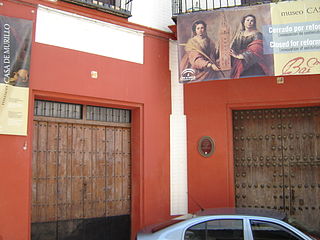
The Casa de Murillo is a historical house in Seville, Andalusia, Spain, at number 8, calle Santa Teresa, in the historic Barrio de Santa Cruz. It was the home of the painter Bartolomé Esteban Murillo (1617–1682) in the latter years of his life. The building has two storeys and a central patio (courtyard) with columns.
Inmaculada Concepción is the Immaculate Conception in Spanish language. The name may make reference to several religious buildings

Portrait of Diego Ortiz de Zúñiga is an oil on canvas portrait of the Spanish historian, writer and nobleman Diego Ortiz de Zúñiga, measuring 113 cm by 94 cm. It has been thought to be an autograph work by the Spanish painter Bartolomé Esteban Murillo, then a copy after an original work by Murillo, and is now thought to be an autograph work once again following a 2017 re-attribution by the art historian Benito Navarrete Prieto. It dates to around 1653.

The Young Beggar is a genre painting by Spanish painter Bartolomé Esteban Murillo. Also known as The Lice-Ridden Boy due to the figure of a young boy delousing himself in the painting, The Young Beggar is the first known depiction of a street urchin by Murillo.

The Birth of the Virgin is a 1661 painting by the Spanish artist Bartolomé Esteban Murillo.
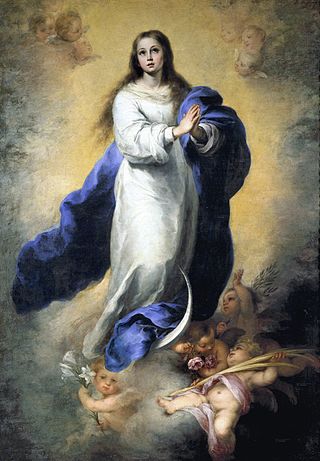
The Immaculate Conception of El Escorial is a circa 1660–1665 oil religious painting by the Spanish Baroque artist Bartolomé Esteban Murillo, now in the Museo del Prado in Madrid. Murillo's many artistic depictions of the immaculate conception of the Virgin Mary were enormously influential on later art. This painting is regarded as one of his best. It was earlier identified as the Immaculate Conception of the Granja due to a mistaken understanding of its history.
Murillo is a Spanish surname. Notable people with the name include:

The Immaculate Conception of Los Venerables or The Immaculate Conception of Soult is an oil painting by the Spanish artist Bartolomé Esteban Murillo. It was painted c. 1678 and measures 274 cm × 190 cm. Looted by Marshal Jean-de-Dieu Soult in 1813 and taken to France, it was bought by the Louvre in 1852. It has been held by the Museo del Prado, Madrid, since 1941.

Our Lady of the Rosary is an oil on canvas painting of Our Lady of the Rosary by Bartolomé Esteban Murillo, created c. 1650-1655. It was previously in the El Escorial Monastery and Palacio Real de Madrid and now is held in the Museo del Prado, in Madrid.

Madonna and Child of the Napkin or Our Lady of the Napkin is an oil on canvas painting by Bartolomé Esteban Murillo, created c. 1666, as part of the altarpiece of the church of the Capuchin monastery in Seville and now in the Museum of Fine Arts of Seville. The vivid colour and delicacy of forms are reminiscent of Raphael, while the atmosphere is influenced by Velázquez and Rubens.

The La Colasal Immaculate Conception is a c. 1645-1655 oil on canvas painting by Bartolomé Esteban Murillo in the Museum of Fine Arts of Seville.

The Flower Girl is a c. 1665-1670 oil on canvas painting by the Spanish artist Bartolomé Esteban Murillo, now in the Dulwich Picture Gallery, in London.

The Aranjuez Immaculate Conception is a c.1675 oil on canvas painting by Bartolomé Esteban Murillo. It first appears in the written record in 1818, when it was in the royal chapel of San Antonio in the Palacio de Aranjuez in Madrid, after which it is named. It next appears in the queen's quarters in the same palace in 1827 and is now in the Prado Museum.

Saint Thomas of Villanova Healing a Lame Man is an oil on canvas painting by Bartolomé Esteban Murillo, created c. 1675. It is held in the Alte Pinakothek in Munich, having been bought for Maximilian I Joseph of Bavaria by General Sebastiani in Paris in 1815. It depicts a miracle performed by the Spanish saint Thomas of Villanova.
Christ on the Cross may refer to:
This page is based on this
Wikipedia article Text is available under the
CC BY-SA 4.0 license; additional terms may apply.
Images, videos and audio are available under their respective licenses.
