
The Oka is a river in central Russia, the largest right tributary of the Volga. It flows through the regions of Oryol, Tula, Kaluga, Moscow, Ryazan, Vladimir and Nizhny Novgorod and is navigable over a large part of its total length, as far upstream as the town of Kaluga. Its length is 1,500 km (930 mi) and its catchment area is 245,000 km2 (95,000 sq mi). The Russian capital Moscow sits on one of the Oka's tributaries—the Moskva.

Polotsk or Polatsk is a historical city in Belarus, situated on the Dvina River. It serves as the administrative center of Polotsk District in Vitebsk Region. It is served by Polotsk Airport and Borovitsy air base. As of 2023, it has a population of 79,960.

Murom is a historical city in Vladimir Oblast, Russia, which sprawls along the left bank of the Oka River. Population: 107,497 (2021 Census); 116,075 (2010 Census); 126,901 (2002 Census); 124,229 (1989 Census).
Oleg Svyatoslavich was a Sviatoslavichi prince whose equivocal adventures ignited political unrest in Kievan Rus' at the turn of the 11th and 12th centuries. He reigned as Prince of Chernigov from 1097 to 1115, and was the progenitor of the Olgovichi family.
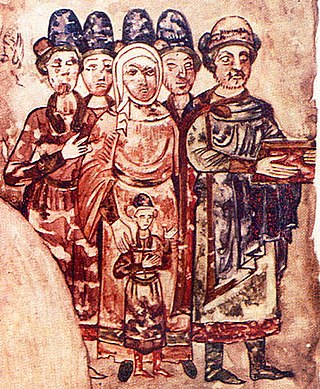
Constantine of Murom known as Saint Constantine the Blessed was a direct descendant of Vladimir I of Kiev and the son of Prince Svyatoslav of Chernigov.

The Principality of Chernigov was one of the largest and most powerful states within Kievan Rus'. For a time the principality was the second most powerful after Kiev. The principality was formed in the 10th century and maintained some of its distinctiveness until the 16th century. The Principality of Chernigov consisted of regions of modern-day Ukraine, Belarus, and Russia.

The architecture of Kievan Rus' comes from the medieval state of Kievan Rus' which incorporated parts of what is now modern Ukraine, Russia, and Belarus, and was centered on Kiev and Novgorod. Its architecture is the earliest period of Russian architecture, using the foundations of Byzantine culture but with great use of innovations and architectural features. Most remains are Russian Orthodox churches or parts of the gates and fortifications of cities.
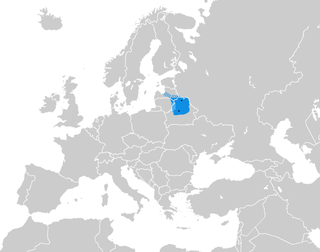
The Principality of Polotsk, also known as the Duchy of Polotsk or Polotskian Rus', was a medieval principality of the Early East Slavs. The origin and date of state establishment is uncertain. Chronicles of Kievan Rus' mention Polotsk being conquered by Vladimir the Great, and thereafter it became associated with Kievan Rus' and its ruling Rurik dynasty.

The Principality of Ryazan, later known as the Grand Principality of Ryazan, was a principality from 1129 to 1521. Its capital was the city of Ryazan, now known as Old Ryazan, which was destroyed in 1237 during the Mongol invasions. The capital was moved to Pereyaslavl-Ryazansky, later renamed Ryazan.
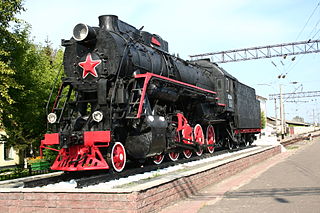
The 1,520 mm broad gauge Murom Railway is a subdivision of the state-owned Gorky Railway in Russia. It was built between the towns of Kovrov and Murom in 1874-1880.
The Prince of Murom was the title of the ruler of the Principality of Murom.

The Principality of Murom, also referred to as the Murom-Ryazan Principality until the mid-12th century, was a principality with its capital in Murom, now in Vladimir Oblast, Russia. Murom lay in an area that was strongly Finnic and for much of its medieval history, located in the homeland of the Muromians.

The Council of Liubech was one of the best documented princely meetings in Kievan Rus' that took place in Liubech in 1097. The council ended the Chernihiv war of succession (1093–1097) between Sviatopolk II of Kiev, Vladimir II Monomakh and Oleg I of Chernigov who fought for the heritage of his father Sviatoslav II of Kiev.
Davyd Sviatoslavich was the ruler of Murom and Chernigov.

The Gorky Railway is a subsidiary of the Russian Railways headquartered in Nizhny Novgorod.

The Day of Saint Peter and Saint Fevronia also known as the Day of Family, Love and Faithfulness, the Orthodox patrons of marriage, was officially introduced in Russia in 2008. Svetlana Medvedeva is among the most active promoters of the new holiday. Its symbol is a white daisy.

Muromsky District is an administrative and municipal district (raion), one of the sixteen in Vladimir Oblast, Russia. It is located in the east of the oblast. The area of the district is 1,050 square kilometers (410 sq mi). Its administrative center is the city of Murom. Population: 15,013 (2021 Census); 24,991 (2010 Census); 26,382 ; 29,975 (1989 Census).
The sack of Chernigov occurred during the westward expansion of the Mongol Empire. It was part of the 1237–1242 Mongol invasion of Rus'. The siege and capture of the capital of the Chernigov Principality by the Mongols occurred on 18 October, 1239.
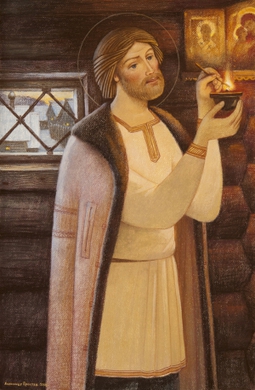
Davyd Yuryevich and Euphrosyne, known as Saints Peter and Fevronia of Murom, were the russian Prince and Princess consort of the Principality of Murom. They are some of the most renowned Russian saints and wonderworkers venerated both in the Eastern Orthodox Church and the Eastern Catholic Church; their feast day is celebrated every year on 25 June, N.S..
