Related Research Articles

East Pakistan was the eastern polity of The Islamic Republic of Pakistan, established in 1955 under the One Unit Policy, renaming and restructuring the province as such from East Bengal, which, in modern times, is split between India and Bangladesh. Its land borders were with India and Burma, with a coastline on the Bay of Bengal. East Pakistanis were popularly known as "Pakistani Bengalis"; to distinguish this region from India's state West Bengal, East Pakistan was known as "Pakistani Bengal". In 1971, East Pakistan became the newly independent state Bangladesh, which means "country of Bengal" or "country of Bengalis" in Bengali language.

Sheikh Mujibur Rahman, popularly known by the honorific prefix Bangabandhu was a Bangladeshi politician, revolutionary, statesman, activist and diarist. As a politician, Mujib had held continuous positions as president or prime minister from April 1971 until his assassination in August 1975: as president from 1971 to 1972 and briefly from 1975 until his death, and as prime minister from 1972 to 1975. Mujib successfully led the Bangladeshi independence movement and restored the Bengali sovereignty after over two centuries following the Battle of Plassey in 1757, for which he is honoured as the 'Father of the Nation' in Bangladesh. In 2011, the fifteenth constitutional amendment in Bangladesh referred to Sheikh Mujib as the Father of the Nation who declared independence; these references were enshrined in the fifth, sixth, and seventh schedules of the constitution. His Bengali nationalist ideology, socio-political theories, and political doctrines are sometimes called Mujibism.
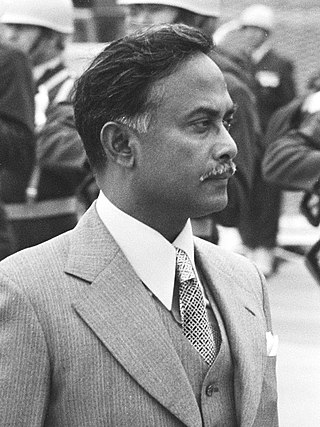
Ziaur Rahman was a Bangladeshi military officer and politician who served as the President of Bangladesh from 1977 until his assassination. He was the founder of the Bangladesh Nationalist Party (BNP) and served as its chairman until his assassination. He previously served as the second chief of army staff from 1975 to 1978 with a minor break.

The Bangladesh Liberation War was a revolution and armed conflict sparked by the rise of the Bengali nationalist and self-determination movement in East Pakistan, which resulted in the independence of Bangladesh. The war began when the Pakistani military junta based in West Pakistan—under the orders of Yahya Khan—launched Operation Searchlight against the people of East Pakistan on the night of 25 March 1971, initiating the Bangladesh genocide.

Victory Day is a national holiday in Bangladesh celebrated on 16 December to commemorate the defeat of the Pakistan Armed Forces in the Bangladesh Liberation War in 1971 and the Independence of Bangladesh. It commemorates the Pakistani Instrument of Surrender, wherein the commander of the Pakistani Forces, General AAK Niazi, surrendered to the Mukti Bahini and their Indian allies, ending the nine-month Bangladesh Liberation War and 1971 Bangladesh genocide and marking the official secession of East Pakistan to become the new state of Bangladesh.

Ghulam Azam was a Bangladeshi Islamist politician. He was the former leader of Bangladesh Jamaat-e-Islami, the largest Islamist political party in Bangladesh.
Khaled Mosharraf, Bir Uttom was a Bangladeshi army officer who is known for his role in the Bangladesh Liberation War and the subsequent coups in post-independence Bangladesh. After deposing Khondakar Mustaq Ahmad in the 3 November 1975 coup, Mosharraf was assassinated on 7 November 1975.

Armed Forces Day is observed in Bangladesh on 21 November. This signifies the day in 1971, when the members of the Bangladesh army, navy and air force were officially united and launched joint operations against the Pakistan occupation forces. On 16 December 1971, the Pakistani Army of 93,000 surrendered to the allied force of Bangladesh army, ending the Liberation War of Bangladesh.
Syed Ali Ahsan was a Bangladeshi poet, writer and university academic. He was awarded Ekushey Padak (1982) and Independence Day Award (1987) by the Government of Bangladesh. In 1987, he was selected as the National Professor of Bangladesh. He was credited as the official English translator of the National Anthem of Bangladesh.
Shafaat Jamil, Bir Bikrom was a Bangladesh Army colonel. He was the commanding officer of the 3rd East Bengal Regiment of Z Force Brigade in Sector 11 of Bangladesh Forces during the War of Bangladesh Independence in 1971. He was among the first Bengali officers who rebelled against the Pakistani Army in the 1971 Liberation War of Bangladesh and later fought in 11 sector and in Sylhet sector.

Ali Ahsan Mohammad Mojaheed was a Bangladeshi politician who served as a Member of Parliament and as the Minister of Social Welfare from 2001 to 2007. He was executed in 2015 for war crimes committed during the 1971 Liberation war of Bangladesh.

In 1971, the Pakistan Army and their local collaborators, most notably the extreme right wing militia group Al-Badr, engaged in the systematic execution of Bengali intellectuals during the Bangladesh Liberation War of 1971. Bengali intellectuals were abducted, tortured and killed during the entire duration of the war as part of the 1971 Bangladesh genocide. However, the largest number of systematic executions took place on 25 March and 14 December 1971, two dates that bookend the conflict. 14 December is commemorated in Bangladesh as Martyred Intellectuals Day.
Kazi Mohammed Shafiullah Bir Uttam, also known as K. M. Shafiullah, is a retired Bangladeshi general, former Chief of Army Staff of the Bangladesh Army, and former member of parliament.
Swadhin Bangla Betar Kendra was the radio broadcasting centre of Bengali nationalist forces during the Bangladesh Liberation War in 1971. This station played an important role in the liberation struggle, broadcasting the Declaration of Independence and increasing the morale of Bangladeshis during the genocide. In 1971, radio was the only media reaching the far ends of Bangladesh. The station ran a liberation campaign throughout the liberation war.
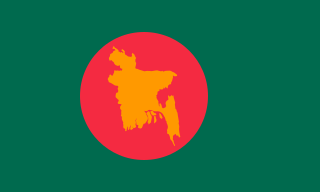
The Independence Day of Bangladesh is celebrated on 26 March as a national holiday in Bangladesh. It commemorates the country's declaration of independence from Pakistan in the early hours of 25 March 1971.
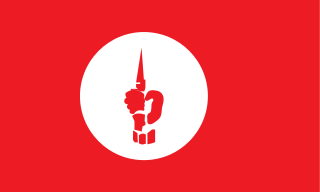
The Mukti Bahini, also known as the Bangladesh Forces, was the guerrilla resistance movement consisting of the Bangladeshi military, paramilitary and civilians during the Bangladesh Liberation War that transformed East Pakistan into Bangladesh in 1971. They were initially called the Mukti Fauj.
Faizur Rahman Ahmed was a police officer and a freedom fighter of the 1971 Bangladesh Liberation War. He was killed by Pakistani military personnel during the war. He was given the Independence Day Award posthumously by the government of Bangladesh in 2017.

Lieutenant Colonel (Retd.) Quazi Sazzad Ali Zahir is a veteran of the Bangladesh Liberation War. The Bangladesh government awarded him the Bir Protik gallantary award for his bravery in the war. He was conferred with the Independence Award, Bangladesh's highest civilian in 2013 and India's fourth highest civilian award the Padma Shri on November 9, 2021.
Shaheed Mohammad Nazmul Haque was the deputy director of anti-corruption in Chittagong until his kidnapping and presumed death at the hands of the Pakistan military. In 2015, the Shaheed Nazmul Haque Police Barrack in Naogaon District, his birthplace, were named after him following renovations. He was awarded the Independence Day Award in 2017 by the government of Bangladesh.
Shah Abdul Mazid was the superintendent of Pakistan Police in Rajshahi District who was killed in an attack on the Rajshahi police line by the Pakistan Army in 1971. In 2016, he was posthumously awarded the Independence Day Award, the highest civilian award in Bangladesh.
References
- 1 2 3 4 5 6 7 8 চৌধুরী, ফয়জুল লতিফ (2019-12-15). "উনিশ শ' একাত্তর". Samakal (in Bengali). Archived from the original on 15 December 2019. Retrieved 2024-02-16.
- ↑ "15 individuals, BAF named for Independence Award". New Age | The Most Popular Outspoken English Daily in Bangladesh. Retrieved 2024-02-16.
- ↑ "Air Force, 15 people get Independence Award 2017". The Daily Star. 2017-02-17. Retrieved 2024-02-16.
- ↑ "Air Force, 15 personalities receive Independence Award 2017". The Daily Star. 2017-03-23. Retrieved 2024-02-16.