Nairan

Last updated

In the ancient Japanese government, nairan(内覧) was the inspection of documents submitted to the tennō (emperor), or the position held by those who performed the inspection. [1]

Japan Constitutional monarchy in East Asia

Japan is an island country in East Asia. Located in the Pacific Ocean, it lies off the eastern coast of the Asian continent and stretches from the Sea of Okhotsk in the north to the East China Sea and the Philippine Sea in the south.
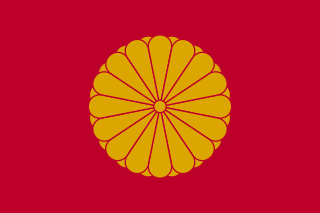
Emperor of Japan Monarch in Japan

The Emperor of Japan is the head of the Imperial Family and the head of state of Japan. Under the 1947 constitution, he is defined as "the symbol of the State and of the unity of the people." Historically, he was also the highest authority of the Shinto religion. In Japanese, the Emperor is called Tennō (天皇), literally "heavenly sovereign". In English, the use of the term Mikado for the Emperor was once common, but is now considered obsolete.

The tennō usually gave a nairan-no-senji(内覧の宣旨, an imperial edict of inspection) to the regent (either a sesshō or kampaku ).

Sesshō and Kampaku Wikimedia list article

In Japan, Sesshō (摂政) was a title given to a regent who was named to act on behalf of either a child Emperor before his coming of age, or an empress regnant. The Kanpaku (関白) was theoretically a sort of chief advisor for the Emperor, but was the title of both first secretary and regent who assists an adult Emperor. During a certain period in the Heian period, they were the effective rulers of Japan. There was little, if any, effective difference between the two titles, and several individuals merely changed titles as child Emperors grew to adulthood, or adult Emperors retired or died and were replaced by child Emperors. The two titles were collectively known as Sekkan (摂関), and the families that exclusively held the titles were called Sekkan-ke or Sekkan family. After the Heian period, shogunates took over the power.

Related Research Articles

Emperor Heizei, also known as Heijō-tennō, was the 51st emperor of Japan, according to the traditional order of succession. Heizei's reign lasted from 806 to 809.

Emperor Junna was the 53rd emperor of Japan, according to the traditional order of succession. Junna reigned from 823 to 833.

Emperor Montoku Emperor of Japan

Emperor Montoku was the 55th emperor of Japan, according to the traditional order of succession.

Emperor Seiwa Emperor of Japan

Emperor Seiwa was the 56th emperor of Japan, according to the traditional order of succession.

Emperor Toba Emperor of Japan

Emperor Toba was the 74th emperor of Japan, according to the traditional order of succession.

Emperor Go-Fukakusa Emperor of Japan

Emperor Go-Fukakusa was the 89th emperor of Japan, according to the traditional order of succession. This reign spanned the years 1246 through 1260.

Emperor Horikawa was the 73rd emperor of Japan, according to the traditional order of succession.

Emperor Murakami Emperor of Japan

Emperor Murakami was the 62nd emperor of Japan, according to the traditional order of succession.

Emperor Daigo Emperor of Japan

Emperor Daigo was the 60th emperor of Japan, according to the traditional order of succession.

Hōtoku Japanese era

Hōtoku (宝徳) was a Japanese era name after Bun'an and before Kyotoku. This period spanned the years from July 1449 through July 1452. The reigning emperor was Go-Hanazono-tennō (後花園天皇).

Empress of Japan wife of the reigning emperor of Japan

Empress of Japan or Japanese Empress means an empress consort. The current empress consort is Empress Michiko. The term can also mean a female imperial ruler.

Princess Yoshiko (Kōkaku) empress consort of Emperor Kōkaku; daughter of emperor Go-Momozono

Princess Yoshiko was the empress consort of Emperor Kōkaku of Japan. She enjoys the distinction of being the last daughter of an emperor who would herself rise to the position of empress. When she was later given the title of Empress Dowager, she became the first person to be honored with that title while still living since 1168.

Chashinai Station is a railway station on the Hakodate Main Line in Bibai, Hokkaidō, Japan, operated by the Hokkaido Railway Company.

Niikappu River is a river in Hokkaidō, Japan.

Xiangzhou District, Zhuhai District in Guangdong, Peoples Republic of China

Xiangzhou District(Chinese: 香洲区; pinyin: Xiāngzhōu Qū; literally: "Fragrant Islet") is a district of Zhuhai, Guangdong province. It is located at the southwest corner of the Pearl River Delta, bordering Macau to the south and southeast. The district is the political, financial, transit, and cultural center of Zhuhai.

Japanese people in China are Japanese expatriates and emigrants and their descendants residing in Greater China. There were 127,282 Japanese nationals living in People's Republic of China in 2009. About 105,764 Japanese nationals resided in Mainland China, 27,429 in Hong Kong and Macau, about 20,373 in the Republic of China.

Tsurara-onna is a Japanese folklore. It is a tale about an icicle that became a woman, so it is often confused with yuki-onna.

References

  1. Goble, Andrew (1996). Kenmu: Go-Daigo's Revolution. Harvard University Press. p. 41. ISBN   0-674-50255-8.