
The Aegean Sea is an elongated embayment of the Mediterranean Sea between Europe and Asia. It is located between the Balkans and Anatolia, and covers an area of some 215,000 square kilometres. In the north, the Aegean is connected to the Marmara Sea and the Black Sea by the straits of the Dardanelles and the Bosphorus. The Aegean Islands are located within the sea and some bound it on its southern periphery, including Crete and Rhodes. The sea reaches a maximum depth of 3,544 meters, to the east of Crete. The Thracian Sea and the Myrtoan Sea are subdivisions of the Aegean Sea.
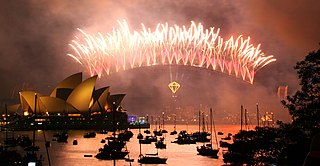
Fireworks are a class of low explosive pyrotechnic devices used for aesthetic and entertainment purposes. The most common use of a firework is as part of a fireworks display, a display of the effects produced by firework devices.

Hydra, or Ydra or Idra, is one of the Saronic Islands of Greece, located in the Aegean Sea between the Myrtoan Sea and the Argolic Gulf. It is separated from the Peloponnese by a narrow strip of water. In ancient times, the island was known as Hydrea, a reference to the natural springs on the island.

Piraeus is a port city within the Athens urban area, in the Attica region of Greece. It is located in the Athens Riviera, 8 kilometres southwest of Athens’ city centre, along the east coast of the Saronic Gulf.

Pyrotechnics is the science and craft of creating such things as fireworks, safety matches, oxygen candles, explosive bolts and other fasteners, parts of automotive airbags, as well as gas-pressure blasting in mining, quarrying, and demolition. This trade relies upon self-contained and self-sustained exothermic chemical reactions to make heat, light, gas, smoke and/or sound. The name comes from the Greek words pyr ("fire") and tekhnikos.

Poros is a small Greek island-pair in the southern part of the Saronic Gulf, about 58 km (36 mi) south from Athens' port of Piraeus and separated from the Peloponnese by a 200 m (656 ft) wide sea channel, with the town of Galatas on the mainland across the strait. Its surface area is about 31 square kilometres (12 sq mi) and it has 3,780 inhabitants. The ancient name of Poros was Pogon. Like other ports in the Saronic, it is a popular weekend destination for Athenian travellers.

A firecracker is a small explosive device primarily designed to produce a large amount of noise, especially in the form of a loud bang, usually for celebration or entertainment; any visual effect is incidental to this goal. They have fuses, and are wrapped in a heavy paper casing to contain the explosive compound. Firecrackers, along with fireworks, originated in China.

A sparkler is a type of hand-held firework that burns slowly while emitting colored flames, sparks, and other effects.
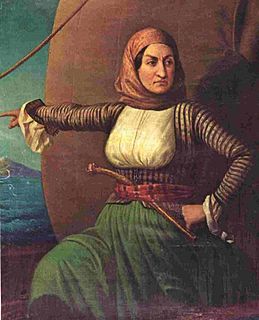
Laskarina "Bouboulina" Pinotsi was a Greek naval commander, heroine of the Greek War of Independence in 1821, and considered the first woman-admiral of the Imperial Russian Navy.

Spetses is an affluent island and a municipality in the Islands regional unit, Attica, Greece. It is sometimes included as one of the Saronic Islands. Until 1948, it was part of the old prefecture of Argolis and Corinthia Prefecture, which is now split into Argolis and Corinthia. In ancient times, it was known as Pityussa; Spetses is a borrowing from Italian spezie "spices".

Fireworks in England, Scotland and Wales are governed primarily by the Fireworks Regulations 2004, the Pyrotechnic Articles (Safety) Regulations 2015, and British Standards BS 7114 until 4/7/17 and BS-EN 15947-2015. In Northern Ireland, fireworks are governed by The Pyrotechnic Articles (Safety) Regulations 2015, and Explosives (Fireworks) Regulations (NI) 2002.

Pyro Spectaculars is an American pyrotechnics and fireworks company with its primary offices in Rialto, California. They are one of the largest fireworks companies in the world today. Jim Souza is the President and CEO of the company, which was founded in 1979 by his father, Bob Souza. The company shoots hundreds of shows each year in multiple countries, including the largest fireworks show in the United States each year. The company also conducts a series of pyrotechnics classes and seminars to train licensed pyrotechnicians.

The Anastenaria, is a traditional barefoot fire-walking ritual with ecstatic dance performed in some villages in Northern Greece and Southern Bulgaria. The communities which celebrate this ritual are descended from refugees who entered Greece from Eastern Thrace following the Balkan Wars of 1911–12 and the Population exchange between Greece and Turkey in 1923.
This is a list of worldwide fireworks competitions.

Sydney New Year's Eve is an annual multi-tiered event held every New Year's Eve in Sydney, Australia. Centring on the Sydney Harbour Bridge and surrounding Port Jackson, its main events are two pyrotechnic displays: the 9 pm Family Fireworks and the Midnight Fireworks, both of which are televised nationally with the more popular Midnight Fireworks televised globally.
BraviSEAmo! was a nighttime water show at Tokyo DisneySea. The show featured water, pyrotechnic, and firework effects and was performed on the lagoon of the Mediterranean Harbor. The show was directed by Yves Pépin from ECA2 and used little dialogue, instead featuring an orchestral score by Gavin Greenaway. BraviSEAmo! replaced Tokyo DisneySea's earlier nighttime show DisneySea Symphony, and was replaced by a new version of Fantasmic! in 2011. The show ran from July 17, 2004 to November 13, 2010 and was sponsored by NTT DoCoMo throughout its run.

Bonfire Night is a name given to various annual celebrations characterised by bonfires and fireworks. The event celebrates different traditions on different dates, depending on the country. Some of the most popular instances include Guy Fawkes Night in Great Britain, which is also celebrated in some Commonwealth countries; Northern Ireland's Eleventh Night, and 5 November in Newfoundland and Labrador. In various parts of Ireland, Bonfire Nights are held on Saint John's Eve, Bealtaine eve and Halloween. In Scandinavia it is known as Walpurgis Night and in Denmark also sankthansaften. Saint John's Eve is also a very important celebration in Spain and Northern Portugal. Several other cultures also include night-time celebrations involving bonfires and/or fireworks.

Mexican handcrafted fireworks production is mostly concentrated in the State of Mexico in central Mexico. The self-declared fireworks capital of Mexico is Tultepec, just north of Mexico City. Although the main ingredient for fireworks, gunpowder, was brought by the conquistadors in the 16th century, fireworks became popular in Mexico in the 19th century. Today, it is Latin America’s second largest producer, almost entirely for domestic use, with products ranging from small firecrackers to large shells and frames for pyrotechnics called “castillos” (castles) and “toritos”. The industry is artisanal, with production concentrated in family-owned workshops and small factories with a number operating illegally. The relatively informal production and sales of fireworks have made it dangerous with a number of notable accidents in from the late 1990s to the present, despite attempts to safety regulations.
Star Fireworks is a British company that stages professional fireworks displays and special effects for events. It specializes in providing choreographed firework sequences for film and television use. It was formed in 1971. It was known as Bracknell Fireworks until the name of the company was changed in 2005. Its main offices are in Bracknell, Berkshire.
Dimitris Koutsiabasakos is a Greek film director, writer, and independent producer, known for his documentaries, series, short and feature films. He was born in 1967 and studied movie and television direction at the Gerasimov Institute of Cinematography, in Moscow, Russia (V.G.I.K.). Since 2000, he teaches film acting at several Drama Schools, among which the National Theatre of Northern Greece. He has been a lecturer both in the Department of Cultural Technology and Communication at the University of the Aegean and the Faculty of Fine Arts, School of Film Studies, at the Aristostle University of Thessaloniki. His work has been critically acclaimed and has received many national and international awards.

