Native Americans in vaudeville

Last updated

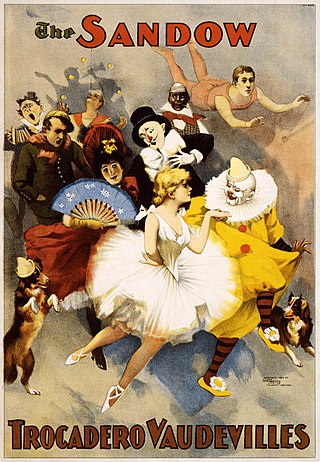
Native Americans were involved in Wild West shows and vaudeville performances in the late 19th and early 20th century, often playing to prevalent stereotypes. Notable Native American vaudeville performers included Molly Spotted Elk, Will Rogers, Esther Louise Georgette Deer, and Lucy Nicolar Poolaw.

Contents

Reasons for involvement

Native Americans became involved in vaudeville performances for a variety of reasons and in a variety of ways. When considering the historical context of the 1880s–1920s, the mistreatment of Native Americans was a focal point. With the passage of the Dawes Act in 1887, reservations were broken up and divided into allotments that would then be given to individual Native American people or families. This was an effort by the Federal Government to encourage assimilation among the Indigenous population. [1] The Federal Government also did not incentivize Indigenous people to stay on reservations or make life there very appealing. Job and other opportunities were lacking on reservations meaning there was not much to do on reservations leading many Native Americans to wanting to leave. [2] As they were increasingly being driven off their lands or crammed into smaller lands, Indigenous people needed to find new ways to survive in the world they were being forced into. With the growth of vaudeville, they found some amount of security.[ citation needed ]

Life among white people was much different than that of traditional Indigenous tribes. With their land disappearing and being robbed from them, Native Americans' livelihoods went too. The Dawes Act encouraged Native Americans to take up agriculture as a means of assimilating to white culture. [1] However, this was not the way they knew how to live life or survive. Native American tribes are historically that: tribes. They lived traditionally as interdependent communities, working together and relying on each other, rather than as individuals, fending for themselves or their families. Native Americans made a living doing seasonal jobs such as working in lumber or on river drives. When that was unavailable, depending on the season, other forms of earning were needed. Some turned to vaudeville to fill this role. Performing in vaudeville was a means of making money, even if wages were typically fairly low. With the intrigue that came with the exotic unknown of Indigenous culture, people were willing to pay to see these performances done by authentic Indians.[ citation needed ]

The Carlisle Indian School CARLISLE INDIAN INDUSTRIAL SCHOOL, CUMBERLAND COUNTY.jpg
The Carlisle Indian School

Also prevalent during this period were American Indian boarding schools. These boarding schools were another effort by the United States government to assimilate Native Americans to a more Euro-centric, Christin lifestyle. The students were punished for speaking their native languages instead of English, forced to cut their hair and abandon traditional clothing. They were taught Christianity so they would abandon their own religions and furthermore were taught that their own cultures were inferior to white culture. [3] Some of these students ran away to join vaudeville or became performers after graduating. [4] By joining vaudeville, they could once again embrace their culture and traditions on stage and not be punished for it like they had been when attending boarding school. Multiple students from the Carlisle Indian School reported in student surveys that they went on to be vaudeville performers. [5]

Of course the drive to vaudeville being out of necessity to survive was not a universal experience. Others, such as Will Rogers, went into vaudeville and performing in general because of a love of theatrics rather than needing to make a living. [6]

Stereotypical portrayals

Often, the audiences watching vaudeville performances were not interested in seeing accurate portrayals of Indigenous life in the United States. They wanted a show and wanted to see their racist assumptions about Native Americans to be confirmed in performances. While on the stages of vaudeville, Native Americans would often play into the stereotypes, acting in shows where they were portrayed as primitive and savage through face paint, feather headdresses, and war hooping, [7] or "playing Indian" [8] for their white audiences. When Indian dances were performed on vaudeville stages, it did not matter if a performer from one tribe danced a traditional dance from another tribe. [2] Traditions and cultures intermixed on the stages of vaudeville. One Indigenous vaudevillian even went as far as calling herself "the universal Indian" [2] for she would play a character from whatever tribe the show called for. For female Indigenous performers, or female performers playing Indigenous characters, their portrayals were often sexualized and exotic, [9] sometimes even going as far as wearing only a skimpy outfit with a feather headdress. [2]

Wild West shows were the precursor to vaudeville and other on-stage performances and laid the ground work for how Native Americans were to be portrayed on stage. One of the cornerstones of these wild west shows was portraying stereotypical western life in which battles between Native Americans and white cowboys were reenacted. Native Americans in these shows were shown as savages against the white man, showcasing their war chants especially. Many Native Americans that went on to perform in vaudeville got their start with a number of these wild west shows and learned to play their role of the savage Indian through these shows. [2] [6]

Article written about Eva Tanguay The Wild Girl (1917) - 3.jpg
Article written about Eva Tanguay

It was not uncommon for non-Native people to play Native characters by dressing up with feathers, war-paint, or even painting their skin so it had a red hue to it. This type of performing is also referred to as redface, [10] similar to blackface used in minstrel shows. Redface was also used in vaudeville to perpetuate the primitive and savage stereotypes of Native Americans. Eva Tanguay is one such vaudeville performer. She played primitive, hyper-sexualized characters that dressed in revealing animal skin costumes and adorned with feathers. The characters she often played furthered the exotic, sexual maiden stereotype associated with Native American women. [11]

Later in the vaudeville period, Indigenous performers - especially those that had achieved more fame - had more of a say in their portrayal on the stage. The relationship between Indigenous performer and audience was more genuine than other forms of media at that time. Because of this, Indigenous performers were able to take more creative liberty in how they were presented to the audience. They took back some of the power in how their cultures and traditions were shown on stage, breaking down the stereotypes of primitivism and savagery in wild west shows and in films during that time and later. In doing so, performers were able to share their culture in a more positive light. [12]

Notable performers

Molly Spotted Elk

Molly Alice Nelson, also known as Princess Spotted Elk Molly Spotted Elk (1903-1977) portrait.jpg
Molly Alice Nelson, also known as Princess Spotted Elk

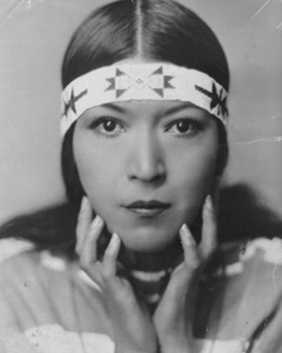
Molly was born in Indian Island, Maine, to a Penobscot family. She was named Molly Alice Nelson. From a young age, Molly loved to dance and even performed for tourists in the summertime with other Penobscot children. When traveling circuses or road shows passed through town, Molly would often participate. After dropping out of high school, Molly started performing in the traveling vaudeville circuit. During this time she found herself mistreated by her manager and left to pursue a college education at the University of Pennsylvania instead. Molly participated in the Women's Glee Club and performed traditional Penobscot dances and songs with accompanying lectures to explain the traditions she shared. Eventually, Molly left this scene and joined the more stereotype perpetuating wild west shows down in San Antonio, Texas. While dancing in a chorus line in San Antonio, Molly gained recognition and soon began performing cliché solo Indian dances. After going to New York to perform on vaudeville stages there, Molly had the opportunity to be the star of a silent film. During this time, Molly struggled with feeling caught between two worlds of being an Indian woman but being celebrated and accepted by the white people around her while other Indians were not given the same treatment. During her time in vaudeville, the Princess Spotted Elk found the revealing, inauthentic costumes she wore on stage to be embarrassing and degrading after a time, hating how her value on stage was becoming sex appeal rather than purely talent. While her performances were important for her as a means of making money to sustain herself but also to send home to the Penobscot reservation on Indian Island, she grew tired of the sexualization and stereotyping of her own culture in vaudeville. [2]

Will Rogers

Trick roping master, Will Rogers Will Rogers - Feb 1920 EH.jpg
Trick roping master, Will Rogers

Will Rogers, born William Penn Adair Rogers in Indian Territory, Oklahoma to a Cherokee Family, went on to become one of the most well known vaudevillians and movie stars. As a young boy, Will loved all things cowboy and disliked formal education, showing that his future did not lie in that realm. His first form of performing was doing Indian stomp dances in Saturday night exhibitions with a childhood friend. They would wear the face paint of Plains Indians, wear headbands, and do war hoops, effectively playing Indian. During this time, Will also worked on his roping skills and became proficient in trick roping. Eventually, Rogers found his way to Texas Jack's Wild West Show in a tour around South Africa where he gained the name "The Cherokee Kid". This was the first time he was able to perform his trick roping abilities for a crowd and he loved it. After forming a strong bond with the showrunner, Texas Jack, Will saw the potential for show business to be his life rather than just a side job to make some extra money. After his time in South Africa, Will eventually found his way back to America where he joined the Mulhall Congress of Rough Riders and Ropers, his first big performing role in the United States. In the Mulhall show, Will would switch between playing the cowboy and playing the Indian in certain performances.


When Will eventually moved to vaudeville with his trick roping, he began performing a horse act where he would rope a horse and rider on the small vaudeville stage. Soon he gained fame for his roping abilities and comedic commentary that accompanied his acts. Will Rogers did not typically do performances in vaudeville that specifically demonstrated his Indigenous heritage and focused mainly on his cowboy, ranching background in his acts. Later in his career, Rogers went on to star in westerns on the big screen. [6]

Esther Louise Georgette Deer- Princess White Deer Princess White Deer - Oct 1921 Tatler.jpg
Esther Louise Georgette Deer- Princess White Deer

Esther Louise Georgette Deer (Princess White Deer)

Esther Louise Georgette Deer, recognized by her stage name Princess White Deer, started her journey in performing early in life. Born into a family of performers, she toured various nations performing with them. Princess White Deer eventually ventured to the United States starting her solo career on the stages of Vaudeville. [13] [14] Stated as the most accomplished Mohawk entertainer of her time, she collaborated with other renowned performers, appeared on Broadway, and formed her own ensemble. Princess White Deer also wrote her own play in which she starred in entitled "From Wigwam to White Lights". This production celebrated the profound contributions of Native Americans to the realms of art, music, dance and theater, embodying Princess White Deer's fusion of cultural heritage with a modern professional women. [13]

Lucy Nicolar Poolaw (Princess Watahwaso)

Lucy Nicolar Poolaw, renowned by her stage name Princess Watahwaso, graced the American Circuit as a Native American performer. She would sing and dance in the Vaudeville shows. [13] Lucy Nicolar Poolaw while traveling, united talents from diverse tribal backgrounds such as Penobscot, Kiowa, Cherokee and Mohawk. [12] During her travels, she encountered Bruce Poolaw of the Kiowa Nation, whom she later married, and together they became a dynamic duo, portraying Indians in various productions. Notably in "The Courtship of Rippling Water", Princess Watahwaso and Bruce Poolaw as Young Chief Poolaw, encapsulated their performances. [12] After retiring from performing, they retreated to the Penobscot reservation on Indian Island, Maine, marking the end of their stage careers. [15]

Related Research Articles

<span class="mw-page-title-main">Vaudeville</span> Entertainment genre

Vaudeville is a theatrical genre of variety entertainment which began in France at the end of the 19th century. A Vaudeville was originally a comedy without psychological or moral intentions, based on a comical situation: a dramatic composition or light poetry, interspersed with songs and dances. It became popular in the United States and Canada from the early 1880s until the early 1930s, while changing over time.
<span class="mw-page-title-main">Penobscot</span> Ethnic group

The Penobscot are an Indigenous people in North America from the Northeastern Woodlands region. They are organized as a federally recognized tribe in Maine and as a First Nations band government in the Atlantic provinces and Quebec.
<span class="mw-page-title-main">Molly Spotted Elk</span> American actress

Mary Nelson Archambaud, best known by her stage name Molly Spotted Elk, was a Penobscot Indian dancer, actress, and writer who was born on the Penobscot Indian Island Reservation, in Maine, U.S.

American Indian Dance Theatre is a professional performing arts company presenting the dances and songs of Native Americans in the United States and the First Nations of Canada.

<span class="mw-page-title-main">Wild West shows</span> 1870–1920 traveling vaudeville performances

Wild West shows were traveling vaudeville performances in the United States and Europe that existed around 1870–1920. The shows began as theatrical stage productions and evolved into open-air shows that depicted romanticized stereotypes of cowboys, Plains Indians, army scouts, outlaws, and wild animals that existed in the American West. While some of the storylines and characters were based on historical events, others were fictional or sensationalized.

Carol Ann (Bunny) McBride is an American author of a wide range of nonfiction books on subjects ranging from cultural survival and wildlife conservation to Native Americans. Her most recent ethnohistory book is Indians in Eden: Wabanakis and Rusticators on Maine's Mt.Desert Island. Throughout the 1970s and 1980s, she regularly published her poetry and essays in the Christian Science Monitor, and reported on her travels in China, West Africa, East Africa, and northern Europe. Her articles appeared in various US newspapers and magazines, including the Washington Post, Boston Globe, Chicago Tribune,International Wildlife, Travel & Leisure, Sierra, Yankee Magazine,Downeast, and Reader's Digest. From 1981 on, she was actively involved in oral history and community development projects with Micmac Indians in Maine.
<span class="mw-page-title-main">Bee Ho Gray</span> American banjoist, actor and circus performer (1885–1951)

Bee Ho Gray was a Western performer who spent 50 years displaying his skills in Wild West shows, vaudeville, circus, silent films, and radio. While he was primarily known as an expert at trick roping, he was also skilled with knife throwing, bullwhips, trick riding, and the banjo. He wove all of these skills together in a homely comic routine. Throughout his long career, he was constantly compared to Will Rogers, which was befitting, considering the two performers worked together several times and developed their acts together in the early 1900s.

<span class="mw-page-title-main">Aida Overton Walker</span> American vaudeville performer

Aida Overton Walker, also billed as Ada Overton Walker and as "The Queen of the Cakewalk", was an American vaudeville performer, actress, singer, dancer, choreographer, and wife of vaudevillian George Walker. She appeared with her husband and his performing partner Bert Williams, and in groups such as Black Patti's Troubadours. She was also a solo dancer and choreographer for vaudeville shows such as Bob Cole, Joe Jordan, and J. Rosamond Johnson's The Red Moon (1908) and S. H. Dudley's His Honor the Barber (1911).

<span class="mw-page-title-main">Horace Poolaw</span> Kiowa photographer

Horace Poolaw (1906–1984) was a Kiowa photographer from Mountain View, Oklahoma.

<span class="mw-page-title-main">Florence LaDue</span> American rodeo performer

Florence "Flores" LaDue (1883–1951) was the stage name of vaudeville performer and champion trick roper Grace Bensel.

<span class="mw-page-title-main">Native Americans in film</span> Depiction of Native Americans

The portrayal of Native Americans in television and films concerns indigenous roles in cinema, particularly their depiction in Hollywood productions. Especially in the Western genre, Native American stock characters can reflect contemporary and historical perceptions of Native Americans and the Wild West.

Native American feminism or Native feminism is, at its root, understanding how gender plays an important role in indigenous communities both historically and in modern-day. As well, Native American feminism deconstructs the racial and broader stereotypes of indigenous peoples, gender, sexuality, while also focusing on decolonization and breaking down the patriarchy and pro-capitalist ideology. As a branch of the broader Indigenous feminism, it similarly prioritizes decolonization, indigenous sovereignty, and the empowerment of indigenous women and girls in the context of Native American and First Nations cultural values and priorities, rather than white, mainstream ones. A central and urgent issue for Native feminists is the Missing and murdered Indigenous women crisis.

William Hammerstein was an American theater manager. He ran the Victoria Theatre on what became Times Square, Manhattan, presenting very popular vaudeville shows with a wide variety of acts. He was known for "freak acts", where celebrities or people notorious for scandals appeared on stage. Hammerstein's Victoria Theatre became the most successful in New York.

The Indian princess or Native American princess is usually a stereotypical and inaccurate representation of a Native American or other Indigenous woman of the Americas. The term "princess" was often mistakenly applied to the daughters of tribal chiefs or other community leaders by early American colonists who mistakenly believed that Indigenous people shared the European system of royalty. This inaccurate portrayal has continued in popular animation, with characters that conform to European standards of beauty, with the most famous misrepresentation being that of Pocahontas. Frequently, the "Indian Princess" stereotype is paired with the "Pocahontas theme" in which the princess "offers herself to a captive Christian knight, a prisoner of her father, and after rescuing him, she is converted to Christianity and lives with him in his native land." - a false narrative which misrepresents the events of Matoaka's life. The phrase "Indian princess", when used in this way, is often considered to be a derogatory term, a type of racial slur, and is deemed offensive by Native Americans.

<span class="mw-page-title-main">Esther Louise Georgette Deer</span> American singer

Esther Louise Georgette Deer was a Native American dancer, singer, and activist. She was of the Mohawk tribe. She performed under the name Princess White Deer as part of The Famous Deer Brothers, a family stage act, which toured the United States, Europe and South Africa. She returned to America as the country was preparing to enter World War I, and participated in war bond rallies, where she was noticed by Florenz Ziegfeld Jr. She joined his Ziegfeld Follies, and became one of its principal artists. She also lobbied to have the rights of Native Americans recognized in America.

<span class="mw-page-title-main">Redface</span> Use of costumes to caricature Indigenous Americans

Redface is the wearing of makeup to darken or redden skin tone, or feathers, warpaint, etc. by non-Natives to impersonate a Native American or Indigenous Canadian person, or to in some other way perpetuate stereotypes of Indigenous peoples of Canada and the United States. It is analogous to the wearing of Blackface. In the early twentieth century, it was often white performers, who wore blackface or redface when portraying Plains Indians in Hollywood Westerns. In the early days of television sitcoms, "non-Native sitcom characters donned headdresses, carried tomahawks, spoke broken English, played Squanto at Thanksgiving gatherings, received 'Indian' names, danced wildly, and exhibited other examples of representations of redface".

Princess White was an American blues singer, dancer, comedian and vaudeville performer.

<span class="mw-page-title-main">Lucy Nicolar Poolaw</span>

Lucy Nicolar Poolaw, also called Wa-Tah-Wa-So and billed as Princess Watahwaso, was a Penobscot and a performer on the Chautauqua and lyceum circuits.
<span class="mw-page-title-main">Native Americans and women's suffrage in the United States</span>

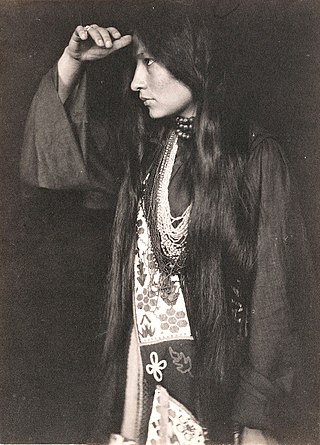
Native American women influenced early women's suffrage activists in the United States. The Iroquois nations, which had an egalitarian society, were visited by early feminists and suffragists, such as Lydia Maria Child, Matilda Joslyn Gage, Lucretia Mott, and Elizabeth Cady Stanton. These women discussed how Native American women had authority in their own cultures at various feminist conventions and also in the news. Native American women became a symbol for some suffrage activists. However, other white suffragists actively excluded Native American people from the movement. When the Nineteenth Amendment was passed in 1920, suffragist Zitkala-Sa, commented that Native Americans still had more work to do in order to vote. It was not until 1924 that many Native Americans could vote under the Indian Citizenship Act. In many states, there were additional barriers to Native American voting rights.

<span class="mw-page-title-main">Atalie Unkalunt</span> Cherokee singer, activist, and designer

Atalie Unkalunt was a Cherokee singer, interior designer, activist, and writer. Her English name Iva J. Rider appears on the final rolls of the Cherokee Nation. Born in Indian Territory, she attended government-run Indian schools and then graduated from high school in Muskogee, Oklahoma. She furthered her education at the New England Conservatory of Music in Boston, Massachusetts. After a thirteen-month engagement with the YMCA as a stenographer and entertainer for World War I troops in France, she returned to the United States in 1919 and continued her music studies. By 1921, she was living in New York City and performing a mixture of operatic arias, contemporary songs, and Native music. Her attempts to become an opera performer were not successful. She was more accepted as a so-called "Indian princess", primarily singing the works of white composers involved in the Indianist movement.

References

  1. 1 2 "Dawes Act (1887)". National Archives. 2021-09-09. Retrieved 2023-11-30.
  2. 1 2 3 4 5 6 MacBride, Bunny (1995). Molly Spotted Elk: a Penobscot in Paris. Norman, Okla.: University of Oklahoma Press. ISBN   978-0-8061-2756-9.
  3. "Boarding Schools: Struggling with Cultural Repression". Native Words, Native Warriors. National Museum of the American Indian. Retrieved 2023-11-30.
  4. Bold, Christine (March 16, 2021). "Vaudeville, Indigeneity, Modernity". Modernism Modernity.
  5. "Carlisle Indian Search". Carlisle Indian School Digital Resource Center. Retrieved 2023-11-30.
  6. 1 2 3 Yagoda, Ben (1993). Will Rogers: a biography. New York: Knopf. ISBN   978-0-394-58512-3.
  7. Prins, Herald (1998). "Chief Big Thunder (1827-1906) The Life History of a Penobscot Trickster" (PDF). Penobscot Nation.
  8. Bold, Christine; Mojica, Monique; Miguel, Gloria; Miguel, Muriel (2018). "Outbreak from the Vaudeville Archive". Western American Literature. 53 (1): 113–126. doi:10.1353/wal.2018.0032. JSTOR   26530727. S2CID   165716813.
  9. Somers, Jacob (2017). The 'Noble Savage' in American Music and Literature, 1790-1855 (Thesis).[ page needed ]
  10. Raheja, Michelle H. (2011). Reservation Reelism: Redfacing, Visual Sovereignty, and Representations of Native Americans in Film. Nebraska. pp. 71–72. ISBN   978-0-8032-3445-1.
  11. Casey, Kathleen (2010). Cross-dressers and race-crossers : intersections of gender and race in American vaudeville, 1900-1930 (Thesis). hdl: 1802/12700 . OCLC   709777700, 885197961 ProQuest   807621190.[ page needed ]
  12. 1 2 3 Bold, Christine (2021). "Indigenous Presence in Vaudeville and Early Cinema". Journal of Cinema and Media Studies. 60 (2): 157–162. doi:10.1353/cj.2021.0008. hdl: 2027/spo.18261332.0060.209 . S2CID   234302256. Project MUSE   781348 ProQuest   2704060763.
  13. 1 2 3 Bold, Christine (2022). "Vaudeville Indians" on Global Circuits, 1880s-1930s. Yale University Press. ISBN   978-0-300-25705-2.
  14. "Princess White Deer (Esther Louise Georgette Deer) - National Portrait Gallery". www.npg.org.uk. Retrieved 2023-11-29.
  15. "Princess Watahwaso's Teepee - Penobscot Nation". www.penobscotnation.org. Retrieved 2023-11-29.