Naval Photographic Science Laboratory

Last updated

The United States Naval Photographic Science Laboratory (NPSL) was opened in the midst of the Second World War, on 24 February 1943, at the Anacostia Naval Air Station, Washington, D. C. It was established under the military command of the Chief of the Navy's Bureau of Aeronautics, Division of Photography, with the mission of centralizing the production and preservation of all naval related photography operations. [1]

Contents

History

United States Secretary of the Navy Frank Knox, who served in that position from 1941 until his death in 1944. USNPSL Frank Knox 11.jpg
United States Secretary of the Navy Frank Knox, who served in that position from 1941 until his death in 1944.

In July, 1941, United States Secretary of the Navy Frank Knox convened a board to study the photographic needs of the United States Navy. By August, the board had recommended an expansion of operations of the Bureau of Aeronautics to include a photographic facility. The Eastman Kodak Company would serve as architect, engineer, and equipment producer for the project, which initiated construction at Anacostia Naval Air Station in February, 1942. [2] While initial operations of the laboratory commenced in February 1943, construction of the Anacostia facility was not completed, and full photographic operations were not underway, until the summer of 1943. [3]

The three-story brick building that would house the NPSL from 1943-1947 contained over 5,000,000 cubic feet of space. [4] Construction of the facility cost the Navy $2,000,000, with an additional $2,500,000 invested in equipment and materials. [5] Despite the building's size, additional working space had to be found in other buildings at Anacostia. Contributing to the lack of space was the housing of both the Navy Photo Interpretation School as well as the Navy's Photographic Intelligence Center (PIC) on the building's third floor. [6] Sealed off from the rest of the facility, the third floor became one of the most closely guarded top secret areas in all of Washington, D.C. Here, men and women worked around-the-clock to produce photo mosaics for both the island hopping operations of the Pacific theater, as well as for Operation Overlord - the D-Day invasion of France. [7]

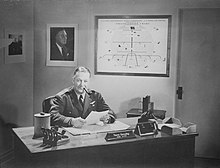
Cmdr. Thorne Donnelley, U.S.N.R., commander of the United States Naval Photographic Science Laboratory at Anacostia Naval Air Station, Washington, D.C.. USNPSL Thorne Donnelley 19.jpg
Cmdr. Thorne Donnelley, U.S.N.R., commander of the United States Naval Photographic Science Laboratory at Anacostia Naval Air Station, Washington, D.C..

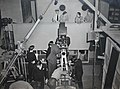
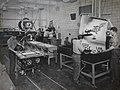
The laboratory was staffed by writers, directors, commentators, animators, cameramen, editors, sound engineers, and musicians. US Navy WAVES were actively involved in many stages of production. A sound stage on site at the Anacostia facility was capable of accommodating several productions simultaneously. The facility's production facilities had the capacity for developing and printing upward of one hundred million feet of film per year. [8]

During its first months of operation, the NPSL provided photographic services exclusively to the Navy, including the conducting of research to develop new photographic equipment and techniques in the areas of motion picture production, still photography, aerial photography, graphic arts and photolithography. It was responsible for providing secret and confidential services at the Anacostia facilities for printing and developing films in quantity and for the training of motion picture camera operators. It was the Navy's sole wartime unit for the production of both live action and animated training films.

During the last two years of the war, the laboratory had expanded its operations to provide production services for any military or governmental activity. The NPSL also served as a storehouse for copies of motion pictures and still photographs sent to the laboratory from war-time fleet and air base operations. This included, but was not limited to, the in theater work of the Naval Aviation Photographic Unit under the command of Cmdr. Edward Jean Steichen. Additionally, the laboratory was tasked with preserving and cataloging much of the historical photographic record of prior US military engagements, for all branches of service, dating as far back as the American Civil War.

In 1947, while maintaining its operations base at Anacostia, the NPSL was renamed the United States Naval Photographic Center (NPC). [9]

Footnotes

Related Research Articles

<span class="mw-page-title-main">Joint Base Anacostia–Bolling</span> US military installation in Washington, DC

Joint Base Anacostia–Bolling (JBAB) is a 905-acre (366 ha) military installation, located in Southwest Washington, D.C., established on 1 October 2010 in accordance with congressional legislation implementing the recommendations of the 2005 Base Realignment and Closure Commission. The legislation ordered the consolidation of Naval Support Facility Anacostia and Bolling Air Force Base (BAFB), which were adjoining but separate military installations into a single joint base, one of twelve formed in the country as a result of the law. The base hosts the Defense Intelligence Agency Headquarters amongst its other responsibilities. The only aeronautical facility at the base is a 100-by-100-foot helipad.

The Bureau of Aeronautics (BuAer) was the U.S. Navy's material-support organization for naval aviation from 1921 to 1959. The bureau had "cognizance" (i.e., responsibility) for the design, procurement, and support of naval aircraft and related systems. Aerial weapons, however, were under the cognizance of the Navy's Bureau of Ordnance (BuOrd).

<span class="mw-page-title-main">Alfred M. Pride</span> United States Navy admiral

Alfred Melville Pride was a United States Navy admiral and pioneer naval aviator, who distinguished himself during World War II as an aircraft carrier commander.
<span class="mw-page-title-main">Naval Air Station Patuxent River</span> Military naval air station and flight test centre in Maryland, United States

Naval Air Station Patuxent River, also known as NAS Pax River, is a United States naval air station located in St. Mary’s County, Maryland, on the Chesapeake Bay near the mouth of the Patuxent River.

<span class="mw-page-title-main">Naval Air Facility Washington</span> US Navy airfield near Camp Springs, Maryland, United States

Naval Air Facility Washington or NAF Washington is a United States Naval Reserve installation located near Camp Springs, Maryland in the United States of America. The facility was established at Andrews Air Force Base in 1958. As part of the 2005 Base Realignment and Closure (BRAC) program, it merged with Andrews Air Force Base in 2009, to create Joint Base Andrews-Naval Air Facility Washington.

<span class="mw-page-title-main">George William Goddard</span> US Air Force general, aerial photography pioneer (1889–1987)

George William Goddard was a United States Air Force brigadier general and a pioneer in aerial photography.
<span class="mw-page-title-main">Photographers Mate</span>

Photographers mate was a rating in the United States Navy's aviation and public affairs community. It was merged into the Mass communication specialist rating on 1 July 2006.

<span class="mw-page-title-main">Naval Support Facility Anacostia</span> United States Navy base in Washington, DC, United States

Naval Support Facility (NSF) Anacostia is a United States Naval Base in Washington, D.C., close to where the Anacostia River joins the Potomac River. On 1 October 2010 the base was conjoined with the adjacent Bolling Air Force Base to form the Joint Base Anacostia–Bolling in accordance with congressional legislation implementing the recommendations of the 2005 Base Realignment and Closure Commission. NSF Anacostia fell under the command of Naval Support Activity Washington.

<span class="mw-page-title-main">Gerald P. Pulley</span>

Gerald P. Pulley was an American photographer noted for his work with the United States Navy.

<span class="mw-page-title-main">Naval District Washington</span> One of eleven naval regions of the U.S. Navy

The Naval District Washington is one of eleven current naval regions responsible to Commander, Navy Installations Command for the operation and management of Naval shore installations in the Washington D.C. Metropolitan Area. The Commandant is currently the only remaining Naval Districts from the 1900s era, making it, by default the oldest of the current naval regions. The Commandant is headquartered at the Washington Navy Yard only a few yards away from the Commander, Navy Installations Command headquarters.

<span class="mw-page-title-main">Walter Stuart Diehl</span>

Walter Stuart Diehl was an American naval officer and aeronautical engineer.

<span class="mw-page-title-main">Naval Aviation Photographic Unit</span> Military unit

The Naval Aviation Photographic Unit was a group of military photographers in the United States Navy during the Second World War, under the command of Edward Steichen.

<span class="mw-page-title-main">Aviation in Washington, D.C.</span>

The United States capital, Washington, D.C., has been the site of several events in the nation's history of aviation, beginning from the time of the American Civil War, often for the purpose of promoting the adoption of new aeronautical technologies by the government. It has also been home to several governmental and civilian aircraft manufacturers and aviation organizations, and several aerospace contractors.

<span class="mw-page-title-main">Bolling Air Force Base</span> Air Force base in Washington, D.C., United States

Bolling Air Force Base or Bolling AFB is a United States Air Force base in Washington, D.C. In 2010, it was merged with Naval Support Facility Anacostia to form Joint Base Anacostia–Bolling. From its beginning, the installation has hosted elements of the Army Air Corps and Navy aviation and support elements.

<span class="mw-page-title-main">Joint Base Andrews</span> United States military facility located in Prince Georges County, Maryland

Joint Base Andrews (JBA) is a United States military facility located in Prince George's County, Maryland. The facility is under the jurisdiction of the United States Air Force (USAF) 316th Wing, Air Force District of Washington (AFDW). The base was established in 2009, when Andrews Air Force Base and Naval Air Facility Washington were merged.

<span class="mw-page-title-main">Henry C. Mustin Naval Air Facility</span>

Henry C. Mustin Naval Air Facility, also known as NAF Mustin Field, is a former military airfield located at the United States Navy Naval Aircraft Factory on board the Philadelphia Naval Shipyard, Philadelphia, Pennsylvania. It was in service from 1926 to 1963.

<span class="mw-page-title-main">Lookout Mountain Air Force Station</span> USAF movie studio and documentary unit, 1948-1967

Lookout Mountain Air Force Station (LMAFS) is a Formerly Used Defense Site which today is a private residence of actor Jared Leto in the Laurel Canyon neighborhood of Los Angeles, California. The USAF military installation produced motion pictures and still photographs for the United States Department of Defense and the Atomic Energy Commission (AEC) from 1947 to 1969.

<span class="mw-page-title-main">Naval Reserve Flying Corps</span>

The Naval Reserve Flying Corps (NRFC) was the first United States Navy reserve pilot procurement program. As part of demobilization following World War I the NRFC was completely inactive by 1922; but it is remembered as the origin of the naval aviation component of the United States Navy Reserve, the Naval Air Reserve.

Bruce McNeil was an American environmental fine arts photographer predominantly known for photographic work which has documented the Washington, DC area waterways. For over two decades his environmental photography has especially focused on documenting the Anacostia River. The Washington Examiner and The Washington Post have dubbed him as “DC River Man” and “Washington’s River Man.” He was the organizer of the Anacostia River School of Photography, "a ragtag group of a half-dozen photographers who either live or work in the neighborhood and are devoted to shooting the river and its environs." McNeill died on May 16, 2019, at the age of 80.

References

  1. https://catalog.archives.gov/id/10466012 National Archives Catalog: Department of the Navy. Bureau of Aeronautics. Naval Photographic Science Laboratory. (2/24/1943 - 1947)
  2. Bors, Joseph A. "Navy Photo Science Laboratory." Popular Photography, vol. 14, No. 5, May 1944 p. 34-35 & 87.
  3. DeForge, Gerald T. "Navy Photographer's Mate Training Series: Naval photography. Module 1, p. 2-15"
  4. DeForge, Gerald T. "Navy Photographer's Mate Training Series: Naval photography. Module 1, p. 2-16"
  5. DeForge, Gerald T. "Navy Photographer's Mate Training Series: Naval photography. Module 1, p. 2-16"
  6. DeForge, Gerald T. "Navy Photographer's Mate Training Series: Naval photography. Module 1, p. 2-16"
  7. DeForge, Gerald T. "Navy Photographer's Mate Training Series: Naval photography. Module 1, p. 2-16"
  8. Bors, Joseph A. "Navy Photo Science Laboratory." Popular Photography, vol. 14, No. 5, May 1944 p. 34-35 & 87.
  9. https://catalog.archives.gov/id/10466012 National Archives Catalog: Department of the Navy. Bureau of Aeronautics. Naval Photographic Science Laboratory. (2/24/1943 - 1947)