
Look up nerone in Wiktionary, the free dictionary.
Nerone may refer to:
Nerone may refer to:


Falstaff is a comic opera in three acts by the Italian composer Giuseppe Verdi. The Italian-language libretto was adapted by Arrigo Boito from the play The Merry Wives of Windsor and scenes from Henry IV, Part 1 and Part 2, by William Shakespeare. The work premiered on 9 February 1893 at La Scala, Milan.
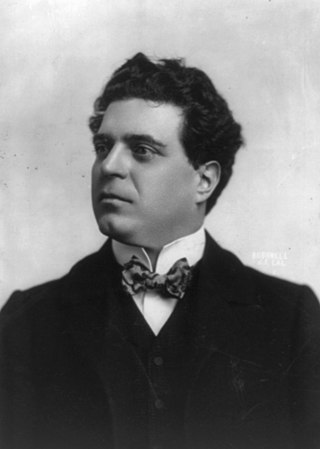
Pietro Mascagni was an Italian composer primarily known for his operas. His 1890 masterpiece Cavalleria rusticana caused one of the greatest sensations in opera history and single-handedly ushered in the Verismo movement in Italian dramatic music. While it was often held that Mascagni, like Ruggero Leoncavallo, was a "one-opera man" who could never repeat his first success, L'amico Fritz and Iris have remained in the repertoire in Europe since their premieres.

Arrigo Boito was an Italian librettist, composer, poet and critic whose only completed opera was Mefistofele. Among the operas for which he wrote the libretti are Giuseppe Verdi's monumental last two operas Otello and Falstaff as well as Amilcare Ponchielli's La Gioconda.
Nero (37–68) was emperor of the Roman Empire from 54 to 68.
Stoyanka Savova Nikolova, best known by her stage name Elena Nicolai, was a Bulgarian operatic mezzo-soprano.

Rosa Raisa was a Polish-born and Italian-trained Russian and Jewish operatic dramatic soprano who became a naturalized American. She possessed a voice of remarkable power and was the creator of the title role of Puccini's last opera, Turandot, at La Scala, Milan.

Nerone (Nero) is an opera in three acts by Pietro Mascagni from a libretto by Giovanni Targioni-Tozzetti, based on the 1872 play Nerone by Pietro Cossa. Most of Mascagni's music was drawn from a failed project Vistilia – the music made to 'fit' a wholly unconnected libretto.
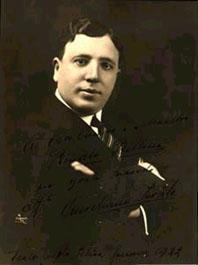
Aureliano Pertile was an Italian lyric tenor. Many critics consider him one of the most exciting operatic artists of the inter-war period, and one of the most important tenors of the 20th century.
Nerone (Nero) is an opera in four acts composed by Arrigo Boito, to a libretto in Italian written by the composer. The work is a series of scenes from Imperial Rome at the time of Emperor Nero depicting tensions between the Imperial religion and Christianity, and ends with the Great Fire of Rome. Boito died in 1918 before finishing the work.
Carlo Galeffi was a leading Italian baritone, particularly associated with the operatic works of Giuseppe Verdi and the various verismo composers.
Anda-Louise Bogza is a celebrated Romanian opera soprano. In 1994, she won both the First Prize and the Audience Prize at the Vienna International Singing Competition. In 2007, she was honored with the Thalia Award.
Emilio Venturini (1878–1952) was an Italian operatic lyric tenor known for his portrayal of character roles. He made his professional opera debut in 1900 in Italy where he remained for the next several years. In 1901 he sang the role of Brighella in Mascagni's Le maschere at the Teatro Regio in Turin. He made his La Scala debut in 1903 as Froh in Wagner's Das Rheingold and sang in the premiere of Umberto Giordano's Siberia. In 1904, he originated the role of Prince Yamadori in Puccini's Madama Butterfly at La Scala.

Lina Bruna Rasa was an Italian operatic dramatic soprano. She was particularly noted for her performances in the verismo repertoire and was a favourite of Pietro Mascagni who considered her the ideal Santuzza. Bruna Rasa created the roles of Atte in Mascagni's Nerone, Cecilia Sagredo in Franco Vittadini's La Sagredo and Saint Clare in Licinio Refice's 1926 oratorio, Trittico Francescano. She also sang the role of Tsaritsa Militrisa in the Italian premiere of Nikolai Rimsky-Korsakov's The Tale of Tsar Saltan.

Romilda Pantaleoni was an Italian dramatic soprano who had a prolific opera career in Italy during the 1870s and 1880s. She sang a wide repertoire that encompassed bel canto roles, Italian and French grand opera, verismo operas, and the German operas of Richard Wagner. She became particularly associated with the roles of Margherita in Boito's Mefistofele and the title role in Ponchielli's La Gioconda; two roles which she performed in opera houses throughout Italy. She is best remembered today for originating the roles of Desdemona in Giuseppe Verdi's Otello (1887) and Tigrana in Giacomo Puccini's Edgar (1889). Universally admired for her acting skills as well as her singing abilities, Pantaleoni was compared by several critics to the great Italian stage actress Eleonora Duse.
Christmas Eve is the evening or day before Christmas Day.

Francesco Marconi was an operatic tenor from Rome who enjoyed an important international career. In 1924, a reputable biographical dictionary of musicians called him 'one of the most renowned and esteemed singers of the last 50 years'. Along with his great contemporary Francesco Tamagno (1850–1905), he is the earliest Italian tenor to have left a representative legacy of acoustic recordings.

Maria Capuana was an Italian mezzo-soprano who had a major international opera career during the first half of the 20th century. She possessed a voice with a dark timbre that she used with great expression.

Maria Carbone was an Italian operatic soprano. She created the lead female roles in two of Gian Francesco Malipiero's operas: the title role in Ecuba and Cleopatra in Antonio e Cleopatra.
Cavalleria rusticana is an 1890 opera by Pietro Mascagni. The title may also refer to: