Jean Balue was a French cardinal and minister of Louis XI. Born without resources, he managed to climb the political ladder by exploiting connections, to whom he often did not remain loyal, and by making himself an indispensable agent of the king's purposes in a time of political disorder in France. His services were as much military as ecclesiastical, bringing him the critical task of defending the city of Paris against the King's enemies. His work as a diplomat in dealing with Duke Francis of Brittany and with Charles de France brought him the office of first minister to the King. Balue overreached himself in negotiating a treaty between the King and Charles the Bold, who had become Duke of Burgundy and was trying to recover all his family inheritance. Secret correspondence revealed that he might have been playing both sides in the negotiation, and he was arrested, and held on charges of treason from 1469 to 1481, while King and Pope argued over jurisdiction. After the death of King Louis and Pope Sixtus, the new French king, Charles VIII, appointed Balue his ambassador in Rome.
Unigenitus is an apostolic constitution in the form of a papal bull promulgated by Pope Clement XI in 1713. It opened the final phase of the Jansenist controversy in France. Unigenitus censured 101 propositions of Pasquier Quesnel as:
false, captious, ill-sounding, offensive to pious ears, scandalous, pernicious, rash, injurious to the Church and its practices, contumelious to Church and State, seditious, impious, blasphemous, suspected and savouring of heresy, favouring heretics, heresy, and schism, erroneous, bordering on heresy, often condemned, heretical, and reviving various heresies, especially those contained in the famous propositions of Jansenius.

Louis Antoine de Noailles, Cardinal de Noailles, second son of Anne de Noailles, 1st Duke of Noailles, was a French bishop and cardinal. His signing of the Unigenitus bull in 1728 would end the formal Jansenist controversy.

Jean Le Veneur, son of a Norman baron, was a French Abbot, Bishop, Courtier, royal official, and Roman Catholic cardinal.

The Archdiocese of Rouen is a Latin Church archdiocese of the Catholic Church in France. As one of the fifteen Archbishops of France, the Archbishop of Rouen's ecclesiastical province comprises the greater part of Normandy. The Archbishop of Rouen is currently Dominique Lebrun.

The Diocese of Coutances (–Avranches) is a Latin diocese of the Catholic Church in France. Its mother church is the Cathedral of Coutance in the commune of Coutances in France. The diocese is suffragan of the Archbishop of Rouen and comprises the entire department of Manche. It was enlarged in 1802 by the addition of the former Diocese of Avranches and of two archdeaconries from the Diocese of Bayeux. Since 1854 its bishops have held the title of Bishop of Coutances (–Avranches).

Antoine Sanguin was a French cleric, courtier and Cardinal. He was the second son of Antoine Sanguin, Seigneur de Meudon and Maître des Eaux-Forêts de l'Isle de France, Champagne et Brie; and Marie Simon, daughter of Jean Simon, Seigneur de Marquemont. The younger Antoine had a brother and three sisters; his sister Anne was married to Guillaume de Pisseleu. He was therefore the uncle of Anne de Pisseleu d'Heilly, mistress of François I, to whom he owed his ecclesiastical career; there is no record of his having taken holy orders.
The Grand Almoner of France was an officer of the French monarchy and a member of the Maison du Roi during the Ancien Régime. He directed the religious branch of the royal household also known as the Royal Chapel.

Jean-Baptiste Count de Belloy was an Archbishop of Paris and cardinal of the Catholic Church.

The Diocese of Châlons is a Latin Church ecclesiastical territory or diocese of the Catholic Church in Châlons-sur-Marne, France. The diocese comprises the department of Marne, excluding the arrondissement of Reims.

Arc-sur-Tille is a commune in the Côte-d'Or department in the Bourgogne-Franche-Comté region of eastern France.

Robert de Lenoncourt was a French bishop, Cardinal, and diplomat. He was the son of Thierry de Lenoncourt, Seigneur de Vignory, Councillor and Chamberlain of the King, and Jeanne de Ville. He had a brother, Henry, Sire de Lenoncourt and Baron of Vignory, a sister named Jacquette, who married Jean d'Aguerre, son of the Governor of Mouzon, and a sister named Nicole, who married Érard du Châtelet. Robert's paternal uncle, also called Robert de Lenoncourt, was Archbishop of Reims.

Alexandre Angélique de Talleyrand-Périgord was a French churchman and politician. He was the paternal uncle of Charles-Maurice de Talleyrand-Périgord (1754–1838).

The Diocese of Lisieux was a Roman Catholic ecclesiastical territory in France, centered on Lisieux, in Calvados. The bishop of Lisieux was the Ordinary of the Roman Catholic Diocese of Lisieux. The bishopric was suppressed during the French Revolution and was not reinstated. Present day Lisieux is part of the Diocese of Bayeux.
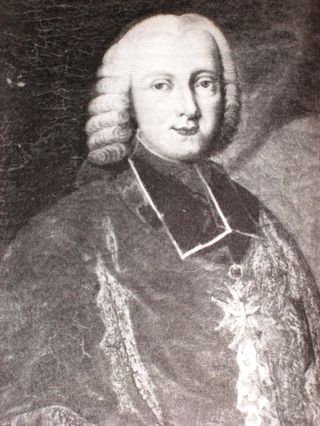
François-Armand-Auguste de Rohan-Soubise, Prince of Tournon, Prince of Rohan was a French prelate, Prince-Bishop of Strasbourg. His parents, Anne Julie de Melun and Jules, Prince de Soubise, both died of smallpox when he was still a child.

Louis César Constantin de Rohan was a French prelate of the House of Rohan.

Frédéric Jérôme de La Rochefoucauld was a French cardinal known as the Cardinal de La Rochefoucauld.

Georges II d'Amboise (1488–1550) was a French Roman Catholic bishop and cardinal.

Louis de La Vergne-Montenard de Tressan or Louis III de La Vergne de Tressan was a French cleric of the Roman Catholic Church, Archbishop of Rouen (France) from 17 October 1723 to 18 April 1733.