
Dominicus Corea also known as Domingos Corea and Edirille Rala, was the son of Don Jeronimo Corea and Anna Corea. Don Jeronimo Corea was also known as Mudaliyar Vikramasinha, Commander-in-Chief of King Mayadunne's army. Jeronimo Corea was executed by King Mayadunne's son, Rajasinghe. Dominicus Corea was born in Colombo in 1565. At that time, the Portuguese had colonised Ceylon, and his parents converted to Catholicism.

Rajasinghe I was a king of the Kingdom of Sitawaka who was known for his extreme bravery and patriotism against the Portuguese invasion of Sri Lanka. Born as Tikiri Bandara to King Mayadunne of the Kingdom of Sitawaka, he received the name "Rajasinha" after the fierce fighting against Portuguese forces at the Battle of Mulleriyawa. Rajasinha means the King of Lions.

Puviraja Pandaram ruled the Jaffna kingdom during a period of chaos during and after the death of his father Cankili I in 1565. He became king in 1561 following a local uprising against Cankili I. Although he was the nominal king, Cankili I wielded real power behind the throne until his death in 1565. After Cankili's death, Puviraja Pandaram lost power to one Kasi Nainar and Periyapillai. After the death or abdication of Periyapillai in 1582, Puviraja Pandarm was nominated as the king for the second time.

The Kingdom of Sitawaka was a kingdom located in south-central Sri Lanka. It emerged from the division of the Kingdom of Kotte following the Spoiling of Vijayabahu in 1521. Over the course of the next seventy years it came to dominate much of the island. Sitawaka also offered fierce resistance to the Portuguese, who had arrived on the island in 1505. Despite its military successes, Sitawaka remained unstable, having to contend with repeated uprisings in its restive Kandyan territories, as well as a wide-ranging and often devastating conflict with the Portuguese. Sitawaka disintegrated soon after the death of its last king Rajasimha I in 1593.
Mayadunne (1501–1581) was a king of the Kingdom of Sitawaka, who ruled for 60 years between 1521 and 1581. Mayadunne was a fierce opponent of the Portuguese, who had arrived on the Island in 1505. He devoted his whole life attempting to oust his brother Bhuvanekabahu, the king of Kotte and thereby preserve the independence of Lanka, which was being undermined by the Portuguese intrigue. He constantly invaded the territory of Bhuvanekabahu of Kotte.
The Battle of Mulleriyawa in 1559 was part of the Sinhalese–Portuguese War. It was one of the most decisive battles in Sri Lankan history and considered as the worst defeat of Portuguese during that period. According to local chronicles the marshlands of Mulleriyawa turned red with blood after the annihilation of the Portuguese. With this victory Sitawaka emerged as a military power which able to challenge the Portuguese expansion.
The Vijayabā Kollaya took place in the Kingdom of Kotte in 1521. The three sons of the reigning king Vijayabahu VI mutinied against their father, killing him, and divided the Kingdom among themselves. The three sons were products of the king's first marriage and were named Bhuvanekabahu, Pararajasingha and Mayadunne. Queen Kiravella, whom the king married second, had a son named Deva Rajasinghe by her previous marriage. The princes overheard that the king intended to make Devaraja the heir to the throne, at the request of his second queen, and became hostile to the king, and hired a foreigner to murder the king in the palace.

The Kingdom of Kotte, named after its capital, Kotte, was a Sinhalese kingdom that flourished in Sri Lanka during the 15th century.

Kusumāsana Devi, also known as Dona Catherina, was ruling Queen of Kandy in 1581. She was deposed, but queen consort of Kandy by marriage to Vimaladharmasuriya I of Kandy from 1594 to 1604.
Bhuvanaikabahu VII was King of Kotte in the sixteenth century, who ruled from 1521 to 1551. He was the eldest son of Vijayabahu VII of Kotte, whom he succeeded, and his chief queen Anula Kahatuda. He was born in 1468 and his brothers were Mayadunne of Sitawaka and Rayigam Bandara. After his father married a second time, his new queen brought a son from another relationship called Deva Rajasinghe, who the king intended to pass on the crown to, and Bhuvanaikabahu and his two brothers responded by fleeing the kingdom, and on their return they had an army given by the King of Kandy.

The Edirimanne Corea Family Union (ECFU) is a group set up to 'foster interaction' among the members of the powerful Corea family in the island of Sri Lanka. The Corea family is one of the leading families of Sri Lanka. They trace their ancestry to Dominicus Corea also known as Edirille Rala who was crowned King of Kotte and Sitawaka in Sri Lanka - Dominicus Corea was born in Colombo in 1565.
The siege of Kotte from November 1557 – November 1558 was a battle part of the Sinhalese–Portuguese War. A 50,000 strong Sitawaka army led by King Mayadunne besieged Sri Jayawardenapura Kotte, the capital of Kotte Kingdom, for 12 months against a combined force of Portuguese and Lascarins led by Captain-major Dom Afonso Pereira de Lacerda. After receiving reinforcements from Mannar, Portuguese made a sally and succeeded in forcing the besiegers to withdraw. This siege marked the beginning of a series of battles between Portuguese and Sitawaka forces, and ultimately ended as Portuguese abandoned Sri Jayawardenapura Kotte in 1565.
The Danture campaign comprised a series of encounters between the Portuguese and the Kingdom of Kandy in 1594, part of the Sinhalese–Portuguese War. It is considered a turning point in the indigenous resistance to Portuguese expansion. For the first time in Sri Lanka a Portuguese army was essentially annihilated, when they were on the verge of the total conquest of the island. A 20,000-strong Portuguese army, led by Governor Pedro Lopes de Sousa, invaded Kandy on 5 July 1594. After three months, severely depleted by guerilla warfare and mass desertions, what remained of the Portuguese army was annihilated at Danture by the Kandyans under King Vimaladharmasuriya. With this victory, the Kingdom of Kandy emerged as a major military power; it was to retain its independence, against Portuguese, Dutch, and British armies, until 1815.
The Sinhalese–Portuguese War was a series of conflicts waged from 1527 to 1658 in Sri Lanka between the native Sinhalese kingdoms against the Portuguese Empire. It spanned from the Transitional to the Kandyan periods of Sri Lankan history. A combination of political and military moves gained the Portuguese control over most of the island, but their invasion of the final independent kingdom was a disaster, leading to a stalemate in the wider war and a truce from 1621. In 1638 the war restarted when the Dutch East India Company intervened in the conflict, initially as an ally of the Sinhalese against the Portuguese, but later as an enemy of both sides. The war concluded in 1658, with the Dutch in control of about half the island, the Kingdom of Kandy the other half, and the Portuguese expelled.
House of Siri Sanga Bo was a powerful dynasty which ruled parts of Sri Lanka from Vijayabahu III of Dambadeniya (1220–1224) until Rajasinha I of Sitawaka (1581–1591). Vijayabahu III of Dambadeniya routed Kalinga Magha's armies from Maya Rata and established his fortress at Dambadeniya. This dynasty was able to protect their independence by facing so many foreign invasions thereafter. They had to change their capital city to Dambadeniya, Yapahuwa and Kurunagala because of continuous invasions from southern India.
Veediya Bandara was the commander-in-chief of the Kingdom of Kotte, Sri Lanka, during the reign of Bhuvanaikabahu VII of Kotte (1521–1551). He was a gifted warrior and widely regarded as one of the greatest generals of Sri Lankan history. Well known for his prowess of warfare, he was the central figure of the Kotte army, in a series of relentless wars against King Mayadunne of Sitawaka and occasionally, against the Portuguese. Being impetuous by nature, he got himself involved in many scandals, including the murder of his wife, Samudra Deviya, the daughter of his king.
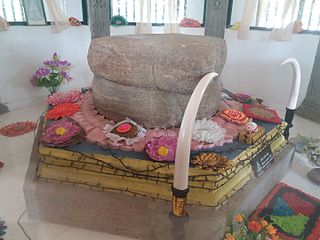
Delgamuwa Raja Maha Vihara is an ancient Buddhist temple situated in Kuruvita of Ratnapura District, Sri Lanka. This temple is reputed as the hiding place of the tooth relic of Buddha during the ruling period of Portuguese in the country.
Kuruvita Rala was a Sri Lankan rebel leader and prince of Uva, who served as regent in the kingdom of Kandy. He was also a relation of Dona Catherina, Queen of Kandy and the guardian of her children.
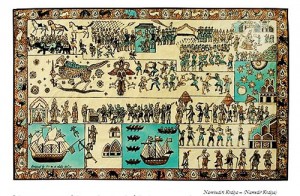
Maggona Arachchi is a Sinhalese speaking Khandayat ethnic group of Sri Lanka. The House of Kaikesi Irugal migrated from Odisha in the 13th Century, claiming lineage to the Yadava royalty in the Kingdom of Kalinga in Eastern India. They are probably related to Khandayat people.
Rajasuriya was a king of Sitawaka and the successor of Rajasimha I, in 1597. Although proclaimed as monarch, most regions of his kingdom were vastly dissolved with the sudden demise of his grandfather. He reigned for a few months until he was assassinated by his chief minister, Ariṭṭakīvendu.


