Related Research Articles

A shipyard, also called a dockyard or boatyard, is a place where ships are built and repaired. These can be yachts, military vessels, cruise liners or other cargo or passenger ships. Compared to shipyards, which are sometimes more involved with original construction, dockyards are sometimes more linked with maintenance and basing activities. The terms are routinely used interchangeably, in part because the evolution of dockyards and shipyards has often caused them to change or merge roles.

BLRT Western Shipyard is a shipyard in Klaipėda, Lithuania. The company belongs to the Estonian company BLRT Grupp and provides shipbuilding and repair services in the Baltic region.

A floating production storage and offloading (FPSO) unit is a floating vessel used by the offshore oil and gas industry for the production and processing of hydrocarbons, and for the storage of oil. An FPSO vessel is designed to receive hydrocarbons produced by itself or from nearby platforms or subsea template, process them, and store oil until it can be offloaded onto a tanker or, less frequently, transported through a pipeline. FPSOs are preferred in frontier offshore regions as they are easy to install, and do not require a local pipeline infrastructure to export oil. FPSOs can be a conversion of an oil tanker or can be a vessel built specially for the application. A vessel used only to store oil is referred to as a floating storage and offloading (FSO) vessel.
Odense Steel Shipyard was a Danish shipyard company located in Odense. It was best known for building container ships for its parent group, A.P. Moller – Maersk Group, including the Mærsk E class in 2006 which at the time were the biggest container ships in the world. The global financial crisis led to Maersk announcing its closure in 2009 and the last new ship was delivered in January 2012.

Malaysia Marine and Heavy Engineering Holdings Berhad is a Malaysian owned shipbuilding and heavy engineering industries company. It was formerly known as Malaysia Shipyard and Engineering Sdn Bhd. MHB has been long involved in oil and gas engineering and construction works.

Davie Shipbuilding is a shipbuilding company located in Lauzon, Quebec, Canada. The facility is now operating as Chantier Davie Canada Inc. and is the oldest continually operating shipbuilder in North America.
Samsung Heavy Industries Co., Ltd. (Korean: 삼성중공업) is one of the largest shipbuilders in the world and one of the "Big Three" shipbuilders of South Korea. Geoje is one of the largest shipyards in the world, having 3 dry docks and 5 floating docks. A core subsidiary of the Samsung Group, South Korea's largest conglomerate, SHI's main focus is on the engineering, procurement, construction, commissioning and the delivery of: transportation ships for the commercial industry, topsides modules, drilling and floating production units for the oil and gas sector, gantry cranes for fabrication yards, digital instrumentation and control devices for ships, and other construction and engineering services.
HD Hyundai Samho (Korean: HD현대삼호) is the world's largest dockyard and produces approximately 40 vessels per year. Its yard is located in Samho-eup, Yeongam, South Korea.
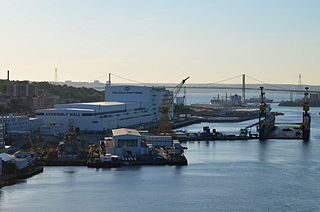
The Halifax Shipyard Limited is a Canadian shipbuilding company located in Halifax, Nova Scotia.

Hanwha Ocean Co., Ltd., formerly known as Daewoo Shipbuilding & Marine Engineering, is one of the "Big Three" shipbuilders of South Korea, along with Hyundai and Samsung.
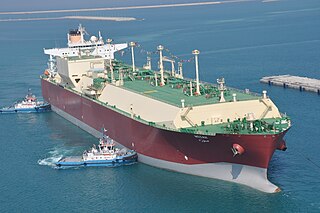
Q-Max is a type of ship, specifically a membrane type LNG carrier. In the name Q-Max, "Q" stands for Qatar and "Max" for the maximum size of ship able to dock at the Liquefied natural gas (LNG) terminals in Qatar. Ships of this type are the largest LNG carriers in the world.
Davie Yards Incorporated was a ship building unit of TECO Group of Norway and is the successor to Davie Shipbuilding and MIL-Davie Shipbuilding from 2006 to 2011.
A floating liquefied natural gas (FLNG) facility is a floating production storage and offloading unit that conducts liquefied natural gas (LNG) operations for developing offshore natural gas resources. Floating above an offshore natural gas field, the FLNG facility produces liquefied stores and transfers LNG at sea before carriers ship it directly to markets.

Valemax ships are a fleet of very large ore carriers (VLOC) owned or chartered by the Brazilian mining company Vale S.A. to carry iron ore from Brazil to European and Asian ports. With a capacity ranging from 380,000 to 400,000 tons deadweight, the vessels meet the Chinamax standard of ship measurements for limits on draft and beam. Valemax ships are the largest bulk carriers ever constructed, when measuring deadweight tonnage or length overall, and are amongst the longest ships of any type currently in service.

The Tide-class tanker (formerly the Military Afloat Reach and Sustainability (MARS) project) is a class of four fast fleet tankers that entered service with the British Royal Fleet Auxiliary from 2017. The 37,000 t ships provide fuel, food, fresh water, ammunition and other supplies to Royal Navy vessels around the world. Norway ordered a similar 26,000 t version with a 48-bed hospital and greater solid stores capacity, but reduced liquid capacity; it was delivered in November 2018 as HNoMS Maud two years after originally planned. The two classes are very similar but are not directly comparable due to large variance in capabilities delivered.
Prelude FLNG is a floating liquefied natural gas (FLNG) platform owned by Shell plc and built by the Technip–Samsung Consortium (TSC) in South Korea for a joint venture between Royal Dutch Shell, KOGAS, and Inpex. The hull was launched in December 2013.

Maersk Mc-Kinney Moller is the first ship of Maersk Line's Triple E class of container vessels. At the time of its entry into service in 2013, it had the largest cargo capacity in twenty-foot equivalent unit (TEU) of any vessel, and was the longest container ship in service worldwide. Constructed for Maersk by Daewoo Shipbuilding & Marine Engineering (DSME) of South Korea, it was launched in February 2013 and began operational service during July 2013. It was named for Mærsk Mc-Kinney Møller, the CEO of Maersk from 1965 to 1993. The ship is the first of a class of 20 identical vessels.

Hudong–Zhonghua Shipbuilding is a subsidiary of China State Shipbuilding Corporation (CSSC). It produces civilian and military ships. Hudong–Zhonghua claims to be the "Cradle of Chinese Frigates and Landing Ships" for its work for the People's Liberation Army Navy.

Imabari Shipbuilding is a major Japanese ship building, marine engineering, and service company headquartered in Imabari, Ehime Prefecture, Japan.

The first plant, Sakhalin II, was completed in Russia in 2009 having utilised the skills of Shell plc, who had sold 50% of the project to Gazprom in 2006. Prior to 2017 Gazprom was the sole producer of Liquefied Natural Gas (LNG) in Russia.
References
- ↑ "Asian players land bigger fish". Oil Online. Retrieved 22 December 2012.
- ↑ "Daewoo Building Biggest Floating Dock (South Korea)". LNG World News. Retrieved 22 December 2012.
- ↑ "DSME begins construction of world's largest floating dock". Ship-Technology. 23 November 2011. Retrieved 22 December 2012.
- ↑ "DSME to Construct World's Largest Floating Dock". Rig Zone. Retrieved 22 December 2012.
- ↑ "DSME starts construction of world's largest floating dock". Marinelog. 21 November 2011. Retrieved 22 December 2012.