
In the mathematical field of graph theory, a bipartite graph is a graph whose vertices can be divided into two disjoint and independent sets and , that is every edge connects a vertex in to one in . Vertex sets and are usually called the parts of the graph. Equivalently, a bipartite graph is a graph that does not contain any odd-length cycles.

In computer science, the clique problem is the computational problem of finding cliques in a graph. It has several different formulations depending on which cliques, and what information about the cliques, should be found. Common formulations of the clique problem include finding a maximum clique, finding a maximum weight clique in a weighted graph, listing all maximal cliques, and solving the decision problem of testing whether a graph contains a clique larger than a given size.

In graph theory, a vertex cover of a graph is a set of vertices that includes at least one endpoint of every edge of the graph.
In computer science, parameterized complexity is a branch of computational complexity theory that focuses on classifying computational problems according to their inherent difficulty with respect to multiple parameters of the input or output. The complexity of a problem is then measured as a function of those parameters. This allows the classification of NP-hard problems on a finer scale than in the classical setting, where the complexity of a problem is only measured as a function of the number of bits in the input. The first systematic work on parameterized complexity was done by Downey & Fellows (1999).
In graph theory, the metric dimension of a graph G is the minimum cardinality of a subset S of vertices such that all other vertices are uniquely determined by their distances to the vertices in S. Finding the metric dimension of a graph is an NP-hard problem; the decision version, determining whether the metric dimension is less than a given value, is NP-complete.
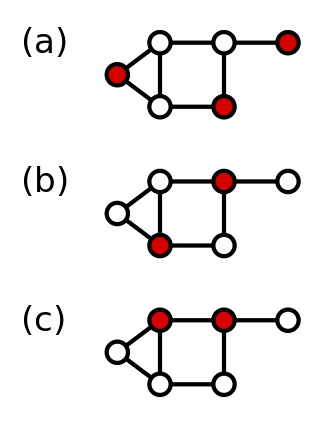
In graph theory, a dominating set for a graph G is a subset D of its vertices, such that any vertex of G is either in D, or has a neighbor in D. The domination numberγ(G) is the number of vertices in a smallest dominating set for G.

In graph theory, a maximal independent set (MIS) or maximal stable set is an independent set that is not a subset of any other independent set. In other words, there is no vertex outside the independent set that may join it because it is maximal with respect to the independent set property.
In the mathematical discipline of graph theory, a feedback vertex set (FVS) of a graph is a set of vertices whose removal leaves a graph without cycles. Equivalently, each FVS contains at least one vertex of any cycle in the graph. The feedback vertex set number of a graph is the size of a smallest feedback vertex set. The minimum feedback vertex set problem is an NP-complete problem; it was among the first problems shown to be NP-complete. It has wide applications in operating systems, database systems, and VLSI chip design.
In graph theory, a connected dominating set and a maximum leaf spanning tree are two closely related structures defined on an undirected graph.
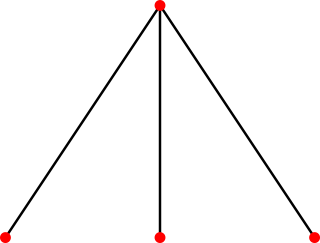
In graph theory, an area of mathematics, a claw-free graph is a graph that does not have a claw as an induced subgraph.
In computer science, a kernelization is a technique for designing efficient algorithms that achieve their efficiency by a preprocessing stage in which inputs to the algorithm are replaced by a smaller input, called a "kernel". The result of solving the problem on the kernel should either be the same as on the original input, or it should be easy to transform the output on the kernel to the desired output for the original problem.
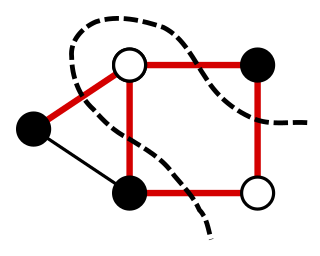
For a graph, a maximum cut is a cut whose size is at least the size of any other cut. That is, it is a partition of the graph's vertices into two complementary sets S and T, such that the number of edges between S and T is as large as possible. Finding such a cut is known as the max-cut problem.
Bidimensionality theory characterizes a broad range of graph problems (bidimensional) that admit efficient approximate, fixed-parameter or kernel solutions in a broad range of graphs. These graph classes include planar graphs, map graphs, bounded-genus graphs and graphs excluding any fixed minor. In particular, bidimensionality theory builds on the graph minor theory of Robertson and Seymour by extending the mathematical results and building new algorithmic tools. The theory was introduced in the work of Demaine, Fomin, Hajiaghayi, and Thilikos, for which the authors received the Nerode Prize in 2015.
In the mathematical field of graph theory, the intersection number of a graph is the smallest number of elements in a representation of as an intersection graph of finite sets. In such a representation, each vertex is represented as a set, and two vertices are connected by an edge whenever their sets have a common element. Equivalently, the intersection number is the smallest number of cliques needed to cover all of the edges of .
In the study of graph algorithms, Courcelle's theorem is the statement that every graph property definable in the monadic second-order logic of graphs can be decided in linear time on graphs of bounded treewidth. The result was first proved by Bruno Courcelle in 1990 and independently rediscovered by Borie, Parker & Tovey (1992). It is considered the archetype of algorithmic meta-theorems.
In the parameterized complexity of algorithms, the klam value of a parameterized algorithm is a number that bounds the parameter values for which the algorithm might reasonably be expected to be practical. An algorithm with a higher klam value can be used for a wider range of parameter values than another algorithm with a lower klam value. The klam value was first defined by Downey and Fellows (1999), and has since been used by other researchers in parameterized complexity both as a way of comparing different algorithms to each other and in order to set goals for future algorithmic improvements.
In computer science, iterative compression is an algorithmic technique for the design of fixed-parameter tractable algorithms, in which one element is added to the problem in each step, and a small solution for the problem prior to the addition is used to help find a small solution to the problem after the step.
In the mathematical fields of graph theory and finite model theory, the logic of graphs deals with formal specifications of graph properties using sentences of mathematical logic. There are several variations in the types of logical operation that can be used in these sentences. The first-order logic of graphs concerns sentences in which the variables and predicates concern individual vertices and edges of a graph, while monadic second-order graph logic allows quantification over sets of vertices or edges. Logics based on least fixed point operators allow more general predicates over tuples of vertices, but these predicates can only be constructed through fixed-point operators, restricting their power.

In graph theory, an odd cycle transversal of an undirected graph is a set of vertices of the graph that has a nonempty intersection with every odd cycle in the graph. Removing the vertices of an odd cycle transversal from a graph leaves a bipartite graph as the remaining induced subgraph.
The twin-width of an undirected graph is a natural number associated with the graph, used to study the parameterized complexity of graph algorithms. Intuitively, it measures how similar the graph is to a cograph, a type of graph that can be reduced to a single vertex by repeatedly merging together twins, vertices that have the same neighbors. The twin-width is defined from a sequence of repeated mergers where the vertices are not required to be twins, but have nearly equal sets of neighbors.


