
A miniature is a small illustration used to decorate an ancient or medieval illuminated manuscript; the simple illustrations of the early codices having been miniated or delineated with that pigment. The generally small scale of such medieval pictures has led to etymological confusion with minuteness and to its application to small paintings, especially portrait miniatures, which did however grow from the same tradition and at least initially used similar techniques.

Reza Abbasi, also known as Aqa Reza, was the leading Persian miniaturist of the Isfahan School during the later Safavid period, spending most of his career working for Shah Abbas I. He is considered to be the last great master of the Persian miniature, best known for his single miniatures for muraqqa or albums, especially single figures of beautiful youths.

Mughal painting is a South Asian style of painting on paper confined to miniatures either as book illustrations or as single works to be kept in albums (muraqqa), originating from the territory of the Mughal Empire in the Indian subcontinent. It emerged from Persian miniature painting and developed in the court of the Mughal Empire of the 16th to 18th centuries. Battles, legendary stories, hunting scenes, wildlife, royal life, mythology, as well as other subjects have all been frequently depicted in paintings.

A Persian miniature is a small Persian painting on paper, whether a book illustration or a separate work of art intended to be kept in an album of such works called a muraqqa. The techniques are broadly comparable to the Western Medieval and Byzantine traditions of miniatures in illuminated manuscripts. Although there is an equally well-established Persian tradition of wall-painting, the survival rate and state of preservation of miniatures is better, and miniatures are much the best-known form of Persian painting in the West, and many of the most important examples are in Western, or Turkish, museums. Miniature painting became a significant genre in Persian art in the 13th century, receiving Chinese influence after the Mongol conquests, and the highest point in the tradition was reached in the 15th and 16th centuries. The tradition continued, under some Western influence, after this, and has many modern exponents. The Persian miniature was the dominant influence on other Islamic miniature traditions, principally the Ottoman miniature in Turkey, and the Mughal miniature in the Indian sub-continent.
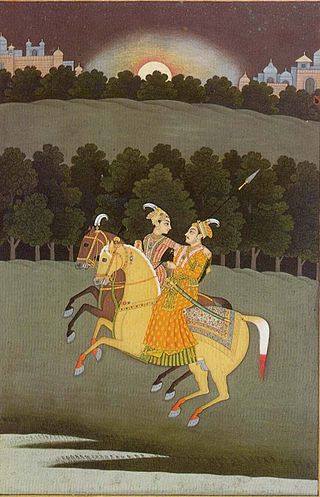
Rani Roopmati (kavi roopmati) was a Poet queen of Mandu and the consort of the Sultan of Malwa, Baz Bahadur. Roopmati features prominently in the folklores of Malwa, which often describe the romance of the Sultan and his consort.
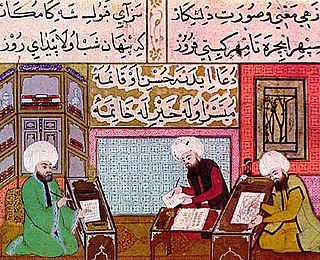
Ottoman miniature is a style of illustration found in Ottoman manuscripts, often depicting portraits or historic events. Its unique style was developed from multiple cultural influences, such as the Persian Miniature art, as well as Byzantine and Mongol art. It was a part of the Ottoman book arts, together with illumination (tezhip), calligraphy (hat), marbling paper (ebru), and bookbinding (cilt). The words taswir or nakish were used to define the art of miniature painting in Ottoman Turkish.
Yusuf and Zulaikha is a title given to many tellings in the Muslim world of the story of the relationship between the prophet Yusuf and Potiphar's wife. Developed primarily from the account in Sura 12 of the Qur'an, a distinct story of Yusuf and Zulaikha seems to have developed in Persia around the tenth century CE. According to Agnès Kefeli, "in the biblical and Qur’anic interpretations of Joseph's story, Potiphar's wife bears all the blame for sin and disappears quickly from the narrative". But "in Turkic and Persian literatures, Joseph and Zulaykha do, ultimately, become sexually united, in parallel to their noncorporeal mystical union". The story of Yusuf and Zulaikha is subsequently found in many languages, such as Arabic, Persian, Bengali, Turkish, Punjabi and Urdu. Its most famous version was written in the Persian language by Jami (1414–1492), in his Haft Awrang.
The composite Turko-Persian, Turco-Persian, or Turco-Iranian is the distinctive culture that arose in the 9th and 10th centuries AD in Khorasan and Transoxiana. According to the modern historian Robert L. Canfield, the Turco-Persian tradition was Persianate in that it was centered on a lettered tradition of Iranian origin; it was Turkic in so far as it was for many generations patronized by rulers of Turkic ancestry; and it was "Islamicate" in that Islamic notions of virtue, permance, and excellence infused discourse about public issues as well as the religious affairs of the Muslims, who were the presiding elite."

'Abd al-Ṣamad or Khwaja 'Abd-us-Ṣamad was a 16th century painter of Persian miniatures who moved to India and became one of the founding masters of the Mughal miniature tradition, and later the holder of a number of senior administrative roles. 'Abd's career under the Mughals, from about 1550 to 1595, is relatively well documented, and a number of paintings are authorised to him from this period. From about 1572 he headed the imperial workshop of the Emperor Akbar and "it was under his guidance that Mughal style came to maturity". It has recently been contended by a leading specialist, Barbara Brend, that Samad is the same person as Mirza Ali, a Persian artist whose documented career seems to end at the same time as Abd al-Samad appears working for the Mughals.
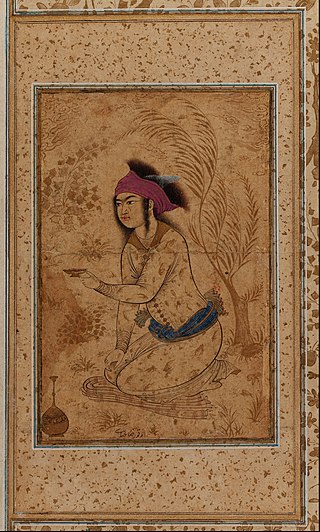
A Muraqqa is an album in book form containing Islamic miniature paintings and specimens of Islamic calligraphy, normally from several different sources, and perhaps other matter. The album was popular among collectors in the Islamic world, and by the later 16th century became the predominant format for miniature painting in the Persian Safavid, Mughal and Ottoman empires, greatly affecting the direction taken by the painting traditions of the Persian miniature, Ottoman miniature and Mughal miniature. The album largely replaced the full-scale illustrated manuscript of classics of Persian poetry, which had been the typical vehicle for the finest miniature painters up to that time. The great cost and delay of commissioning a top-quality example of such a work essentially restricted them to the ruler and a handful of other great figures, who usually had to maintain a whole workshop of calligraphers, artists and other craftsmen, with a librarian to manage the whole process.
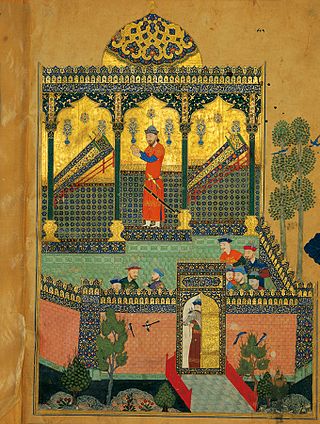
Ghiyath ud-din Baysunghur commonly known as Baysonqor or Baysongor, Baysonghor or (incorrectly) as Baysunqar, also called Sultan Bāysonḡor Bahādor Khan (1397–1433) was a prince of the Timurid dynasty. He was known as a patron of arts and architecture, the leading patron of the Persian miniature in Iran, commissioning the Baysunghur Shahnameh and other works, as well as being a prominent calligrapher.
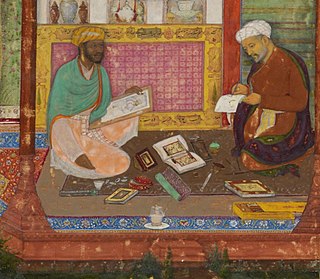
The illuminated manuscript Khamsa of Nizami British Library, Or. 12208 is a lavishly illustrated manuscript of the Khamsa or "five poems" of Nizami Ganjavi, a 12th-century Persian poet, which was created for the Mughal Emperor Akbar in the early 1590s by a number of artists and a single scribe working at the Mughal court, very probably in Akbar's new capital of Lahore in North India, now in Pakistan. Apart from the fine calligraphy of the Persian text, the manuscript is celebrated for over forty Mughal miniatures of the highest quality throughout the text; five of these are detached from the main manuscript and are in the Walters Art Museum, Baltimore as Walters Art Museum MS W.613. The manuscript has been described as "one of the finest examples of the Indo-Muslim arts of the book", and "one of the most perfect of the de luxe type of manuscripts made for Akbar".

Prince Ibrahim Mirza, Solṭān Ebrāhīm Mīrzā, in full Abu'l Fat'h Sultan Ibrahim Mirza was a Persian prince of the Safavid dynasty, who was a favourite of his uncle and father-in-law Shah Tahmasp I, but who was executed by Tahmasp's successor, the Shah Ismail II. Ibrahim is now mainly remembered as a patron of the arts, especially the Persian miniature. Although most of his library and art collection was apparently destroyed by his wife after his murder, surviving works commissioned by him include the manuscript of the Haft Awrang of the poet Jami which is now in the Freer Gallery of Art in Washington D.C.
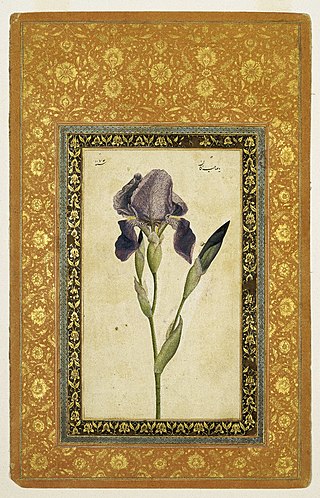
Muhammad Zaman ibn Haji Yusuf Qumi, known as Mohammad Zaman, was a famous Safavid calligrapher and painter.

The Shahnameh of Shah Tahmasp or Houghton Shahnameh is one of the most famous illustrated manuscripts of the Shahnameh, the national epic of Greater Iran, and a high point in the art of the Persian miniature. It is probably the most fully illustrated manuscript of the text ever produced. When created, the manuscript contained 759 pages, 258 of which were miniatures. These miniatures were hand-painted by the artists of the royal workshop in Tabriz under rulers Shah Ismail I and Shah Tahmasp I. Upon its completion, the Shahnameh was gifted to Ottoman Sultan Selim II in 1568. The page size is about 48 x 32 cm, and the text written in Nastaʿlīq script of the highest quality. The manuscript was broken up in the 1970s and pages are now in a number of different collections around the world.
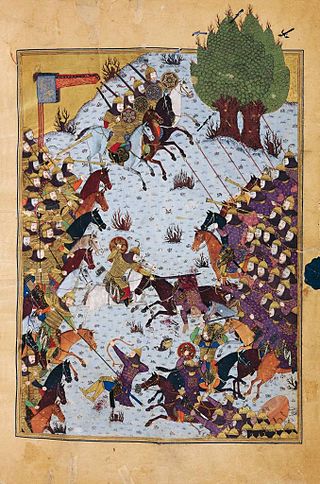
The Baysunghur Shahnameh is an illustrated manuscript of the Shahnameh, the national epic of Greater Iran. The work on this manuscript was started in 1426 at the order of Baysunghur Mirza, the Timurid prince, and was completed on 5 Jumada 833,. It is now in the museum of The Golestan Palace, in Tehran, Iran, and regarded as a key masterpiece of the Persian miniature.

The Great Mongol Shahnameh also known as the Demotte Shahnameh or Great Ilkhanid Shahnama, is an illustrated manuscript of the Shahnameh, the national epic of Greater Iran, probably dating to the 1330s. In its original form, which has not been recorded, it was probably planned to consist of about 280 folios with 190 illustrations, bound in two volumes, although it is thought it was never completed. It is the largest early book in the tradition of the Persian miniature, in which it is "the most magnificent manuscript of the fourteenth century", "supremely ambitious, almost awe-inspiring", and "has received almost universal acclaim for the emotional intensity, eclectic style, artistic mastery and grandeur of its illustrations".
Indian cookbooks are cookbooks written in India, or about Indian cooking. Some of the oldest cookbooks were written in India Indian cooking varies regionally and has evolved over the centuries due to various influences. Vegetarianism has made a significant impact on Indian cooking. Spices play a major role in Indian cooking.
The Ni'matnāmah Naṣir al-Dīn Shāhī, is a medieval Indian cookbook, written in Persian language in Naskh script, of delicacies and recipes, some accompanied by paintings illustrating the preparation of the dishes. It was started for Ghiyath Shah, the ruler of the Malwa Sultanate in central India. After he was forced to abdicate, it was completed for his son 'Abd al-Muzaffar Naṣir Shāh..
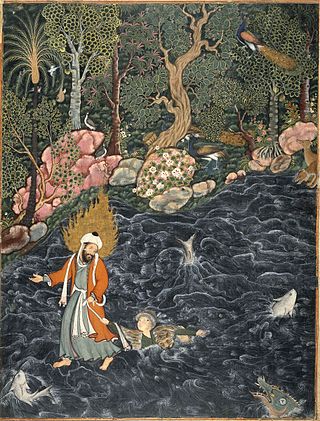
The Akbar Hamzanama is an enormous illustrated manuscript, now fragmentary, of the Persian epic Hamzanama commissioned by the Mughal emperor Akbar around 1562.


