The Norwegian Movement for Vietnam (Norwegian : Vietnambevegelsen i Norge) was a Norwegian advocacy group.
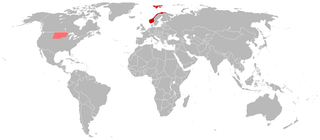
Norwegian is a North Germanic language spoken mainly in Norway, where it is the official language. Along with Swedish and Danish, Norwegian forms a dialect continuum of more or less mutually intelligible local and regional varieties; some Norwegian and Swedish dialects, in particular, are very close. These Scandinavian languages, together with Faroese and Icelandic as well as some extinct languages, constitute the North Germanic languages. Faroese and Icelandic are not mutually intelligible with Norwegian in their spoken form because continental Scandinavian has diverged from them. While the two Germanic languages with the greatest numbers of speakers, English and German, have close similarities with Norwegian, neither is mutually intelligible with it. Norwegian is a descendant of Old Norse, the common language of the Germanic peoples living in Scandinavia during the Viking Era.
Advocacy groups, also known as special interest groups, use various forms of advocacy in order to influence public opinion and ultimately policy. They play an important role in the development of political and social systems.
Its purpose was to convey friendship and solidarity with "people of Indochina", opposing the Vietnam War. It was created in January 1968 as an offshoot of the Norwegian Solidarity Committee for Vietnam, which had been hijacked by the Socialist Youth League (SUF) to the dismay of the Workers' Youth League. Eventually, the Movement for Vietnam was joined by Socialist Youth, the Young Communist League as well as various trade unions and women's organizations. [1]
The Vietnam War, also known as the Second Indochina War, and in Vietnam as the Resistance War Against America or simply the American War, was a conflict in Vietnam, Laos, and Cambodia from 1 November 1955 to the fall of Saigon on 30 April 1975. It was the second of the Indochina Wars and was officially fought between North Vietnam and South Vietnam. North Vietnam was supported by the Soviet Union, China, and other communist allies; South Vietnam was supported by the United States, South Korea, the Philippines, Australia, Thailand and other anti-communist allies. The war, considered a Cold War-era proxy war by some, lasted 19 years, with direct U.S. involvement ending in 1973, and included the Laotian Civil War and the Cambodian Civil War, which ended with all three countries becoming communist in 1975.
The Workers' Youth League is Norway's largest political youth organization and is affiliated with the Norwegian Labour Party.

Socialist Youth is the youth league of the Socialist Left Party of Norway. The current head of the organisation is Andreas Unneland. SU considers itself a revolutionary party and wants to gain popular support for socialism in Norway. In this respect it differs from SV, the mother party.
Leaders of the Movement for Vietnam include Arne Kokkvoll (1969–1972), [2] MP Tove Pihl (1973–1974), [3] and Jostein Nyhamar. [4]
Arne Kokkvoll was a Norwegian historian, librarian/archivist and politician for the Labour Party.
Tove Agnethe Pihl was a Norwegian educator and politician for the Labour Party.
Jostein Nyhamar was a Norwegian magazine editor, biographer and politician for the Labour Party.
The Earls of Lade were a dynasty of rulers of Earldom of Lade, present day Trøndelag and Hålogaland in Norway from the 9th century to the 11th century.
Events in the year 2007 in Norway.
Arbeideren was a Norwegian newspaper, published in Hamar, Hedmark county. It was started in 1909 as the press organ of the Labour Party in Hedemarken and its adjoining regions, and was called Demokraten until 1923. It was issued three days a week between 1909 and 1913, six days a week in 1914, three days a week again between 1914 and 1918 before again increasing to six days a week. It was renamed to Arbeideren in 1923, and in the same year it was taken over by the Norwegian Communist Party. The Communist Party incorporated the newspaper Gudbrandsdalens Arbeiderblad into Arbeideren in 1924, and until 1929 the newspaper was published under the name Arbeideren og Gudbrandsdalens Arbeiderblad. After Arbeideren had gone defunct, the name was used by the Communist Party for other newspapers elsewhere.
Tore Linné Eriksen is a Norwegian historian. His fields of study include global history, development studies and African history, especially focusing on Southern Africa.
Hans Fredrik Dahl is a Norwegian historian, journalist and media scholar, best known in the English-speaking world for his biography of Vidkun Quisling, a Nazi collaborationist and Minister President for Norway during the Second World War. His research is focused on media history, the totalitarian ideologies of the 20th century, and the Second World War. He served as culture editor of Dagbladet 1978–1985 and has been a board member of the paper since 1996. He was a professor at the University of Oslo 1988–2009, and is now a professor emeritus.

Gustav Adolf Lammers Heiberg was a Norwegian barrister and politician for the Labour Party.
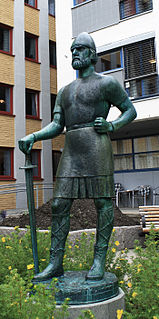
Tim Greve was a Norwegian historian, biographer, civil servant, diplomat and newspaper editor.
Sverre Steen was a Norwegian historian and professor at the University of Oslo from 1938 to 1965. He served as president of the Norwegian Historical Association from 1936 to 1947
Clarté was a socialist and pacifist organisation in Norway.
Aake Anker Ording was a Norwegian civil servant and politician for Mot Dag and the Labour Party.
Praksis ("Practice") is a Norwegian magazine, published by the Workers Youth League.
Håkon Andreas Christie was a Norwegian architectural historian, antiquarian and author. Together with his wife, Sigrid Marie Christie he worked from 1950 on the history of Norwegian church architecture, particularly stave churches. Their research resulted in Norges Kirker which consisted of seven major volumes covering churches in Østfold, Akershus and Buskerud.
Arne Vinje Gunnerud was a Norwegian sculptor.
Arne Paasche Aasen was a Norwegian politician, journalist and poet, who worked for the labour movement.
Per Jorsett was a Norwegian freelance sports reporter, sport historian and sports shooter. He reported for Sportsmanden from 1945 to 1961, and for the newspapers Dagbladet and Nationen. He had commissions for the Norwegian Broadcasting Corporation from 1947 to 1991, often along with fellow reporter Knut Bjørnsen. Among his books are Norges skytterkonger, Hvem er hvem i norsk idrett and books on the Olympic Games.
Axel Christian Zetlitz Sømme was a Norwegian educator, economist and geographer. During the 1920s, he was a political activist, magazine editor and newspaper editor.
Gunnar Brunvoll was a Norwegian impresario and opera administrator. He was co-founder of Norsk Operaselskap, and was manager at Den Norske Opera for more than twenty years.
| This article about an organisation based in Norway is a stub. You can help Wikipedia by expanding it. |