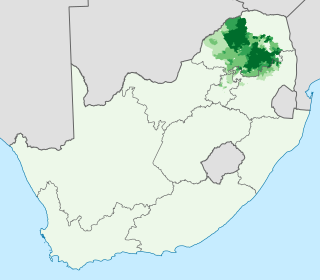
Sesotho sa Lebowa is a Sotho-Tswana language group spoken in the northeastern provinces of South Africa, most commonly in Mpumalanga, Gauteng and the Limpopo provinces. It is erroneously commonly referred to in its standardised form as Pedi or Sepedi and holds the status of an official language in South Africa.

Ciskei, officially the Republic of Ciskei, was a Bantustan for the Xhosa people, located in the southeast of South Africa. It covered an area of 7,700 square kilometres (3,000 sq mi), almost entirely surrounded by what was then the Cape Province, and possessed a small coastline along the shore of the Indian Ocean.

The Kamov Ka-27 is a military helicopter developed for the Soviet Navy, and currently in service in various countries including Russia, Ukraine, Vietnam, China, South Korea, and India. Variants include the Ka-29 assault transport, the Ka-28 downgraded export version, and the Ka-32 for civilian use.

British Kaffraria was a British colony/subordinate administrative entity in present-day South Africa, consisting of the districts now known as Qonce and East London. It was also called Queen Adelaide's Province and, unofficially, British Kaffiria and Kaffirland.

The Van Riebeeck Medal, post-nominal letters VRM, is a military decoration for bravery which was instituted by the Union of South Africa in 1952. It was awarded to other ranks for distinguished service in the field.

The Korea Medal is a military campaign medal which was instituted by the Union of South Africa in 1953. It was awarded to volunteers of the Union Defence Forces for service in Korea during the 1950-1953 Korean War.

The Bisho massacre occurred on 7 September 1992 in Bisho, in the then nominally independent homeland of Ciskei which is now part of the Eastern Cape in South Africa. Twenty-eight African National Congress supporters and one soldier were shot dead by the Ciskei Defence Force during a protest march when they attempted to enter Bisho to demand the reincorporation of Ciskei into South Africa during the final years of apartheid.

The Marumo Medal, Class I was instituted by the State President of the Republic of Bophuthatswana in 1988.
The State President's Medal for Shooting was instituted by the State President of the Republic of Bophuthatswana in 1990, for award to champion shots.

The Sandile Decoration, post-nominal letters SD, was instituted by the President of the Republic of Ciskei in 1988, for award to all ranks for meritorious service.
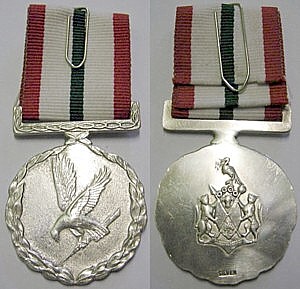
The Sandile Medal was instituted by the President of the Republic of Ciskei in 1988, for award to all ranks for meritorious service.

The Chief C.D.F. Commendation Medal was instituted by the President of the Republic of Ciskei in 1992, for award to all ranks for service commended by the Chief of the Ciskei Defence Force.
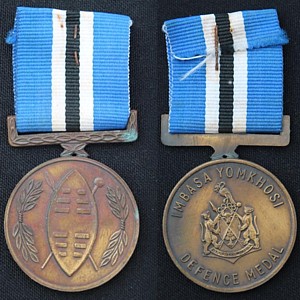
The Ciskei Defence Medal was instituted by the President of the Republic of Ciskei in 1988, for award to all ranks for general service.

The Independence Medal was instituted by the President of the Republic of Ciskei in 1981, for award to all serving members of the Ciskei Defence Force on 4 December 1981 to commemorate the independence of Ciskei.

The Medal for Long Service, Bronze was instituted by the President of the Republic of Ciskei in 1988, for award to all ranks for ten years faithful service.

The President's Medal for Shooting was instituted by the President of the Republic of Ciskei in 1988, for award to champion shots.
The National Heritage Monument is a group of copper statues representing anti-apartheid activists, Zulu chiefs and missionaries in Groenkloof Nature Reserve, South Africa. The monument is meant to reflect the struggle for liberation going back into the 1600s. The project was started in 2010, but as of 2015, only has 55 statues. A total of 400 to 500 statues are planned. When complete, the monument will be called "The Long March to Freedom".
The Battle of Amalinda was an armed confrontation between two Xhosa chiefs of the Rharhabe House, which took place in October 1818 just outside of what is today King Williams Town, in the Eastern Cape region of South Africa. On the eve of the fifth Xhosa War Chief Ngqika had close ties with the British, while his uncle, Chief Ndlambe, had no such agreements and painted Ngqika as someone selling out his people in return for personal gain. Chief Ndlambe was assisted in the battle by the senior, King Hintsa and his Gcaleka warriors. When chief Ngqika was defeated in the battle, he retreated and appealed to the British for protection. A British-led force commanded by Colonel Thomas Brereton then seized 23,000 head of cattle from Ndlambe's people in retaliation, leading to the battle of Grahamstown.
Lt. General Xhanti Charles Sebe was leader of the Ciskei Defence Force- the military of the Bantustan of Ciskei, and its Director of State Security. A former Security Branch policeman, he later joined the South African Bureau of State Security (B.O.S.S.) before founding the Ciskei state security apparatus. Described as having created a police state in Ciskei, and being perceived as its de facto ruler, he is the young brother of Lennox Sebe. He was subsequently arrested by his brother's government, and sentenced to prison by the Ciskei government for incitement, but was rescued from jail by white mercenaries, and escaped to the nearby Bantustan of Transkei, where he began an organisation that aimed to overthrow his brother's government.
Mazibuko Jara, born in Mdantsane in the Eastern Cape, one of the province of South Africa. An activist in the democratic Marxist tradition, he was active in the South African Students Congress (SASCO) and the left-wing Young Christian Students. He was a member of the South African Communist Party (SACP) until 2005, serving as its spokesperson, including editing the party paper Umsebenzi, and strategist. He was ousted from the party after he wrote a paper in 2005 rejecting the SACP's overt support for Jacob Zuma, entitled What Colour Is Our Flag? Red or JZ? : A Critique of the SACP Approach on the JZ Matter, one of a number of critical figures purged in the 2000s.


