Related Research Articles
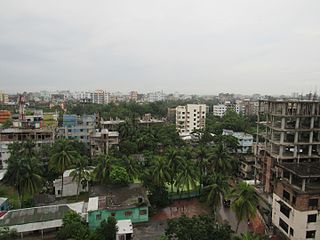
Comilla District, officially known as Cumilla District, is a district located in southeastern Bangladesh. It lies about 100 kilometres south east of Dhaka. Comilla is bordered by Brahmanbaria and Narayanganj districts to the north, Noakhali and Feni districts to the south, Tripura state of India to the east and Munshiganj and Chandpur districts to the west.

Dhaka Medical College and Hospital (DMCH) is a public medical college and hospital located in Dhaka, Bangladesh. Established on 10 July 1946, the college houses a medical school as well as a tertiary care hospital on its campus.
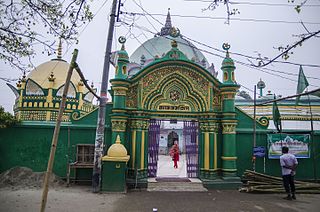
Sirajganj District is a district in the North Bengal region of Bangladesh, located in the Rajshahi Division. It is the 25th largest district by area and 9th largest district by population in Bangladesh. It is known as the gateway to North Bengal.

Govt. Brojomohun College, Barishal, commonly known as BM College, is one of the oldest institutions of higher education in Bangladesh. It is located in the city of Barishal in south-western Bangladesh.

Sir Salimullah Medical College (SSMC), commonly known as Mitford, is a public medical college in Dhaka, Bangladesh. Founded in 1875, it is the oldest and second largest medical school in Bangladesh. It includes Mitford Hospital, which is the oldest hospital in the country and one of the earliest hospitals in the Indian subcontinent from where the evolution of medical education started.

Mirza Abu Talib, better known as Shaista Khan, was a Moghul General and the Subahdar of Mughal Bengal, he was maternal uncle to the Mughal Emperor Aurangzeb, he acted as a key figure during his reign, Shaista Khan initially governed the Deccan, where he clashed with the Maratha ruler Shivaji, However, he was most notable for his tenure as the governor of Bengal from 1664 to 1688, Under Shaista Khan's authority, the city of Dhaka and Mughal power in the province attained its greatest heights. His achievements include constructions of notable mosques such as the Sat Gambuj Mosque and masterminding the conquest of Chittagong. Shaista Khan was also responsible for sparking the outbreak of the Anglo-Mughal War with the English East India Company.

Hakim Habibur Rahman was an Unani physician, litterateur, journalist, politician and chronicler in early 20th-century Dhaka.

Mahendralal Sarkar CIE was a Bengali medical doctor (MD), the second MD graduated from the Calcutta Medical College, social reformer, and propagator of scientific studies in nineteenth-century India. He was the founder of the Indian Association for the Cultivation of Science.
Raimangal River is a tidal estuarine river in and around the Sundarbans in South 24 Parganas district in the Indian state of West Bengal and Satkhira District in Bangladesh.
Kalindi River is a tidal estuarine river in and around the Sundarbans in North 24 Parganas district in the Indian state of West Bengal, bordering on Satkhira District of Bangladesh.
Hariabhanga River (also spelt Haribhanga) is a tidal estuarine river in and around the Sundarbans in North 24 Parganas district in the Indian state of West Bengal, bordering on Satkhira District of Bangladesh.

The Matua Mahasangha is a Hindu reform movement that originated around 1860 AD in modern-day Bangladesh. Today, it has a considerable number of adherents both in Bangladesh and in West Bengal, India.

Prabhu Jagadbandhu was an Indian religious leader from Bengal. He spent much of his life meditating and preaching at the Sri Angan ashram in modern India and Bangladesh. His teachings inspired the founding of a Krishnaite Hindu revival movement in the last decade of the 19th century and later on the Mahanam Sampradaya, a monastic organisation. His devotees equate him with and also believes that he is Krishna and Chaitanya Mahaprabhu.

The Sylheti or Sylhetis are an Indo-Aryan ethnocultural group that are associated with the Sylhet region. There are strong diasporic communities in Barak Valley of Assam, India, North Tripura, as well as in rest of Bangladesh and northeast India. They speak Sylheti, an Eastern Indo-Aryan language that is considered "a distinct language by many and a dialect of Bengali by some others".
Shyama Prasad Mandal is an Indian orthopedic surgeon and the co-chairperson of Sir Ganga Ram Hospital, New Delhi. After securing his graduate and MS degrees from the All India Institute of Medical Sciences, New Delhi, he continued his education to secure the degree of MCh in orthopedics from Liverpool University. He is a former president of the Indian Orthopaedic Association as well as the president of its Building Committee and the incumbent president of Board of Trustees of Amarjyoti Charitable Trust, a not-for-profit organization engaged in educational and rehabilitation service. He has been involved with the organization of medical conferences, and was the co-chairman of the organizing committee of Knee and Arthroscopy Workshop of 2008 and the patron of the Lower Limb Symposia of 2012, conducted jointly by the Indian Federation of Sports Medicine, Indian Arthroscopy Society and Indian Association of Sports Medicine. He was in the news when he examined Sachin Tendulkar in 1999 for his recurring back injury. The Government of India awarded him the fourth highest civilian honour of the Padma Shri, in 2011, for his contributions to medical science. He is also a recipient of a civilian honor from the Government of Bangladesh. Indian Orthopedic Association has instituted an award, S. P. Mandal Gold Medal, in his honor.
Ahmed Ali Enayetpuri was a Bengali writer, journalist, and politician.
Munshi Muhammad Ashraf Hussain, was a Bengali poet, researcher and a collector of puthis and folk literature. He was also known for his contribution in the study of the Sylheti Nagri script.
Dobhashi or Dobhashi Bengali is a neologism used to refer to a historical register of the Bengali language which borrowed extensively, in all aspects, from Arabic and Persian. It became the most customary form for composing puthi poetry predominantly using the traditional Bengali alphabet. However, Dobhashi literature has also been produced in the Sylhet Nagri script, as well as in the modified Arabic scripts of Chittagong and Nadia. The standardisation of the modern Bengali language during the colonial period, eventually led to its decline.

ʿAbd al-Awwal Jaunpūrī was an Indian Muslim scholar, religious preacher, educationist, poet and author. Described by Muhammad Mojlum Khan as one of the "most gifted and outstanding" of Karamat Ali Jaunpuri's many children, he displayed an important role leading his father's founded Taiyuni reformist movement in Bengal.
References
- ↑ Rahman, Syedur (27 April 2010). Historical Dictionary of Bangladesh. Scarecrow Press. p. 350. ISBN 978-0-8108-7453-4.
- ↑ "National Awards - Banglapedia". en.banglapedia.org. Retrieved 2024-09-13.
- ↑ The Indian Medical Register, 1960. Medical Council of India. 1965. p. 1451.
  | This Bangladeshi academic-related biographical article is a stub. You can help Wikipedia by expanding it. |