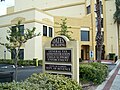
The Florida Theatre is a historic American movie theater located in Jacksonville, Florida. Opened in April 1927, it was added to the U.S. National Register of Historic Places on November 4, 1982. On April 18, 2012, the AIA's Florida Chapter placed the building on its list of Florida Architecture: 100 Years. 100 Places.
Patee Town Historic District is a national historic district located at St. Joseph, Missouri. The district encompasses 71 contributing buildings and 1 contributing site in the Patee Town section of St. Joseph. It developed between about 1858 and 1939, and includes representative examples of Greek Revival and Italianate style architecture. Located in the district are the separately listed Patee House, a hotel that is a U.S. National Historic Landmark, and Jesse James House. Other notable buildings include the Morey Piro House (1910), Charles E. Herycele House (1903), R. L. McDonald Manufacturing Co. Warehouse (1899), Mrs. Pemetia Cornish Duplex, Fred Wenz Store Building (1903), Fire Station #5 (1939), German Salems Church, and Matthew Ziebold House (1895).

The Old Calhoun County Courthouse built in 1904 is an historic building located at 314 East Central Avenue in Blountstown, Florida. On October 16, 1980, it was added to the U.S. National Register of Historic Places.
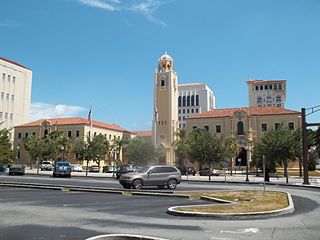
The Sarasota County Courthouse is a historic courthouse building located in Sarasota, Florida. Designed by architect Dwight James Baum in the Mediterranean Revival style, it was built in 1926-1927 by Stevenson and Cameron, Inc. of New York.

The Sanford Grammar School, also known as the Sanford High School and as the Margaret K. Reynolds Building, is a historic school building located at 301 West 7th Street in Sanford, Florida, United States. Built in 1902, it was designed by Wilbur B. Talley in the Romanesque Revival style of architecture. Sanford architect Elton James Moughton designed the wings which were added in 1916. On November 23, 1984, it was added to the U.S. National Register of Historic Places.
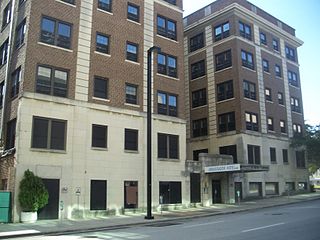
The 310 West Church Street Apartments, also known as the Ambassador Hotel, is a historic building located at 420 North Julia Street in Jacksonville, Florida, United States. On April 7, 1983, it was added to the U.S. National Register of Historic Places.

The Ribault Club is an historic building on Fort George Island near Jacksonville, Florida. It is now home to the Fort George Island Visitor Center. The building was designed in a Colonial Revival architecture style and is credited to Maurice Fatio and Mellen Clark Greeley. It was added to the U.S. National Register of Historic Places on May 11, 2000, and is located on Fort George Road. It was built in 1928 for winter recreation on the site of a former hotel and is considered a legacy of Fort George Island's resort era. Winter recreational opportunities included golf, tennis, hunting, fishing, and yachting. Today many weddings are held at the Club. The building is listed as a Historic Landmark by the City of Jacksonville. It became part of the Fort George Island Cultural State Park in 1989.

The Mount Zion AME Church is a historic church in Jacksonville, Florida, United States. It is located at 201 East Beaver Street. On December 30, 1992, it was added to the U.S. National Register of Historic Places. The "AME" is an abbreviation of African Methodist Episcopal, the religious denomination.
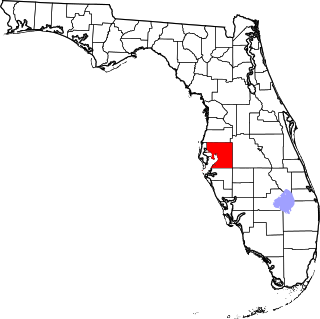
This is a list of the National Register of Historic Places listings in Hillsborough County, Florida.

The Lummus Park Historic District or simply Lummus Park, is on the National Register of Historic Places and a locally historic designated district in Miami, Florida. It is roughly bound by Northwest Fifth Street to the north, Flagler Street to the south, Northwest Third Avenue to the east, and the Miami River to the west. On October 25, 2006, it was added to the U.S. National Register of Historic Places. Lummus Park has some of the oldest structures in Miami, and over the decades, has been able to retain a large part of its early pioneer character.

The Richmond Railroad Station Historic District is a group of historic commercial buildings and national historic district located at Richmond, Wayne County, Indiana.

This is a list of the National Register of Historic Places listings in Mobile, Alabama.
The Spanish Revival Residences in Mobile Multiple Property Submission is a multiple property submission of buildings that were listed together on the National Register of Historic Places as some of the best remaining examples in Mobile, Alabama of houses built in the Spanish Colonial Revival style. It covers ten properties.
The Oates–Reynolds Memorial Building is a historic building in Newton, Alabama. The Baptist Collegiate Institute was founded in 1898, providing elementary, high school, and early college education. One of the oldest educational institutions in the Wiregrass Region, the school had over 250 students by 1918. The entire campus burned in the early 1920s, and a classroom building and girls' dormitory were built to replace it. The Institute closed in 1929; the classroom building was taken over by the public school system, and the dormitory was rented out. The dormitory currently serves as the town library and museum.

Cathedral Hill Historic District is a national historic district located at St. Joseph, Missouri. The district encompasses 309 contributing buildings, 1 contributing site, and contributing structures in a predominantly residential section of St. Joseph. It developed between about 1860 and 1950, and includes representative examples of Greek Revival, Italianate, Queen Anne, Colonial Revival, and American Craftsman style architecture. Located in the district is the separately listed Virginia Flats. Other notable buildings include the Nisen Stone House, Thomas Culligan House, A. D. Hudnutt House (1909), St. Joseph Cathedral (1877), James Wall House, Taylor Apartments, E. F. Weitheimer House (1888), Sarah and Ann Walsh Apartment House (1915), Henry Owen Stable (1898), George T. Hoagland Speculative House (1901), and James Hull House (1887).

Dewey Avenue–West Rosine Historic District is a national historic district located at St. Joseph, Missouri. The district encompasses 37 contributing buildings and 1 contributing site in a predominantly residential section of St. Joseph. It developed between about 1880 and 1930, and includes representative examples of Italianate, Second Empire, Queen Anne, Colonial Revival, Tudor Revival, and American Craftsman style architecture. Notable buildings include the Marshall B. Stroud House (1890), John and Frank Whitman House (1890), Johanna Johnson House (1908), Frank Lacy House (1900), and a number of speculative houses built by Charles H. Nowland.

Harris Addition Historic District is a national historic district located at St. Joseph, Missouri. The district encompasses 288 contributing buildings and 1 contributing site in a predominantly residential section of St. Joseph. It developed between about 1866 and 1940, and includes representative examples of Colonial Revival, Tudor Revival, and American Craftsman style architecture. Notable buildings include the William Payne House (1889), W.C. Green Apartment Building, C.B. Powers House, the Parry-Motter House designed by architect Edmond Jacques Eckel (1845–1934), and a number of speculative houses built by George J. Englehart and W.H. Haynes.
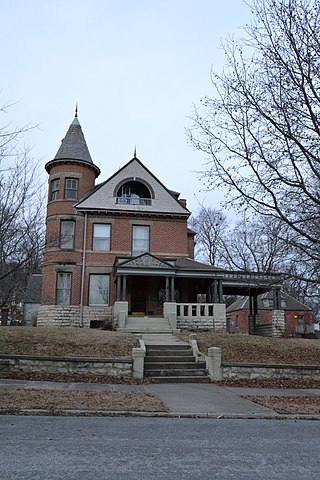
Krug Park Place Historic District is a national historic district located at St. Joseph, Missouri. The district encompasses 28 contributing buildings and 1 contributing site in a predominantly residential section of St. Joseph. It developed between about 1888 and 1938, and includes representative examples of Italianate, Queen Anne, Colonial Revival, Tudor Revival, and American Craftsman style architecture. Notable buildings include the Henry Krug, Jr. House (1892) designed by architect Edmond Jacques Eckel (1845–1934),`A.V. Schaeffer House (1913), W.W. Van Sant House (1914), J.G. Schneider House (1899) by Eckel, Benton Quick House (1901), Mrs. W.B. Watkins House (1903), and George Ward House.

Kemper Addition Historic District is a national historic district located at St. Joseph, Missouri. The district encompasses 74 contributing buildings and 1 contributing site in a predominantly residential section of St. Joseph. It developed between about 1880 and 1950, and includes representative examples of Colonial Revival, Tudor Revival, and American Craftsman style architecture. Notable buildings include the Jacob Spencer House (1912), H. E. Hutchings House (1887), Fred Binz House, Thomas Moseley Duplex (1894), Plaza Apartments (1928–1929), Hickey-Fargrave House with alterations by architect Edmond Jacques Eckel (1845–1934),`C. E. Sprague House (1905) by Eckel, David Bartlett House (1900) by Eckel, and Samuel Nave House (1889).

This is a list of the National Register of Historic Places listings in Tampa, Florida.