
Occlusion may refer to:
Occlusion may refer to:

In phonetics, a plosive, also known as an occlusive or simply a stop, is a pulmonic consonant in which the vocal tract is blocked so that all airflow ceases.
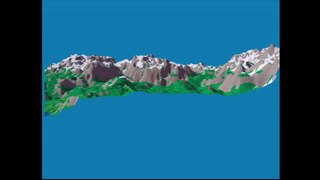
The painter’s algorithm is an algorithm for visible surface determination in 3D computer graphics that works on a polygon-by-polygon basis rather than a pixel-by-pixel, row by row, or area by area basis of other Hidden-Surface Removal algorithms. The painter’s algorithm creates images by sorting the polygons within the image by their depth and placing each polygon in order from the farthest to the closest object.

A depth buffer, also known as a z-buffer, is a type of data buffer used in computer graphics to represent depth information of objects in 3D space from a particular perspective. Depth buffers are an aid to rendering a scene to ensure that the correct polygons properly occlude other polygons. Z-buffering was first described in 1974 by Wolfgang Straßer in his PhD thesis on fast algorithms for rendering occluded objects. A similar solution to determining overlapping polygons is the painter's algorithm, which is capable of handling non-opaque scene elements, though at the cost of efficiency and incorrect results.

In 3D computer graphics, hidden-surface determination is the process of identifying what surfaces and parts of surfaces can be seen from a particular viewing angle. A hidden-surface determination algorithm is a solution to the visibility problem, which was one of the first major problems in the field of 3D computer graphics. The process of hidden-surface determination is sometimes called hiding, and such an algorithm is sometimes called a hider. When referring to line rendering it is known as hidden-line removal. Hidden-surface determination is necessary to render a scene correctly, so that one may not view features hidden behind the model itself, allowing only the naturally viewable portion of the graphic to be visible.
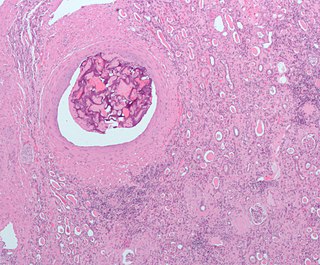
Embolization refers to the passage and lodging of an embolus within the bloodstream. It may be of natural origin (pathological), in which sense it is also called embolism, for example a pulmonary embolism; or it may be artificially induced (therapeutic), as a hemostatic treatment for bleeding or as a treatment for some types of cancer by deliberately blocking blood vessels to starve the tumor cells.
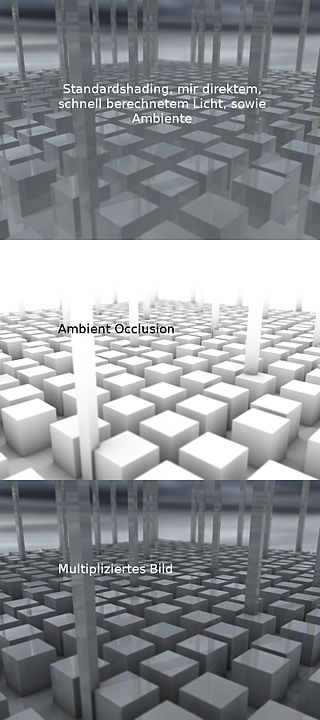
In 3D computer graphics, modeling, and animation, ambient occlusion is a shading and rendering technique used to calculate how exposed each point in a scene is to ambient lighting. For example, the interior of a tube is typically more occluded than the exposed outer surfaces, and becomes darker the deeper inside the tube one goes.
Clipping, in the context of computer graphics, is a method to selectively enable or disable rendering operations within a defined region of interest. Mathematically, clipping can be described using the terminology of constructive geometry. A rendering algorithm only draws pixels in the intersection between the clip region and the scene model. Lines and surfaces outside the view volume are removed.
A vascular bypass is a surgical procedure performed to redirect blood flow from one area to another by reconnecting blood vessels. Often, this is done to bypass around a diseased artery, from an area of normal blood flow to another relatively normal area. It is commonly performed due to inadequate blood flow (ischemia) caused by atherosclerosis, as a part of organ transplantation, or for vascular access in hemodialysis. In general, someone's own vein (autograft) is the preferred graft material for a vascular bypass, but other types of grafts such as polytetrafluoroethylene (Teflon), polyethylene terephthalate (Dacron), or a different person's vein (allograft) are also commonly used. Arteries can also serve as vascular grafts. A surgeon sews the graft to the source and target vessels by hand using surgical suture, creating a surgical anastomosis.
In computer graphics, relief mapping is a texture mapping technique first introduced in 2000 used to render the surface details of three-dimensional objects accurately and efficiently. It can produce accurate depictions of self-occlusion, self-shadowing, and parallax. It is a form of short-distance ray tracing done in a pixel shader. Relief mapping is highly comparable in both function and approach to another displacement texture mapping technique, Parallax occlusion mapping, considering that they both rely on ray tracing, though the two are not to be confused with each other, as parallax occlusion mapping uses reverse heightmap tracing.
In medicine, collateralization, also vessel collateralization and blood vessel collateralization, is the growth of a blood vessel or several blood vessels that serve the same end organ or vascular bed as another blood vessel that cannot adequately supply that end organ or vascular bed sufficiently.
Self-Shadowing is a computer graphics lighting effect, used in 3D rendering applications such as computer animation and video games. Self-shadowing allows non-static objects in the environment, such as game characters and interactive objects, to cast shadows on themselves and each other. For example, without self-shadowing, if a character puts his or her right arm over the left, the right arm will not cast a shadow over the left arm. If that same character places a hand over a ball, that hand will cast a shadow over the ball.
Abdominal angina is abdominal pain after eating that occurs in individuals with ongoing poor blood supply to their small intestines known as chronic mesenteric ischemia. Although the term angina alone usually denotes angina pectoris, angina by itself can also mean "any spasmodic, choking, or suffocative pain", with an anatomic adjective defining its focus; so, in this case, spasmodic pain in the abdomen. Stedman's Medical Dictionary Online defines abdominal angina as "intermittent abdominal pain, frequently occurring at a fixed time after eating, caused by inadequacy of the mesenteric circulation resulting from arteriosclerosis or other arterial disease. Synonym: intestinal angina."
3D computer graphics, sometimes called CGI, 3-D-CGI or three-dimensional computer graphics, are graphics that use a three-dimensional representation of geometric data that is stored in the computer for the purposes of performing calculations and rendering digital images, usually 2D images but sometimes 3D images. The resulting images may be stored for viewing later or displayed in real time.
In 3D computer graphics, Potentially Visible Sets are used to accelerate the rendering of 3D environments. They are a form of occlusion culling, whereby a candidate set of potentially visible polygons are pre-computed, then indexed at run-time in order to quickly obtain an estimate of the visible geometry. The term PVS is sometimes used to refer to any occlusion culling algorithm, although in almost all the literature, it is used to refer specifically to occlusion culling algorithms that pre-compute visible sets and associate these sets with regions in space. In order to make this association, the camera's view-space is typically subdivided into regions and a PVS is computed for each region.

Central retinal vein occlusion, also CRVO, is when the central retinal vein becomes occluded, usually through thrombosis. The central retinal vein is the venous equivalent of the central retinal artery and both may become occluded. Since the central retinal artery and vein are the sole source of blood supply and drainage for the retina, such occlusion can lead to severe damage to the retina and blindness, due to ischemia and edema (swelling).
Vascular occlusion is a blockage of a blood vessel, usually with a clot. It differs from thrombosis in that it can be used to describe any form of blockage, not just one formed by a clot. When it occurs in a major vein, it can, in some cases, cause deep vein thrombosis. The condition is also relatively common in the retina, and can cause partial or total loss of vision. An occlusion can often be diagnosed using Doppler sonography.
In phonetics, an occlusive, sometimes known as a stop, is a consonant sound produced by occluding airflow in the vocal tract, but not necessarily in the nasal tract. The duration of the block is the occlusion of the consonant. An occlusive may refer to one or more of the following, depending on the author:
Percutaneous intentional extraluminal revascularization is a percutaneous technique used in interventional radiology for limb salvage in patients with lower limb ischemia due to long superficial femoral artery occlusions. This method is intended for those patients who make poor candidates for infrainguinal arterial bypass surgery. A guide wire is intentionally introduced in the subintimal space, after which balloon dilatation is performed to create a new lumen for the blood to flow through. The technique is not without complications but may serve as a "temporary bypass" to provide wound healing and limb salvage.
This is a glossary of terms relating to computer graphics.
Occlusives form a barrier/block on the surface of the skin keeping moisture from escaping. In phonetics, an occlusive is a pulmonic consonant in which the vocal tract is closed or blocked off: