
Look up Old English in Wiktionary, the free dictionary.
Old English was an early form of the English language spoken by Anglo-Saxons until the 12th century.
Contents
Old English or Olde English may also refer to:
Old English was an early form of the English language spoken by Anglo-Saxons until the 12th century.
Old English or Olde English may also refer to:

Anglo-Saxons were Germanic tribes that settled in England, mainly in the sixth century.
Old English literature refers to poetry and prose written in Old English in early medieval England, from the 7th century to the decades after the Norman Conquest of 1066, a period often termed Anglo-Saxon England. The 7th-century work Cædmon's Hymn is often considered as the oldest surviving poem in English, as it appears in an 8th-century copy of Bede's text, the Ecclesiastical History of the English People. Poetry written in the mid 12th century represents some of the latest post-Norman examples of Old English. Adherence to the grammatical rules of Old English is largely inconsistent in 12th-century work, and by the 13th century the grammar and syntax of Old English had almost completely deteriorated, giving way to the much larger Middle English corpus of literature.
Old English, pronounced[ˈeŋɡliʃ]), or Anglo-Saxon, was the earliest recorded form of the English language, spoken in England and southern and eastern Scotland in the early Middle Ages. It developed from the languages brought to Great Britain by Anglo-Saxon settlers in the mid-5th century, and the first Old English literary works date from the mid-7th century. After the Norman Conquest of 1066, English was replaced for several centuries by Anglo-Norman as the language of the upper classes. This is regarded as marking the end of the Old English era, since during the subsequent period the English language was heavily influenced by Anglo-Norman, developing into what is now known as Middle English in England and Early Scots in Scotland.

The Saxons, sometimes called the Old Saxons, were the Germanic people of "Old" Saxony which became a Carolingian "stem duchy" in 804, in what is now northern Germany. Before any clear historical mention of Saxony as a country, "Saxons" became important during the late Roman Empire, when the name was used to refer to coastal raiders who attacked from the north, in a similar sense to the much later term Viking. These early raiders and settlers were believed by contemporaries to come from coastal regions north of the Rhine and the homeland of the Franks, including Frisians, Angles and Jutes, but also overlapping the territory of the later duchy. Significant numbers of these early Saxons settled in what later became northern France and England. Because of the relative importance of those related populations, authors such as Bede sometimes referred to the Saxons of Germany as the old Saxons, and their country as old Saxony, and this differentiation is still often used by historians today.

The Anglo-Saxons, the English or Saxons of Britain, were a cultural group who spoke Old English and inhabited much of what is now England and south-eastern Scotland in the Early Middle Ages. They traced their origins to Germanic settlers who became one of the most important cultural groups in Britain by the 5th century. Historically, the Anglo-Saxon period in Britain is considered to have started by about 450 and ended in 1066, with the Norman Conquest. Although the details of their early settlement and political development are not clear, by the 8th century a single Anglo-Saxon cultural identity which was generally called Englisc, had developed out of the interaction of these settlers with the pre-existing Romano-British culture. By 1066, most of the people of what is now England spoke Old English, and were considered English. Viking and Norman invasions changed the politics and culture of England significantly, but the overarching Anglo-Saxon identity evolved and remained dominant even after the Norman Conquest of 1066. Late Anglo-Saxon political structures and language are the direct predecessors of the high medieval Kingdom of England and the Middle English language. Although the modern English language owes less than 26% of its words to Old English, this includes the vast majority of everyday words.
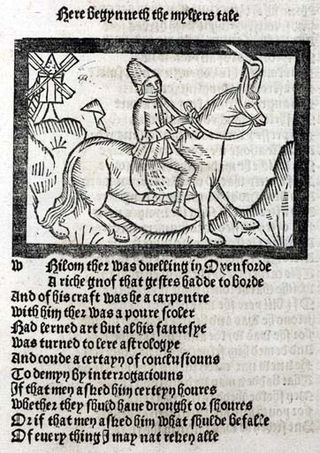
Middle English is a form of the English language that was spoken after the Norman Conquest of 1066, until the late 15th century. The English language underwent distinct variations and developments following the Old English period. Scholarly opinion varies, but Oxford University Press specifies the period when Middle English was spoken as being from 1100 to 1500. This stage of the development of the English language roughly followed the High to the Late Middle Ages.
The Old English Bible translations are the partial translations of the Bible prepared in medieval England into the Old English language. The translations are from Latin texts, not the original languages.

A housecarl was a non-servile manservant or household bodyguard in medieval Northern Europe.

West Country English is a group of English language varieties and accents used by much of the native population of the West Country, an area found in the southwest of England.
Anglo-Celtic people are descended primarily from English and Irish, Scottish or Welsh people. The concept is mainly relevant outside of England, Ireland, Scotland and Wales particularly in Australia, but is also used in Canada, the United States, New Zealand and South Africa, where a significant diaspora is located.
Orm became an Anglo-Saxon personal name during period of the Danelaw.
The Saxons were a Germanic people during the Early Middle Ages, some of whom became the Anglo-Saxons.
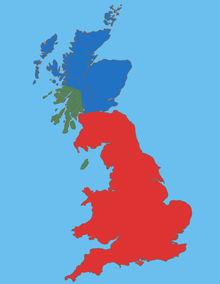
The Britons, also known as Celtic Britons or Ancient Britons, were an indigenous Celtic people who inhabited Great Britain from at least the British Iron Age until the High Middle Ages, at which point they diverged into the Welsh, Cornish, and Bretons. They spoke Common Brittonic, the ancestor of the modern Brittonic languages.

Penney is a common surname of British origin.
Welsh is a surname from the Old English language given to the Celtic Britons. The surname can also be the result of anglicization of the German cognate Welsch. Welsh is a popular surname in Scotland.
The English people are an ethnic group and nation native to England, who speak the English language, a West Germanic language, and share a common ancestry, history, and culture. The English identity began with the Anglo-Saxons, when they were known as the Angelcynn, meaning race or tribe of the Angles. Their ethnonym is derived from the Angles, one of the Germanic peoples who invaded Britain around the 5th century AD.
Classical English may refer to:
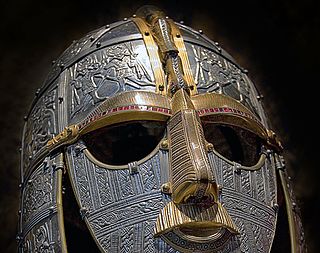
The settlement of Great Britain by diverse Germanic peoples led to the development of a new Anglo-Saxon cultural identity and shared Germanic language, Old English, which was most closely related to Old Frisian on the other side of the North Sea. The first Germanic-speakers to settle permanently are likely to have been soldiers recruited by the Roman administration, possibly already in the fourth century or earlier. Significant, material cultural changes which show parallels with northern Germany, as well as a breakdown of the Roman economy, become apparent in the archaeological record in the early fifth century, after the end of Roman rule in Britain.
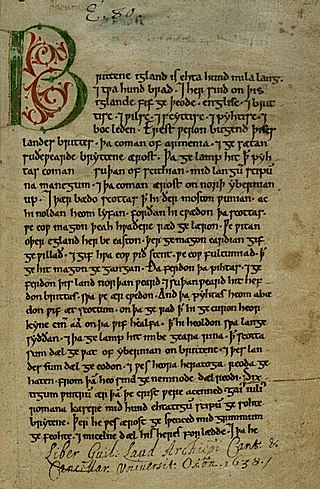
The Anglo-Saxon Chronicle is a collection of annals in Old English, chronicling the history of the Anglo-Saxons.
Magic in Anglo-Saxon England refers to the belief and practice of magic by the Anglo-Saxons between the fifth and eleventh centuries AD in Early Mediaeval England. In this period, magical practices were used for a variety of reasons, but from the available evidence it appears that they were predominantly used for healing ailments and creating amulets, although it is apparent that at times they were also used to curse.