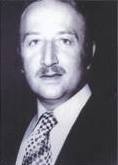
Omar Nimr Nabulsi

Last updated
Omar Nimr Nabulsi
عمر النابلسي
Jordanian Minister of Economy
In office
1970 1972
Jordanian Ambassador to the United Kingdom
of Flag of Jordan.svg  Jordan
to Flag of the United Kingdom.svg  United Kingdom
In office
1972 June 1973
Preceded by Zaid al-Rifai
Succeeded by Ma'an Abu Nowar
Jordanian Minister of Agriculture
In office
June 1973 November 1973
Jordanian Minister of Economy
In office
November 1973 1974
Jordanian Minister of Labour and Construction
In office
1980 1980
Personal details
Born (1936-04-01) April 1, 1936 (age 83)
Nablus
Spouse(s)in 1966 married to Haifa Hatough
Children2 sons
MotherSafia Ali
FatherNimr Nablusi [1]
Alma mater Ain Shams University Cairo, LL.B. of the London University.

Omar Nimr Nabulsi (born April 1, 1936) is a retired Jordanian Ambassador.
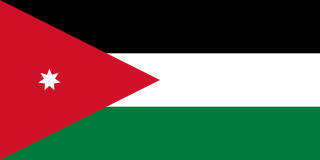
Jordan Arab country in Western Asia

Jordan, officially the Hashemite Kingdom of Jordan, is an Arab country in Western Asia, on the East Bank of the Jordan River. Jordan is bordered by Saudi Arabia to the south and the east, Iraq to the north-east, Syria to the north and Israel and Palestine to the west. The Dead Sea is located along its western borders and the country has a short 26-kilometre (16 mi) coastline on the Red Sea in its extreme south-west, but is otherwise landlocked. Jordan is strategically located at the crossroads of Asia, Africa and Europe. The capital, Amman, is Jordan's most populous city as well as the country's economic, political and cultural centre.

An ambassador is an official envoy, especially a high-ranking diplomat who represents a state and is usually accredited to another sovereign state or to an international organization as the resident representative of their own government or sovereign or appointed for a special and often temporary diplomatic assignment. The word is also often used more liberally for persons who are known, without national appointment, to represent certain professions, activities and fields of endeavor such as sales.
Career

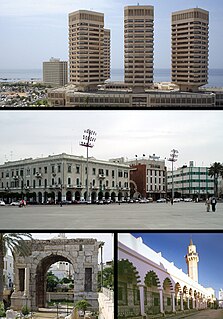
Tripoli Capital city in Greater Tripoli, Libya

Tripoli is the capital city and the largest city of Libya, with a population of about 1.158 million people in 2018. It is located in the northwest of Libya on the edge of the desert, on a point of rocky land projecting into the Mediterranean Sea and forming a bay. It includes the port of Tripoli and the country's largest commercial and manufacturing centre. It is also the site of the University of Tripoli. The vast Bab al-Azizia barracks, which includes the former family estate of Muammar Gaddafi, is also located in the city. Colonel Gaddafi largely ruled the country from his residence in this barracks.

Libya Country in north Africa

Libya, officially the State of Libya, is a country in the Maghreb region in North Africa, bordered by the Mediterranean Sea to the north, Egypt to the east, Sudan to the southeast, Chad to the south, Niger to the southwest, Algeria to the west, and Tunisia to the northwest. The sovereign state is made of three historical regions: Tripolitania, Fezzan and Cyrenaica. With an area of almost 1.8 million square kilometres (700,000 sq mi), Libya is the fourth largest country in Africa, and is the 16th largest country in the world. Libya has the 10th-largest proven oil reserves of any country in the world. The largest city and capital, Tripoli, is located in western Libya and contains over one million of Libya's six million people. The second-largest city is Benghazi, which is located in eastern Libya.

In diplomacy, an attaché is a person who is assigned to the diplomatic or administrative staff of a higher placed person or another service or agency. Although a loanword from French, in English the word is not modified according to gender.

Related Research Articles

Laurens Jan Brinkhorst Dutch politician

Laurens Jan Brinkhorst is a retired Dutch politician and diplomat of the Democrats 66 (D66) party and jurist.

Zaid al-Rifai former Prime Minister of Jordan

Zaid al-Rifai is a former Prime Minister of Jordan.

Abdelmunim Al-Rifai Jordanian politician

Abdul-Monem Rifai was a Jordanian diplomat and political figure of Palestinian descent, who served two non-consecutive terms as the Prime Minister of Jordan in 1969 and 1970.

Suleiman Nabulsi Jordanian politician

Suleiman Nabulsi was a leftist Jordanian political figure who served as Prime Minister of Jordan in 1956–57.

Samir Rifai Jordanian politician

Samir Zaid al-Rifai is a Jordanian politician who was Prime Minister of Jordan from 14 December 2009 to 9 February 2011.

Eid Dahiyat is a Jordanian politician, critic and academic.

Abdullah Rimawi Jordanian politician

Abdullah Rimawi was the head of the Ba'ath Party in Jordan in the 1950s. He served as Foreign Affairs Minister in Suleiman Nabulsi's government in 1957. A staunch pan-Arabist, Rimawi became one of the most vocal opponents of the Hashemite ruling family in Jordan and favored union with Syria. He fled Jordan in 1957 as the result of a crisis between the leftist government he was a part of and the royal family. He based himself in the United Arab Republic where he drew closer to UAR President Gamal Abdel Nasser provoking his expulsion from the Ba'ath Party—which was at odds with Nasser—in 1959. Soon after he founded a splinter party called the Arab Socialist Revolutionary Ba'ath Party. During his exile, he allegedly made a number of attempts to attack or undermine the Jordanian monarchy.

Salem Masadeh is a lawyer and a former minister in the Jordanian government.

Ghassan El-Rıfai is a leading Syrian economist who worked at the World Bank for a long time and served as Syria's Minister of Economy and Trade from December 2001 to October 2004.

Mohammed Said Nabulsi was a Jordanian banker, economist and politician. He served as Governor of the Central Bank of Jordan two times, first from 1973–1985, and secondly from 1989–1995.

Nadeem al-Zaro was a Jordanian politician. He held several ministerial posts during the 1970s. Zaro was Interior Minister during the fourth term of Prime Minister Bahjat Talhouni in 1970. He was Transport Minister during the term of Prime Minister Ahmad al-Lawzi (1971–1973). He continued in this position during the subsequent government of Zaid al-Rifai.

Events from the year 1976 in Jordan.

Zaid or Zayd (زيد) is an Arabic masculine name, which means "to prosper". The name may refer to:

Minister of Foreign Affairs (Jordan) Minister of Foreign Affairs of Jordan

Minister of Foreign Affairs of the Hashemite Kingdom of Jordan is a cabinet minister in charge of the Ministry of Foreign Affairs of Jordan, responsible for conducting foreign relations of the country.

Ali Abu Nuwar

Ali Abu Nuwar was a Jordanian army officer, serving as chief of staff in May 1956 – April 1957. He participated in the 1948 Arab–Israeli War as an artillery officer in the Jordanian army's predecessor, the Arab Legion, but his vocal opposition to British influence in Jordan led to his virtual exile to Paris as military attaché in 1952. There, he forged close ties with Jordanian crown prince Hussein, who promoted Abu Nuwar after his accession to the throne.

FORMER MINISTER MARWAN DUDIN Born in Beersheba (Palestine) October 4th, 1936 Town of origin: Dura-Elkhalil (Hebron) Hashemite Kingdom of Jordan

Rifa`i is a Sufi order founded in the 12th century.

Hassan Ibrahim is a retired Jordanian Ambassador.

National Socialist Party (Jordan)

Not to be confused with similarly named National Socialist Parties.

The 1989 Jordanian protests started in Ma'an on 18 April after the government cut food subsidies, increasing its price. Demonstrations and riots quickly reached neighboring southern towns. Protestors accused the government of rampant corruption, and demanded that the prime minister Zaid Al-Rifai be sacked; martial law be lifted; the electoral laws be reformed; and restrictions on freedom of expression and freedom of the press be removed.

References

  1. Nimr Nablusi, As late as 1923 the Commercial Bulletin reported that 'the first hand machine for soap cutting has been installed by Haj Nimr Nabulsi
  2. Who's Who in the Arab World 2007-2008, p. 598