
Alice Malsenior Tallulah-Kate Walker is an American novelist, short story writer, poet, and social activist. In 1982, she became the first African-American woman to win the Pulitzer Prize for Fiction, which she was awarded for her novel The Color Purple. Over the span of her career, Walker has published seventeen novels and short story collections, twelve non-fiction works, and collections of essays and poetry.
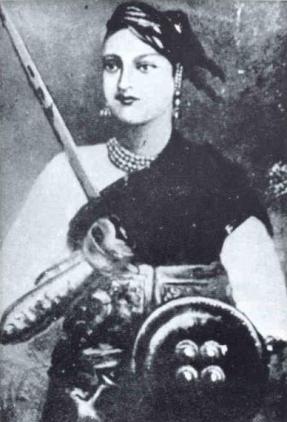
Lakshmibai Newalkar, the Rani of Jhansi, was the Maharani consort of the princely state of Jhansi in Maratha Empire from 1843 to 1853 by marriage to Maharaja Gangadhar Rao Newalkar. She was one of the leading figures in the Indian Rebellion of 1857, who became a national hero and symbol of resistance to the British rule in India for Indian nationalists.

Their Eyes Were Watching God is a 1937 novel by American writer Zora Neale Hurston. It is considered a classic of the Harlem Renaissance, and Hurston's best known work. The novel explores protagonist Janie Crawford's "ripening from a vibrant, but voiceless, teenage girl into a woman with her finger on the trigger of her own destiny".

The Awakening is a novel by Kate Chopin, first published in 1899. Set in New Orleans and on the Louisiana Gulf coast at the end of the 19th century, the plot centers on Edna Pontellier and her struggle between her increasingly unorthodox views on femininity and motherhood with the prevailing social attitudes of the turn-of-the-century American South. It is one of the earlier American novels that focuses on women's issues utilizing narrative techniques. It is also widely seen as a landmark work of early feminism, generating a mixed reaction from contemporary readers and critics.

Annie Oakley is an American Western television series that fictionalizes the life of the famous Annie Oakley. Featuring actress Gail Davis in the title role, the weekly program ran from January 1954 to February 1957 in syndication. A total of 81 black-and-white episodes were produced, with each installment running 25 minutes in length. ABC aired daytime reruns of the series on Saturdays and Sundays from 1959 to 1960 and then again from 1964 to 1965.

The Indian Rebellion of 1857 was a major uprising in India in 1857–58 against the rule of the British East India Company, which functioned as a sovereign power on behalf of the British Crown. The rebellion began on 10 May 1857 in the form of a mutiny of sepoys of the company's army in the garrison town of Meerut, 40 mi (64 km) northeast of Delhi. It then erupted into other mutinies and civilian rebellions chiefly in the upper Gangetic plain and central India, though incidents of revolt also occurred farther north and east. The rebellion posed a military threat to British power in that region, and was contained only with the rebels' defeat in Gwalior on 20 June 1858. On 1 November 1858, the British granted amnesty to all rebels not involved in murder, though they did not declare the hostilities to have formally ended until 8 July 1859.

Flora Annie Steel was a writer who lived in British India for 22 years. She was noted especially for books set in the Indian sub-continent or connected with it. Her novel On the Face of the Waters (1896) describes incidents in the Indian Mutiny.

Begum Hazrat Mahal, also known as the Begum of Awadh, was the second wife of Nawab of Awadh Wajid Ali Shah, and the regent of Awadh in 1857–1858. She is known for the leading role she had in the rebellion against the British East India Company during the Indian Rebellion of 1857.

Field Marshal Sir Henry Wylie Norman, was a senior Indian Army officer and colonial administrator. He served in the Second Anglo-Sikh War, the campaign against the Kohat Pass Afridis, the suppression of the Santhal rebellion, and the suppression of the Indian Mutiny. He became military member of the Viceroy's Council in 1870, in which role he maintained the policy of ensuring that the Indian Army were less well armed than British troops there to deter another mutiny. As a result, he became a member of the Council of India; and in his later years he became Governor of Jamaica and then Governor of Queensland.

Lady Violet Georgiana Powell was a British writer and critic. Her husband was the author Anthony Powell.
Events from the year 1857 in the United Kingdom.

The Steam House is an 1880 Jules Verne novel recounting the travels of a group of British colonists in the Raj in a wheeled house pulled by a steam-powered mechanical elephant. Verne uses the mechanical house as a plot device to have the reader travel in nineteenth-century India. The descriptions are interspersed with historical information and social commentary.

The Odd Women is an 1893 novel by the English novelist George Gissing. Its themes are the role of women in society, marriage, morals and the early feminist movement.

The Manxman is a novel by Hall Caine, first appearing as a serial in The Queen, The Lady's Newspaper and Court Chronicle between January and July 1894. Published as one volume in August 1894 by Heinemann, The Manxman ended the system of three-volume novels. A highly popular novel of its period, it was set in the Isle of Man and concerned a romantic triangle. The novel has as its central themes, the mounting consequences of sin and the saving grace of simple human goodness.
Saros Dara Cowasjee was an Indian-born Canadian novelist, short story writer, commentator, critic, anthologist, and screenwriter, as well as a professor emeritus at University of Regina.

Seraph on the Suwanee is a 1948 novel by African-American novelist Zora Neale Hurston. It follows the life of a White woman and the fraught relationship she has with her husband and family.

Uda Devi Pasi (1830-1857) was an Indian woman freedom fighter who participated in the war on behalf of Indian soldiers against the British East India Company, during the Indian Rebellion of 1857. She was a member of the women's squad of Wajid Ali Shah, the sixth Nawab of Awadh.

Against All Odds is a 2017 novel by American writer Danielle Steel. The story follows Kate Madison and her family. The title for the novel comes from the idea that she cannot keep her children from “playing against the odds” in their choice of romantic partners.

Alice Perrin or Alice Robinson was a British novelist who wrote about the British in colonial India. She became successful after the publication of her short ghost story collection East of Suez.
The Indian independence movement was a series of events aimed at ending the British rule in India, which lasted till 1947. Women played a significant and prominent role in the Indian independence movement. The participation of women in the movement started as early as the eighteenth century.
