Related Research Articles

Meissen is a town of approximately 30,000 about 25 km (16 mi) northwest of Dresden on both banks of the Elbe river in the Free State of Saxony, in eastern Germany. Meissen is the home of Meissen porcelain, the Albrechtsburg castle, the Gothic Meissen Cathedral and the Meissen Frauenkirche. The Große Kreisstadt is the capital of the Meissen district.

Porcelain is a ceramic material made by heating substances, generally including materials such as kaolinite, in a kiln to temperatures between 1,200 and 1,400 °C. The strength and translucence of porcelain, relative to other types of pottery, arises mainly from vitrification and formation of the mineral mullite within the body at these high temperatures. Though definitions vary, porcelain can be divided into three main categories: hard-paste, soft-paste, and bone china. The category that an object belongs to depends on the composition of the paste used to make the body of the porcelain object and the firing conditions.
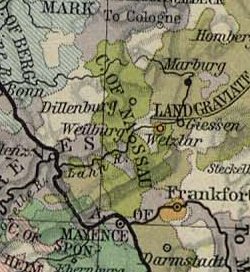
The County of Nassau was a German state within the Holy Roman Empire and later part of the German Confederation. Its ruling dynasty, the male line of which is now extinct, was the House of Nassau.
Neunkirchen is a Kreis (district) in the middle of the Saarland, Germany. Neighboring districts are Sankt Wendel, Kusel, Saarpfalz, Saarbrücken, and Saarlouis.
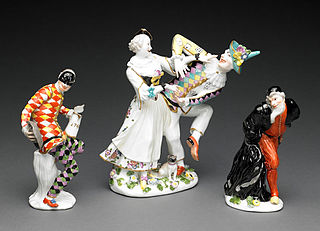
Meissen porcelain or Meissen china was the first European hard-paste porcelain. Early experiments were done in 1708 by Ehrenfried Walther von Tschirnhaus. After his death that October, Johann Friedrich Böttger continued von Tschirnhaus's work and brought this type of porcelain to the market, financed by Augustus the Strong, King of Poland and Elector of Saxony. The production of porcelain in the royal factory at Meissen, near Dresden, started in 1710 and attracted artists and artisans to establish, arguably, the most famous porcelain manufacturer known throughout the world. Its signature logo, the crossed swords, was introduced in 1720 to protect its production; the mark of the swords is reportedly one of the oldest trademarks in existence.
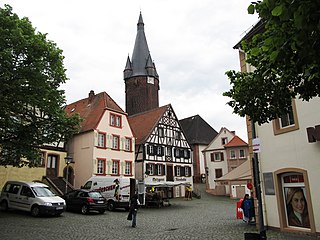
Ottweiler is a municipality, former seat of the district of Neunkirchen, in Saarland, Germany. It is situated on the river Blies, approx. 7 km north of Neunkirchen, and 25 km northeast of Saarbrücken.

The House of Ahlefeldt is an ancient German and Danish noble family. It has similar coat of arms with the von Rumohr family, which indicates that they have descended from one House.

Karlsberg is one of the largest breweries in Germany; the Karlsberg Group also owns various other beer brands. It is called Karlsbräu outside of Germany to differentiate it from the Danish brewing company Carlsberg.

The County of Saarbrücken was an Imperial State in the Upper Lorraine region, with its capital at Saarbrücken. From 1381 it belonged to the Walram branch of the Rhenish House of Nassau.
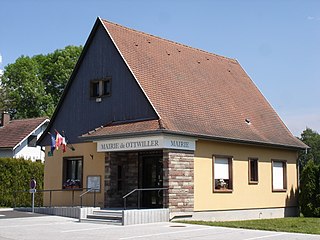
Ottwiller is a commune in the Bas-Rhin department in Grand Est in north-eastern France.

Nassau-Usingen was a county of the Holy Roman Empire in the Upper Rhenish Circle that became a principality in 1688.

The Dresden Porcelain Collection is part of the Staatliche Kunstsammlungen of Dresden, Germany. It is located in the Zwinger Palace.

The Royal Porcelain Factory in Berlin, also known as the Royal Porcelain Manufactory Berlin and whose products are generally called Berlin porcelain, was founded in 1763 by King Frederick II of Prussia. Its actual origins, however, lie in three private enterprises which, under crown patronage, were trying to establish the production of "white gold" in Berlin from the mid-18th century onwards.

Wallendorfer Porzellan or Wallendorf Porcelain is a porcelain manufacturing company which has been in operation since 1764 in Lichte (Wallendorf) in the Thuringian Highlands. Wallendorf is one of the oldest porcelain trademarks in Germany and the whole of Europe.

The Lichte porcelain (GmbH) was founded 1822 in Lichte, Thuringian Highlands.
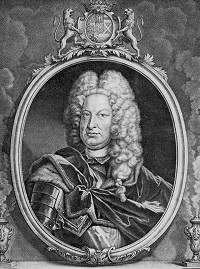
Charles Louis, Count of Nassau-Saarbrücken was the son of Count Gustav Adolf of Nassau-Saarbrücken and Countess Clara Eleanor of Hohenlohe-Neuenstein.
Albert of Nassau-Weilburg-Ottweiler, was a count of the House of Nassau. His territory included the areas around Weilburg, Ottweiler and Lahr in the Black Forest. Like his father, Philip III of Nassau-Weilburg he was an advocate of the Reformation.
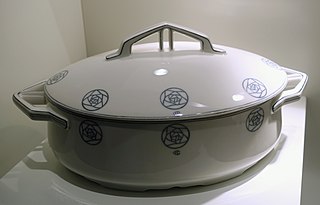
Hutschenreuther is the name of a German family that established the production of porcelain in northern Bavaria, starting in 1814.

Ottweiler (Saar) station is centrally located in the town of Ottweiler in the German state of the Saarland on the Nahe Valley Railway, which was opened in 1860. Since 1937, the Ottweiler–Schwarzerden line has branched off in Ottweiler; it is now used as a museum railway. The station is classified by Deutsche Bahn as a category 5 station.

St. Wendel is an electoral constituency represented in the Bundestag. It elects one member via first-past-the-post voting. Under the current constituency numbering system, it is designated as constituency 298. It is located in northeastern Saarland, comprising the Sankt Wendel district, the northern part of the Neunkirchen district, and parts of the Saarlouis and Saarbrücken districts.
References
- Elisabeth Kessler-Slotta, Ottweiler Porzellan ( ISBN 3-921646-33-2) in German
 | This ceramic art and design-related article is a stub. You can help Wikipedia by expanding it. |