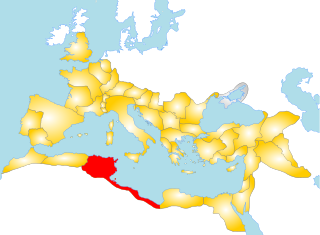
Ifriqiya, also known as al-Maghrib al-Adna, was a medieval historical region comprising today's Tunisia and eastern Algeria, and Tripolitania. It included all of what had previously been the Byzantine province of Africa Proconsularis and extended beyond it, but did not include the Mauretanias.

Al-Kahina, also known as Dihya, was a Berber queen of the Aurès and a religious and military leader who led indigenous resistance to the Muslim conquest of the Maghreb, the region then known as Numidia notably defeating the Umayyad forces in the Battle of Meskiana after which she became the uncontested ruler of the whole Maghreb, before being decisively defeated at the Battle of Tabarka. She was born in the early 7th century and died around the end of the 7th century in modern-day Algeria.
The Jarawa or Jrāwa were a nomadic Berber Zenata tribal confederacy, who probably converted to Christianity. The Berber tribe ruled in northwest Africa before and during the 7th century. Under queen Dihya, the tribe led the Berber resistance against the Umayyad Islamic invasion in the late 7th century.

Harira is a traditional North African soup prepared in Morocco and Algeria. Algerian harira differs from Moroccan harira in that Algerian harira does not contain lentils. It is popular as a starter but is also eaten on its own as a light snack. There are many variations and it is mostly served during Ramadan, although it can be made throughout the year.
The Kutama was a Berber tribe in northern Algeria classified among the Berber confederation of the Bavares. The Kutama are attested much earlier, in the form Koidamousii by the Greek geographer Ptolemy.

The Kabyle people are a Berber ethnic group indigenous to Kabylia in the north of Algeria, spread across the Atlas Mountains, 160 kilometres (100 mi) east of Algiers. They represent the largest Berber-speaking population of Algeria and the second largest in North Africa.
Abu Muhammad Abd al-Haqq I was the first leader of the Marinid dynasty of the Maghreb.
The Banu Ifran or Ifranids, were a Zenata Berber tribe prominent in the history of pre-Islamic and early Islamic North Africa. In the 8th century, they established a kingdom in the central Maghreb, with Tlemcen as its capital.
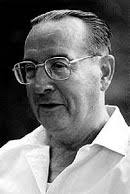
Gabriel Camps was a French archaeologist and social anthropologist, the founder of the Encyclopédie berbère and is considered a prestigious scholar on the history of the Berber people.

Tamazight of Djerba, Chelha of Djerba, or Djerbi is a Berber language of the Eastern Maghreb, spoken on the island of Djerba, in Tunisia. It is a component of what is regularly denominated Tunisian “Chelha”, in the south of the country.
Habib ibn Abd al-Rahman al-Fihri was an Arab noble of the Oqbid or Fihrid family, and briefly ruler of Ifriqiya from 755 to 757.

Igawawen or Gawawa, mostly known as Zwawa were a group of Kabyle tribes inhabiting the Djurdjura mountains, Greater Kabylia, in Algeria, whose most famous and strongest confederations were those of the Aït Betrun, the Aït Iraten, and the Aït Mengellat, and are divided into various tribes, and the tribes themselves are divided into many villages. The Zouaoua are a branch of the Kutama tribe of the Baranis Berbers.
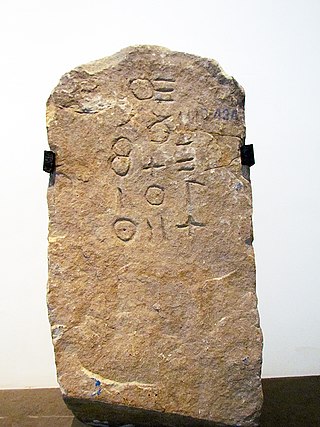
Numidian was a language spoken in ancient Numidia, a territory covering much of northern Africa. The script in which it was written, the Libyco-Berber alphabet, has been almost fully deciphered and most characters have known values. Despite this, the language has barely been deciphered and only a few words are known. Libyco-Berber inscriptions are attested from the 3rd century BC to the 3rd century AD. The language is scarcely attested and can be confidently identified only as belonging to the Afroasiatic family, although it was most likely part of the Berber languages, spoken at the start of the breakup of the Proto-Berber language.
Antalas was a Berber tribal leader who played a major role in the wars of the Byzantine Empire against the Berber tribes in Africa. Antalas and his tribe, the Frexes initially served the Byzantines as allies, but after 544 switched sides. With the final Byzantine victory in his and his tribe once again became Byzantine subjects. The main sources on his life are the epic poem Iohannis of Flavius Cresconius Corippus and the Histories of the Wars of Procopius of Caesarea.

The Zawiya Dila'iya or Zawiyaof Dila was a Sufi brotherhood, centred in the Middle Atlas range of Morocco.

Bilta also known as Balta or Balţah, is an antique town in northern Tunisia, close to Mateur in today's Bizerte governorate. Its name comes from the Numidian language (Lybico-Berber) root BLT, meaning, filled with water.
Mastanabal was one of three legitimate sons of Masinissa, the King of Numidia, a Berber kingdom in, present day Algeria, North Africa. The three brothers were appointed by Scipio Aemilianus Africanus to rule Numidia after Masinissa's death.
The Battle of Tabarka was a military engagement fought between the forces of the Umayyad Caliphate and Dihya, a Berber queen. The battle took place near the city of Tabarka, Tunisia, in either 701, 702 or 703 AD. The battle resulted in a major victory for the Umayyads and the end of organized Berber resistance to the caliphate.
Ikjan is a former town near the present-day town of Beni Aziz in Algeria. Between 902 and 909 it served as the base and capital of the Kutama Berbers led by the dā'ī (missionary) Abu Abdallah al-Shi'i, who had founded an Isma'ili Shi'a state in the region on behalf of the Fatimid cause. This new movement rose in opposition to the Aghlabid dynasty, which ruled the region of Ifriqiya formally on behalf of the Abbasid Caliphs. The site of Ikjan was considered impregnable. In 909 Abu Abdallah and the Kutama armies finally overthrew the Aghlabids and set themselves up in Raqqada, laying the foundations for the Fatimid Caliphate, which was formally established with the enthronement of the first caliph, Abd Allah al-Mahdi, later that year.

Jewelleryof the Berber cultures is a historical style of traditional jewellery that was worn by women mainly in rural areas of the Maghreb region in North Africa and inhabited by indigenous Berber people. Following long social and cultural traditions, Berber or other silversmiths in Morocco, Algeria and neighbouring countries created intricate jewellery with distinct regional variations. In many towns and cities, there were Jewish silversmiths, who produced both jewellery in specific Berber styles as well as in other styles, adapting to changing techniques and artistic innovations.
