Ku, KU, or Kū may refer to:

The Dardic languages, or Hindu-Kush Indo-Aryan languages, are a group of several Indo-Aryan languages spoken in northern Pakistan, northwestern India and parts of northeastern Afghanistan. This region has sometimes been referred to as Dardistan.
Pahri is a rare alternative spelling for either:

The Northern Indo-Aryan languages, also known as Pahāṛi languages, are a proposed group of Indo-Aryan languages spoken in the lower ranges of the Himalayas, from Nepal in the east, through the Indian states of Jammu and Kashmir, Uttarakhand, Himachal Pradesh and Punjab was coined by G. A. Grierson.

Pahari-Pothwari is an Indo-Aryan language variety of Lahnda group, spoken in parts of the Pothohar Plateau in the far north of Punjab, Pakistan, as well as in most of Pakistan-administered Azad Kashmir and in western areas of Indian-administered Jammu and Kashmir. It is known by a variety of names, the most common of which are Pahari, and Pothwari.
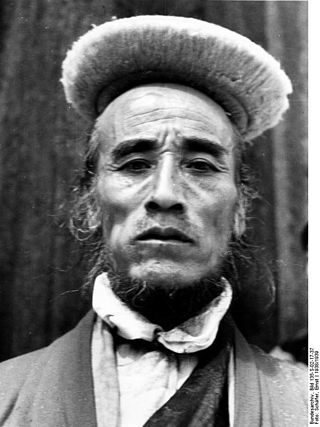
Bhotiya or Bhot is an Indian and Nepali exonym lumping together various ethnic groups speaking Tibetic languages, as well as some groups speaking other Tibeto-Burman languages living in the Transhimalayan region that divides India from Tibet. The word Bhotiya comes from the classical Tibetan name for Tibet, བོད, bod. The Bhotiya speak numerous languages including Ladakhi, Drejongke, Yolmo and Sherpa. The Indian recognition of such language is Bhoti / Bhotia having Tibetan scripts and it lies in the Parliament of India to become one of the official languages through Eighth Schedule of the Indian Constitution.

Mirpur District is a district of Pakistan-administered Azad Jammu and Kashmir region. It is one of the 10 districts of Pakistan's territory of Azad Kashmir. The Mirpur District is bounded on the north by the Kotli District, on the east by the Bhimber District, on the south by the Gujrat District of Punjab, Pakistan, on the south-west by the Jhelum District of Punjab, Pakistan, and on the west by its Rawalpindi District. The district is named after its main city, Mirpur. The Mirpur District has a population of 456,200 and covers an area of 1,010 km2 (390 sq mi). The district is mainly mountainous with some plains. The Mirpur District has a humid subtropical climate which closely resembles that of the Gujrat District and the Jhelum District, the adjoining districts of Pakistan's Punjab Province.

Dogri is an Indo-Aryan language of the Western Pahari group, primarily spoken in the Jammu region of Jammu and Kashmir, India, with smaller groups of speakers in the adjoining regions of western Himachal Pradesh, northern Punjab, and north-eastern Pakistani Punjab. It is the ethnic language of the Dogras, and was spoken in the historical region of Duggar. It is currently spoken in the districts of Kathua, Jammu, Samba, Udhampur, Reasi and other adjoining districts of Jammu Province Unusually for an Indo-European language, Dogri is tonal, a trait it shares with other Western Pahari languages and Punjabi. It has several varieties, all with greater than 80% lexical similarity.

Khas peoples or Khas Tribes, popularly known as Khashya are an Indo-Aryan ethno-linguistic group native to the Himalayan region of the Indian subcontinent, in what is now the South Asian country of Nepal, as well as the Indian states of Uttarakhand, Himachal Pradesh, West Bengal, Assam and Sikkim. Khas consists of many subtribes like Kshetri, Thakuri, Bahun and Sanyasis and all spread across the Himalayas.
Ethnic groups in South Asia are ethnolinguistic groupings within the diverse populations of South Asia, including the countries of Bangladesh, Bhutan, India, Maldives, Nepal, Pakistan, and Sri Lanka. Afghanistan is variously considered to be a part of both Central Asia and South Asia, which means Afghans are not always included among South Asians, but when they are, South Asia has a total population of about 2.04 billion.
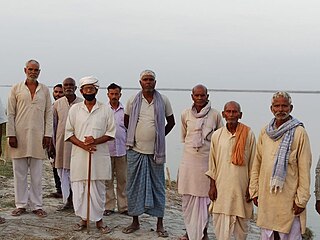
Madheshi people is a term used for several ethnic groups in Nepal living in the Terai region of Nepal. It has also been used as a political pejorative term by the Pahari people of Nepal to refer to Nepalis with a non-Nepali language as their mother tongue, regardless of their place of birth or residence. The term Madheshi became a widely recognised name for Nepali citizens with an Indian cultural background only after 1990.
Pahari, or Pahadi is an ambiguous term that has been used for a variety of languages, dialects and language groups, most of which are found in the lower Himalayas.
Pakistan is an ethnically and linguistically diverse country. The major Pakistani ethnolinguistic groups include Punjabis, Pashtuns, Sindhis, Saraikis, Muhajirs, Balochs, Hindkowans/Hazarewals, Brahuis, and Kohistanis with significant numbers of Shina, Baltis, Kashmiris, Paharis, Chitralis, Torwalis, Hazaras, Burusho, Wakhis, Kalash, Siddis, Uzbeks, Nuristanis, Pamiris and various other smaller minorities.
The Pahadi people are an Indo-Aryan group living in the hilly region (Pahad) of Nepal. Most Paharis, however, identify as members of constituent subgroups and castes within the larger Pahari community such as Brahmin, Kshatriya and Dalits.

Sarazi or Sirazi is an Indo-Aryan language spoken in the Saraz region of the Jammu division of Jammu and Kashmir, India. It is native to the Saraz region, a hilly area taking up the northern half of Doda district and parts of neighbouring Ramban and Kishtwar districts. Sarazi is spoken as a first language by 46,000 people, primarily Hindus, but it is also used as a lingua franca of the Saraz region and so is also spoken as a second language by Muslims, whom are native speakers of Kashmiri.
The Pahari people or Pahari-speaking people is a cover term for a number of heterogeneous communities inhabiting in Indian-administered Jammu and Kashmir, Pothohar Plateau, the Hindkowans of Khyber Pakhtunkhwa and also some parts of Pakistan-administered Azad Kashmir who speak Pahari languages/dialects.
Pahari culture refers to the cultural practices, traditions, arts, languages, lifestyles, and social behavior of the people living in the hilly regions of northern India, Pakistan, and Nepal. The term "pahari" or "pahadi" originates from the Hindi word "pahad", denotes "mountain" or "hill", and collectively describes the inhabitants of mountainous areas, including parts of Jammu and Kashmir, Himachal Pradesh, Uttarakhand, and northern Pakistan, as well as the Himalayan foothills in Nepal.

