
Luca Signorelli was an Italian Renaissance painter from Cortona, in Tuscany, who was noted in particular for his ability as a draftsman and his use of foreshortening. His massive frescos of the Last Judgment (1499–1503) in Orvieto Cathedral are considered his masterpiece.

Orvieto is a city and comune in the Province of Terni, southwestern Umbria, Italy, situated on the flat summit of a large butte of volcanic tuff. The city rises dramatically above the almost-vertical faces of tuff cliffs that are completed by defensive walls built of the same stone.
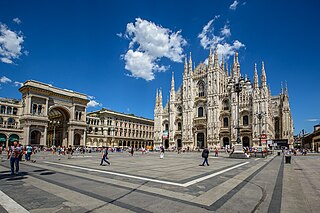
Piazza del Duomo is the main piazza of Milan, Italy. It is named after, and dominated by, Milan Cathedral. The piazza marks the center of the city, both in a geographic sense and because of its importance from an artistic, cultural, and social point of view. Rectangular in shape, with an overall area of 17,000 m2, the piazza includes some of the most important buildings of Milan, as well some of the most prestigious commercial activities, and it is by far the foremost tourist attraction of the city.

Palazzo dei Papi is a palace in Viterbo, northern Latium, Italy. It is considered to be one of the most important monuments in the city, situated alongside the Duomo di Viterbo. The Papal Curia was moved to Viterbo in 1257 by Alexander IV, due to the hostility of the Roman commune and constant urban violence: the former bishop's palace of Viterbo was enlarged to provide the Popes with an adequate residence. The construction, commissioned by the Capitano del popolo Raniero Gatti, provided a great audience hall communicating with a loggia raised on a barrel vault above the city street. It was completed probably around 1266.

Orvieto Cathedral is a large 14th-century Roman Catholic cathedral dedicated to the Assumption of the Virgin Mary and situated in the town of Orvieto in Umbria, central Italy. Since 1986, the cathedral in Orvieto has been the episcopal seat of the former Diocese of Todi as well.

Viterbo Cathedral is a Roman Catholic cathedral, and the principal church of the city of Viterbo, Lazio, central Italy. It is the seat of the Bishop of Viterbo and is dedicated to Saint Lawrence.

Cesare Nebbia (c.1536–c.1614) was an Italian Mannerist painter from Orvieto.

Gothic architecture appeared in the prosperous independent city-states of Italy in the 12th century, at the same time as it appeared in Northern Europe. In fact, unlike in other regions of Europe, it did not replace Romanesque architecture, and Italian architects were not very influenced by it. However, each city developed its own particular variations of the style.

Orvieto, Umbria, Italy, was the refuge of five popes during the 13th century: Urban IV (1261–1264), Gregory X (1271–1276), Martin IV (1281–1285), Nicholas IV (1288–1292) and Boniface VIII (1294–1303). During this time, the popes took up residence in the Papal Palace of Orvieto, which was adjacent to the Orvieto Cathedral and expanded onto the bishop's residence. None of these popes died in Orvieto, and thus no papal elections took place in there, nor are there any papal tombs.
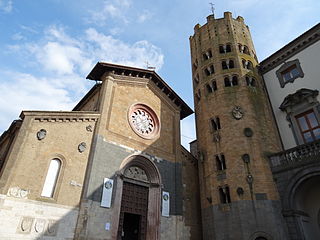
Sant'Andrea is a late-Romanesque-Gothic architecture, Roman Catholic church on the Piazza della Repubblica in Orvieto, region of Umbria, Italy. It dates to the 12th century and is noted for its distinctive decagonal bell tower. the church rises adjacent to the Palazzo Comunale or city hall of Orvieto.
Palazzo Gualterio is a palace opposite the Torre del Moro Orvieto in Orvieto in the Province of Terni, Italy. It was built by the ancient Gualterio family, and decorated with stucco and frescoes. Filippo Antonio Gualterio was the last of the family to live there. The palace was then given to the Banco di Roma, while objects of art were transferred to the museum and halls of the Town Hall of Orvieto, where there are still preserved.

Chiesa di San Francesco is a late-Romanesque- early Gothic architecture, Roman Catholic church located on Via Ippolito Scalza in the southern ridge of the historic center of Orvieto, Umbria, Italy. It was consecrated in 1266. It belongs to the Roman Catholic Diocese of Orvieto-Todi.

The National Archaeological Museum of Orvieto is a museum in Orvieto, region of Umbria, Italy. It is located adjacent to the Duomo in the Gothic-style 13th-century Papal Palace in Piazza Duomo.

The Palazzo del Capitano del Popolo, also known as the Palazzo del Podesta is a late-Romanesque-Gothic architecture, late 13th-century civic palace located in Piazza del Popolo, in the historic center of Orvieto, region of Umbria, Italy. The palace now houses some municipal offices and the main hall is used for cultural events and meetings.

The Palazzo Monaldeschi, known also as Palazzo Sforza Monaldeschi della Cervara or as Palazzo Marsciano or Meoni or, is a Renaissance architecture, aristocratic palace located on Piazza Ippolito Scalza in the historic center of Orvieto in the Region of Umbria, Italy. It is located about a block north of the church of San Francesco on Via Beato Angelico #52, corner with Via di Maurizio.

Palazzo Crispo Marsciano, previously known simply as the Palazzo Marsciano is a Renaissance architecture palace located on Via Postierla #9 on Piazza Marconi in the historic center of Orvieto in the region of Umbria, Italy.

Palazzo Netti is a Neo-Renaissance architecture palace located on Via Lorenzo Maitani #9, the alley that leads west from the central portal of the Duomo of Orvieto in the region of Umbria, Italy. The palace originally belonged to the family of Vincenzo Durante, bishop of Orvieto from 1529 to 1541, then to the Vespi family. The present palace with its elaborate sgraffito facade was refurbished in the 19th-century by the Florentine professor Giuseppe Smerrini under commission by the engineer Aldobrando Netti. Netti became known for opening the first electrical hydropower plant in Orvieto, allowing for the town theater, Teatro Mancinelli, to be one of the first buildings in town with electricity. The Officine Netti was built in 1893, and are located north-west of Orvieto in the neighborhood of Sugano and Rocca Ripesena ; the ruins provide an immage of the luddite victory of nature over early industrialism.

San Giacomo Maggiore is a Neoclassical architecture, Roman Catholic church located on Piazza del Duomo #10, with a facade facing north to the cathedral piazza, just to the west of Palazzo Soliano, and adjacent to the former hospital of Santa Maria della Stella, in Orvieto, region of Umbria, Italy.

The Palazzo Comunale, once called Palazzo Municipale is a Mannerist architecture civic palace located in Piazza della Republica, adjacent to the dodecagonal bell-tower of the church of Sant'Andrea in the historic center of Orvieto, region of Umbria, Italy. The palace houses city hall offices.

The Palazzo dei Sette, also called Palazzo per il Tribunale, Palazzo Apostolico, and Casa del Papa is a Renaissance architecture palace located in Corso Cavour#85, almost central to the upper historic city of Orvieto, region of Umbria, Italy. Adjacent to the palace is the square medieval Torre del Moro which, after climbing its 300 stairs, affords a view of the rest of the town and surrounding countryside.


