
Ferit Orhan Pamuk is a Turkish novelist, screenwriter, academic and recipient of the 2006 Nobel Prize in Literature. One of Turkey's most prominent novelists, his work has sold over thirteen million books in sixty-three languages, making him the country's best-selling writer.
White Castle may refer to:
Orhan is a Turkish given name for males. People named Orhan include:
Article 301 is an article of the Turkish Penal Code making it illegal to insult Turkey, the Turkish nation, Turkish government institutions, or Turkish national heroes such as Mustafa Kemal Atatürk. It took effect on June 1, 2005, and was introduced as part of a package of penal law reform in the process preceding the opening of negotiations for Turkish membership of the European Union (EU), in order to bring Turkey up to Union standards. The original version of the article made it a crime to "insult Turkishness"; on April 30, 2008, the article was amended to change "Turkishness" into "the Turkish nation". Since this article became law, charges have been brought in more than 60 cases, some of which are high-profile. The Great Jurists Union headed by Kemal Kerinçsiz, a Turkish lawyer, is "behind nearly all of Article 301 trials". Kerinçsiz himself is responsible for forty of the trials, including the high-profile ones.
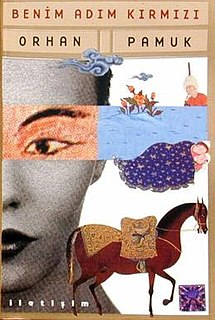
My Name Is Red is a 1998 Turkish novel by writer Orhan Pamuk translated into English by Erdağ Göknar in 2001. Pamuk would later receive the 2006 Nobel Prize in Literature. The novel, concerning miniaturists in the Ottoman Empire of 1591, established Pamuk's international reputation and contributed to his Nobel Prize. The influences of Joyce, Kafka, Mann, Nabokov and Proust and above all Eco can be seen in Pamuk's work.
Maureen Deidre Freely FRSL is an American journalist, novelist, professor, and translator. She has worked on the Warwick Writing Programme since 1996.
Silent House may refer to:
Erdağ Göknar is a Turkish-American scholar, literary translator and poet. He is Associate Professor of Turkish and Middle Eastern Studies at Duke University and Director of the Duke University Middle East Studies Center.
A Turkish name consists of an ad or an isim and a soyadı or soyisim (surname). Turkish names exist in a "full name" format. While there is only one soyadı (surname) in the full name there may be more than one ad. Married women may carry both their maiden and husband's surnames. The soyadı is written as the last element of the full name, after all given names.
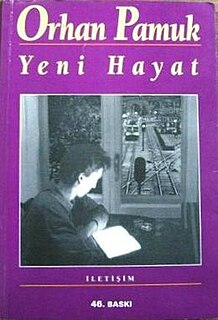
The New Life is a 1994 novel by Turkish writer Orhan Pamuk, translated into English by Güneli Gün in 1997.
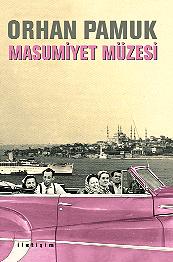
The Museum of Innocence is a novel by Orhan Pamuk, Nobel-laureate Turkish novelist published on August 29, 2008. The book, set in Istanbul between 1975 and 1984, is an account of the love story between the wealthy businessman Kemal and a poorer distant relative of his, Füsun. Pamuk said he used YouTube to research Turkish music and film while preparing the novel.

Murat Gülsoy is a Turkish writer. He started his literary career as a publisher and a writer of the bimonthly magazine Hayalet Gemi in 1992. His works explore the metafictive potential of postmodern self-consciousness with ‘page turning’ plots. He also produced interactive hypertext works on internet exploring new ways of narrative. Gülsoy has published 18 books in Turkey so far. Besides short stories, he has eight novels addressing modern masters Kafka, Borges, Eco, Laurence Sterne, Fowles and Orhan Pamuk. He is the recipient of some of the most prestigious national literary awards. He conducts creative writing workshops since 2004. Besides being a writer, he is also a professor with Bogazici University at Institute of Biomedical Engineering. He is the head of the editorial board of Bogazici University Press and director of Bogazici University Nazım Hikmet Culture and Art Research Center. Stehlen Sie dieses Buch is his first book to be translated into German. His novels are published in English, Macedonian, Arabics, Bulgarian, Albanian and Chinese. His 2000 Sait Faik Award-winning book "Bu Kitabı Çalın" "borrows" its name from Abbie Hoffman's 1971 book "Steal This Book" and it is referred in the book as a postmodern parody.

Silent House (1983) is Orhan Pamuk's second novel published after Cevdet Bey and His Sons. The novel tells the story of a week in which three siblings go to visit their grandmother in Cennethisar, a small town near Istanbul. The book has received positive retrospective reviews from critics.

The Ovid Prize, established in 2002, is a literary prize awarded annually to an author from any country, in recognition of a body of work. It is named in honour of the Roman poet Ovid, who died in exile in Tomis, on the Black Sea, in Romania. Laureates are awarded 10,000 euros.
İpek is a common feminine Turkish given name. In Turkish, "İpek" means "Silk".
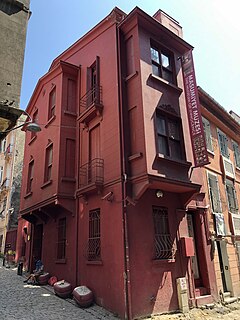
The Museum of Innocence is a museum in a 19th-century house in Istanbul (Çukurcuma) created by novelist Orhan Pamuk as a companion to his novel The Museum of Innocence. The museum and the novel were created in tandem, centred on the stories of two Istanbul families. On 17 May 2014, the museum was announced as the winner of the 2014 European Museum of the Year Award.
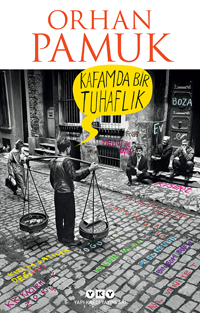
A Strangeness in My Mind is a 2014 novel by Orhan Pamuk. It is the author's ninth novel. Knopf Doubleday published the English translation by Ekin Oklap in the U.S., while Faber & Faber published the English version in the UK.

The Red-Haired Woman is a 2016 novel by Turkish writer Orhan Pamuk. Alex Preston, writing in The Guardian, referred to the novel as "deceptively simple".
The 2006 Nobel Prize in Literature was awarded to the Turkish writer Orhan Pamuk "who in the quest for the melancholic soul of his native city has discovered new symbols for the clash and interlacing of cultures."
