 | This article needs additional citations for verification .(April 2020) |
Pang Meng (died AD 30) was a Chinese general of the Xin dynasty and early period of the Eastern Han dynasty. He was born in Shanyang Commandery, Yanzhou. [1]
| | This article needs additional citations for verification .(April 2020) |
Pang Meng (died AD 30) was a Chinese general of the Xin dynasty and early period of the Eastern Han dynasty. He was born in Shanyang Commandery, Yanzhou. [1]
At first he belonged to the Xiajiang Army of the Green Forest Army. In AD 23, Liu Xuan assumed the position of Emperor Gengshi, Pang Meng was appointed as Jizhou animal husbandry, belonged to Shang Shuling Xie Gong, and defeated general Liu Xiu against Hebei Wang Chang. In AD 24, Liu Xiu slaughtered Xie Gong, and Pang Meng fell to Liu Xiu's subordinates. [2]
In June AD 25, Liu Xiu assumed the position of Emperor Guangwu, appointed Pang Meng as attendant. Pang Meng is humble and meek, trusted and loved by Emperor Guangwu. Emperor Guangwu said: "You can hold the six-foot lonely one, and the one who lives for a hundred miles, Pang Meng is also." Then, Appointed Pang Meng as Pingdi General. [3]
On July 28, the Dong Xian Division of the Prince of Liang Liu Yu camp will take a break and present Lanling (Donghai Commandery) to Eastern Han. Dong Xian Xingbing wanted to recapture Lanling, and Emperor Guangwu ordered Pang Meng and Gai Yan rescued Benxiu. Dong Xian defeated Pang Meng and Gai Yan. As a result, Lanling was retaken by Dong Xian. The Pang Meng mission failed, and there was an unstable atmosphere between Pang Meng and Gai Yan. Emperor Guangwu issued an edict to Gai Yan instead of Pang Meng. Pang Meng thought Gai Yan Emperor Guangwu made a whisper and began to wonder. In March AD 29, Pang Meng killed Chu Commandery Tai Shou Sun Meng, attacked Gai Yan, and attached to Liu Yu camp. [4]
Hearing Pang Meng's rebellion, Emperor Guangwu was furious and scolded Pang Meng the old thief. The pro-raters will recover. Pang Meng was surrounded by Dongping Commandery with the support of Liang Army Su Mao. Emperor Guangwu Army defeated it. Pang Meng fought with Dong Xian in Shandong. Wu Han led the Han army to attack and Pang Meng lost. In February AD 30, Wu Han captured Dong Xian ’s Dong (Donghai Commandery), chased Pang Meng and Dong Xian to Donghai Commandery, and Wu Han ’s captain Han Zhan killed Dong Xian and Fang Yuren ’s Qianling cut Pang meng, sent to the heads of Luoyang. [5] [6]
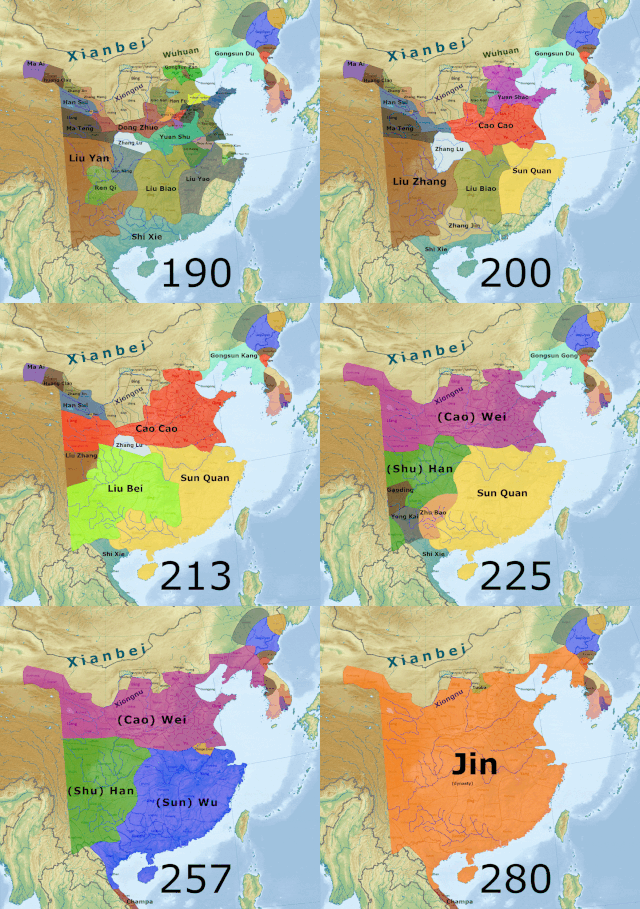
The Three Kingdoms from 220 to 280 AD was the tripartite division of China among the dynastic states of Cao Wei, Shu Han, and Eastern Wu. The Three Kingdoms period was preceded by the Eastern Han dynasty and was followed by the Western Jin dynasty. The short-lived state of Yan on the Liaodong Peninsula, which lasted from 237 to 238, is sometimes considered as a "4th kingdom".

Xiahou Dun, courtesy name Yuanrang, was a Chinese military general and politician serving under the warlord Cao Cao during the late Eastern Han dynasty of China. He served for a few months under Cao Cao's successor, Cao Pi, before his death. As one of Cao Cao's most trusted generals, Xiahou Dun aided the warlord in his campaigns against Lü Bu, Liu Bei, Sun Quan and others.

Zhuge Liang, also commonly known by his courtesy name Kongming, was a Chinese statesman, strategist, and engineer who lived through the end of the Eastern Han dynasty and the early Three Kingdoms period (220–280) of China. During the Three Kingdoms period, he served as the Imperial Chancellor of the state of Shu Han (221–263) from its founding in 221 and later as regent from 223 until his death in September or October 234.

Emperor Guangwu of Han, born Liu Xiu (劉秀), courtesy name Wenshu (文叔), was a Chinese monarch. He served as an emperor of the Han dynasty by restoring the dynasty in AD 25, thus founding the Eastern Han dynasty. He ruled over parts of China at first since his dynasty was formed through rebellion against the short-lived Xin dynasty, and through suppression and conquest of regional warlords, the whole of China proper was consolidated by the time of his death in AD 57. During his reign, Taoism was made the official religion of China, and the Chinese folk religion began to decline.

Emperor Ming of Han, born Liu Yang and also known as Liu Zhuang and as Han Mingdi, was the second Emperor of the Eastern Han dynasty.

The Rebellion of the Seven States or Revolt of the Seven Kingdoms took place in 154 BC against the rule of Emperor Jing of Han dynasty by its regional semi-autonomous kings, to resist the emperor's attempt to centralize the government further.
The military history of the Three Kingdoms period encompasses roughly a century's worth of prolonged warfare and disorder in Chinese history. After the assassination of General-in-chief He Jin in September 189, the administrative structures of the Han government became increasingly irrelevant. By the time of death of Cao Cao, the most successful warlord of North China, in 220, the Han empire was divided between the three rival states of Cao Wei, Shu Han and Eastern Wu. Due to the ensuing turmoil, the competing powers of the Three Kingdoms era found no shortage of willing recruits for their armies, although press-ganging as well as forcible enlistment of prisoners from defeated armies still occurred. Following four centuries of rule under the Han dynasty, the Three Kingdoms brought about a new era of conflict in China that shifted institutions in favor of a more permanent and selective system of military recruitment. This ultimately included the creation of a hereditary military class as well as increasing reliance on non-Chinese cavalry forces and the end of universal conscription.
Liu Yan, courtesy name Bosheng (伯升), was a Chinese general of one of the major uprisings against the Xin dynasty and its emperor, Wang Mang. Although he was militarily successful, he died early as a victim of political intrigue. His younger brother Liu Xiu, however, would eventually found the Eastern Han dynasty.

Wu Han, courtesy name Ziyan, was a Chinese military general and politician during the Eastern Han dynasty who made great contributions to Emperor Guangwu 's reestablishment of the Han Dynasty and who is commonly regarded as Emperor Guangwu's best general, but who was also known for cruelty against civilians. He was also one of the 28 Generals of Yuntai.

The end of the Han dynasty was the period of Chinese history from 189 to 220 CE, roughly coinciding with the tumultuous reign of the Han dynasty's last ruler, Emperor Xian. It was followed by the Three Kingdoms era. During the end of the Han dynasty, the country was thrown into turmoil by the Yellow Turban Rebellion (184–205). Meanwhile, the Han Empire's institutions were destroyed by the warlord Dong Zhuo and fractured into regional regimes ruled by various warlords, some of whom were nobles and officials of the Han imperial court. The warlord Cao Cao took control of Emperor Xian and his court in 196 and began gradually reunifying the empire. Cao Cao ostensibly operated under Emperor Xian's rule, though in reality the emperor was a hostage.
Luo Xian, courtesy name Lingze, was a military general of Shu Han in the Three Kingdoms period of China. After the fall of Shu in 263, he continued serving under the Cao Wei state, then the succeeding Jin dynasty in 266. He is best known for defending his position at Yong'an for about six months against attacks from Shu's former ally state Wu after the fall of Shu.

Romance of the Three Kingdoms is a Chinese television series adapted from the classical 14th century novel of the same title by Luo Guanzhong. The series was produced by China Central Television (CCTV) and was first aired on the network in 1994. It spanned a total of 84 episodes, each approximately 45 minutes long. One of the most expensive television series produced at the time, the project was completed over four years and involved over 400,000 cast and crew members, including divisions of the People's Liberation Army from the Beijing, Nanjing and Chengdu military regions. Some of the dialogue spoken by characters was adapted directly from the novel. Extensive battle scenes, such as the battles of Guandu, Red Cliffs and Xiaoting, were also live-acted.
Xin Xianying (191–269) was a Chinese noblewoman, aristocrat and advisor who lived during the Three Kingdoms period. She was a daughter of Xin Pi, an official of the state of Cao Wei. The only extant historical source about her life is her biography written by her maternal grandson, Xiahou Zhan (夏侯湛), who was a notable scholar and official of the Jin dynasty. She is best known for giving advice to her family members and relatives during significant events in the history of Cao Wei such as the Incident at the Gaoping Tombs and Zhong Hui's Rebellion.

Three Kingdoms is a 2010 Chinese television series based on the events in the late Eastern Han dynasty and the Three Kingdoms period. The plot is adapted from the 14th century historical novel Romance of the Three Kingdoms and other stories about the Three Kingdoms period. Directed by Gao Xixi, the series had a budget of over 160 million RMB and took five years of pre-production work. Shooting of the series commenced in October 2008, and it was released in China in May 2010.

Singing All Along is a 2016 Chinese television series produced by Ruby Lin, starring Lin and Yuan Hong. Set in 1st-century imperial China, the drama is based on Li Xin's (李歆) 2007–2009 romantic novel series Xiuli Jiangshan (秀丽江山) and focuses on the relationship between Liu Xiu, a peasant-turned-Eastern Han dynasty founder, and Yin Lihua, the love of his life. Although the original novel involved time travel, the television series does not contain those parts.
Chengjia, also called the Cheng dynasty or Great Cheng, was a self-proclaimed empire established by Gongsun Shu in 25 AD after the collapse of the Xin dynasty of Chinese history, rivalling the Eastern Han dynasty founded by Emperor Guangwu later in the same year. Based in the Sichuan Basin with its capital at Chengdu, Chengjia covered a large area including modern Sichuan, Chongqing, Guizhou, Yunnan, and southern Shaanxi, and comprised about 7% of China's population at the time. Chengjia was the most dangerous rival to the Eastern Han and was the last separatist regime in China to be conquered by the latter, in 36 AD.

Liang was a kingdom/principality in Han dynasty. Its territories was located within the modern Henan, Anhui and Shandong provinces.
Donghai Commandery was a historical commandery of China from Qin dynasty to Tang dynasty. It was located in present-day southern Shandong and northern Jiangsu.
Liu Yong was a general and politician of the Xin dynasty and early Eastern Han dynasty. He was born in Suiyang County, Liang Commandery, Yuzhou. A member of the Han imperial family, he was the son of Liu Li, Prince of Liang, and an 8th-generation descendant of Liu Wu, Prince Xiao of Liang.