Paper and Fibre Research Institute

Last updated

The Paper and Fibre Research Institute (PFI) (Norwegian : Papir- og fiberinstituttet AS (PFI)) is a centre of expertise for wood fibres, pulp and paper, new biobased materials and sustainable biorefining.
Norwegian language North Germanic language spoken in Norway

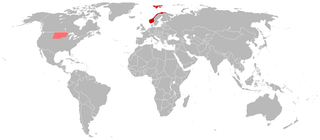
Norwegian is a North Germanic language spoken mainly in Norway, where it is the official language. Along with Swedish and Danish, Norwegian forms a dialect continuum of more or less mutually intelligible local and regional varieties, and some Norwegian and Swedish dialects, in particular, are very close. These Scandinavian languages, together with Faroese and Icelandic as well as some extinct languages, constitute the North Germanic languages. Faroese and Icelandic are hardly mutually intelligible with Norwegian in their spoken form because continental Scandinavian has diverged from them. While the two Germanic languages with the greatest numbers of speakers, English and German, have close similarities with Norwegian, neither is mutually intelligible with it. Norwegian is a descendant of Old Norse, the common language of the Germanic peoples living in Scandinavia during the Viking Era.

PFI was established in Kristiania in 1923 as the Norwegian Pulp and Paper Research Institute. PFI moved to Trondheim in 1997/98, and established a close cooperation with the Department of Chemical Engineering at the Norwegian University of Science and Technology. In 2004 PFI changed name to the Paper and Fibre Research Institute and became a subsidiary of Innventia in Stockholm, Sweden.

Oslo Place in Østlandet, Norway

Oslo is the capital and most populous city of Norway. It constitutes both a county and a municipality. Founded in the year 1040 as Ánslo, and established as a kaupstad or trading place in 1048 by Harald Hardrada, the city was elevated to a bishopric in 1070 and a capital under Haakon V of Norway around 1300. Personal unions with Denmark from 1397 to 1523 and again from 1536 to 1814 reduced its influence. After being destroyed by a fire in 1624, during the reign of King Christian IV, a new city was built closer to Akershus Fortress and named Christiania in the king's honour. It was established as a municipality (formannskapsdistrikt) on 1 January 1838. The city functioned as a co-official capital during the 1814 to 1905 Union between Sweden and Norway. In 1877, the city's name was respelled Kristiania in accordance with an offical spelling reform – a change that was taken over by the municipal authorities only in 1897. In 1925 the city, after incorporating the village retaining its former name, was renamed Oslo.

Trondheim City in Norway

Trondheim is a city and municipality in Trøndelag county, Norway. It has a population of 193,501, and is the third-most populous municipality in Norway, although the fourth largest urban area. Trondheim lies on the south shore of Trondheim Fjord at the mouth of the River Nidelva. The city is dominated by the Norwegian University of Science and Technology (NTNU), the Foundation for Scientific and Industrial Research (SINTEF), St. Olavs University Hospital and other technology-oriented institutions.

Norwegian University of Science and Technology university in Trondheim, Norway

The Norwegian University of Science and Technology is a public research university with campuses in the cities of Trondheim, Gjøvik, and Ålesund in Norway, and has become the largest university in Norway, following the university merger in 2016. NTNU has the main national responsibility for education and research in engineering and technology, originated from Norwegian Institute of Technology (NTH). In addition to engineering and natural sciences, the university offers higher education in other academic disciplines ranging from social sciences, the arts, medical and life sciences, teacher education, architecture and fine art. NTNU is well known for its close collaboration with industry, and particularly with its R&D partner SINTEF, which provided it with the biggest industrial link among all the technical universities in the world.


Related Research Articles

Papermaking economic sector

The art, science, and technology of papermaking addresses the methods, equipment, and materials used to make paper and cardboard, these being used widely for printing, writing, and packaging, among many other purposes and useful products. Today almost all paper is manufactured using industrial machinery, while handmade paper survives as a specialized craft and a medium for artistic expression.

Pulp (paper) fibrous material used notably in papermaking

Pulp is a lignocellulosic fibrous material prepared by chemically or mechanically separating cellulose fibres from wood, fiber crops, waste paper, or rags. Many kinds of paper are made from wood with nothing else mixed into them. This includes newspapers, magazines and even toilet paper. Pulp is one of the most abundant raw materials.

The pulp and paper industry in Europe accounts for about a quarter of world production and is a major employer. The leading producing countries are Finland, Sweden and Germany. The industry is a large user of renewable energy and achieved a recycling rate of 71.5% in 2015.

Paperboard thick paper-based material

Paperboard is a thick paper-based material. While there is no rigid differentiation between paper and paperboard, paperboard is generally thicker than paper and has certain superior attributes such as foldability and rigidity. According to ISO standards, paperboard is a paper with a grammage above 250 g/m2, but there are exceptions. Paperboard can be single- or multi-ply.

Wood fibres are usually cellulosic elements that are extracted from trees and used to make materials including paper.

Kenaf species of plant

Kenaf [etymology: Persian], Hibiscus cannabinus, is a plant in the Malvaceae family also called Deccan hemp and Java jute. Hibiscus cannabinus is in the genus Hibiscus and is native to southern Asia, though its exact origin is unknown. The name also applies to the fibre obtained from this plant. Kenaf is one of the allied fibres of jute and shows similar characteristics.

A paper machine is an industrial machine used in the pulp and paper industry to create paper in large quantities at high speed. Modern paper-making machines are based on the principles of the Fourdrinier Machine, which uses a moving woven mesh to create a continuous paper web by filtering out the fibres held in a paper stock and producing a continuously moving wet mat of fibre. This is dried in the machine to produce a strong paper web.

Paper recycling

The recycling of paper is the process by which waste paper is turned into new paper products. It has a number of important benefits besides saving trees from being cut down. It is less energy and water intensive than paper made from wood pulp. It saves waste paper from occupying landfill and producing methane as it breaks down. Around two thirds of all paper products in the US are now recovered and recycled, although it does not all become new paper. After repeated processing the fibers become too short for the production of new paper.

Tissue paper

Tissue paper or simply tissue is a lightweight paper or, light crêpe paper. Tissue can be made from recycled paper pulp.

Pulp mill facility which pulps wood or plant fibre

A pulp mill is a manufacturing facility that converts wood chips or other plant fibre source into a thick fibre board which can be shipped to a paper mill for further processing. Pulp can be manufactured using mechanical, semi-chemical or fully chemical methods. The finished product may be either bleached or non-bleached, depending on the customer requirements.

Tracing paper

Tracing paper is paper made to have low opacity, allowing light to pass through. It was originally developed for architects and design engineers to create drawings which could be copied precisely using the diazo copy process; it then found many other uses. The original use for drawing and tracing was largely superseded by technologies which do not require diazo copying or manual copying of drawings.

The Confederation of European Paper Industries (CEPI)is the pan-European association representing the forest fibre and paper industry.

Cotton paper, also known as rag paper, is made using cotton linters or cotton from used cloth (rags) as the primary material. Important documents are often printed on cotton paper, because it is known to last many years without deterioration. Cotton paper is superior in both strength and durability to wood pulp-based paper, which may contain high concentrations of acids, and also absorbs ink or toner better. Different grades of cotton paper can be produced.

Paper thin, flexible material mainly used for writing upon, printing upon, drawing or for packaging

Paper is a thin material produced by pressing together moist fibres of cellulose pulp derived from wood, rags or grasses, and drying them into flexible sheets. It is a versatile material with many uses, including writing, printing, packaging, cleaning, decorating, and a number of industrial and construction processes. Papers are essential in legal or non-legal documentation.

Deinking is the industrial process of removing printing ink from paperfibers of recycled paper to make deinked pulp.

The Tasman Mill site is a pulp and paper mill located on Fletcher Avenue just outside the town of Kawerau in New Zealand. The Tasman Mill site is the largest single employer in the Eastern Bay of Plenty region. Three pulp or paper companies operate in Kawerau: Norske Skog operate the mechanical pulp mill and paper mill; Oji Fibre Solutions, formerly Carter Holt Harvey, operate the kraft pulp mill; and SCA who manufacture tissue and base paper.

Shaanxi University of Science & Technology is a university located in Xianyang, Shaanxi province, China.

Paper chemicals

Paper chemicals designate a group of chemicals that are used for paper manufacturing, or modify the properties of paper. These chemicals can be used to alter the paper in many ways, including changing its color and brightness, or by increasing its strength and resistance to water.

Robert Paul Kibblewhite was a New Zealand scientist noted for his research into the properties of wood fibre, particularly in relation to the pulp and paper industry.

Hemp paper

Hemp paper means paper varieties consisting exclusively or to a large extent from pulp obtained from fibers of industrial hemp. The products are mainly specialty papers such as cigarette paper, banknotes and technical filter papers. Compared to wood pulp, hemp pulp offers a four to five times longer fibre, a significantly lower lignin fraction as well as a higher tear resistance and tensile strength. Production costs are much higher than for paper from wood.