
Matthew the Apostle, also known as Saint Matthew and as Levi, was, according to the New Testament, one of the twelve apostles of Jesus. According to Christian traditions, he was also one of the four Evangelists and thus is also known as Matthew the Evangelist, a claim rejected by the majority of modern biblical scholars.

Mark the Evangelist is the traditionally ascribed author of the Gospel of Mark. Mark is said to have founded the Church of Alexandria, one of the most important episcopal sees of early Christianity. His feast day is celebrated on April 25, and his symbol is the winged lion.
Chindōgu (珍道具) originated in Japan and is characterized by the invention of ingenious everyday gadgets that seem to be ideal solutions to particular problems, but which, in fact, cause more problems than they solve.
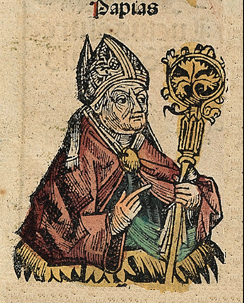
Papias was a Greek Apostolic Father, Bishop of Hierapolis, and author who lived c. 60– c.130 AD. He wrote the Exposition of the Sayings of the Lord in five books. This work, which is lost apart from brief excerpts in the works of Irenaeus of Lyons and Eusebius of Caesarea, is an important early source on Christian oral tradition and especially on the origins of the canonical Gospels.

Cleopas, also spelled Cleophas, was a figure of early Christianity, one of the two disciples who encountered Jesus during the Road to Emmaus appearance in Luke 24:13–32.
Philip of Side or Philip Sidetes, a historian of the early Christian church, was born at Side in Pamphylia. He wrote a Christian history of which fragments survive. For some detail he relied upon the well-known Historia Ecclesiae by Eusebius of Caesarea.
Alphaeus is a man mentioned in the New Testament as the father of two of the Twelve Apostles, namely:
The term logia, plural of logion, is used variously in ancient writings and modern scholarship in reference to communications of divine origin. In pagan contexts, the principal meaning was "oracles", while Jewish and Christian writings used logia in reference especially to "the divinely inspired Scriptures". A famous and much-debated occurrence of the term is in the account by Papias of Hierapolis on the origins of the canonical Gospels. Since the 19th century, New Testament scholarship has tended to reserve the term logion for a divine saying, especially one spoken by Jesus, in contrast to narrative, and to call a collection of such sayings, as exemplified by the Gospel of Thomas, logia.
The Lex Papia et Poppaea was a Roman law introduced in 9 AD to encourage and strengthen marriage. It included provisions against adultery and against celibacy after a certain age and complemented and supplemented Augustus' Lex Julia de Maritandis Ordinibus of 18 BC and the Lex Iulia de Adulteriis Coercendis of 17 BC. The law was introduced by the suffect consuls of that year, Marcus Papius Mutilus and Quintus Poppaeus Secundus, although they themselves were unmarried.
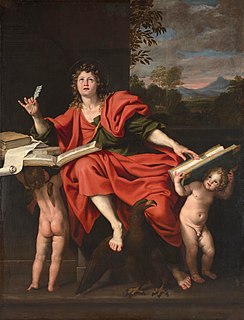
John the Presbyter was an obscure figure of the early Church who is either distinguished from or identified with the Apostle John and/or John of Patmos. He appears in fragments from the church father Papias of Hierapolis as one of the author's sources and is first unequivocally distinguished from the Apostle by Eusebius of Caesarea. He is frequently proposed by some as an alternative author of some or all of the Johannine books in the New Testament.

According to the Gospel of John, Mary of Clopas was one of the women present at the crucifixion of Jesus and bringing supplies for his funeral. The expression Mary of Clopas in the Greek text is ambiguous as to whether Mary was the daughter or wife of Clopas, but exegesis has commonly favoured the reading "wife of Clopas". Hegesippus identified Clopas as a brother of Saint Joseph. In the Roman Martyrology she is remembered with Saint Salome on April 24.

The Augustinian hypothesis is a solution to the synoptic problem, which concerns the origin of the Gospels of the New Testament. The hypothesis holds that Matthew was written first, by Matthew the Evangelist. Mark the Evangelist wrote the Gospel of Mark second and used Matthew and the preaching of Peter as sources. Luke the Evangelist wrote the Gospel of Luke and was aware of the two Gospels that preceded him. Unlike some competing hypotheses, this hypothesis does not rely on, nor does it argue for, the existence of any document that is not explicitly mentioned in historical testimony. Instead, the hypothesis draws primarily upon historical testimony, rather than textual criticism, as the central line of evidence. The foundation of evidence for the hypothesis is the writings of the Church Fathers: historical sources dating back to as early as the first half of the 2nd century, which have been held as authoritative by most Christians for nearly two millennia. Adherents to the Augustinian hypothesis view it as a simple, coherent solution to the synoptic problem.

Mary is identified in the synoptic gospels as one of the women who went to Jesus' tomb after he was buried. Mark 16:1 and Luke 24:10 refer to "Mary the mother of James" as one of the women who went to the tomb. Matthew 27:56 says that "Mary the mother of James and Joseph" was watching the crucifixion from a distance. Mark 15:40 calls her "Mary the mother of James the younger and of Joses" (NKJV). James the younger is often identified with James, son of Alphaeus. The Catholic Encyclopedia identifies him with both James, son of Alphaeus and James the brother of Jesus.
The papias was a eunuch official in the Byzantine court, responsible for the security and maintenance of the buildings of the imperial palaces in Constantinople. He commanded an extensive staff and performed in important role in palace ceremonies. In the Palaiologan period, the honorary title of megas papias was created and awarded to senior aristocrats.

Papias is a Neotropical genus of grass skipper butterflies in the family Hesperiidae.
Papias was a Latin lexicographer from Italy. Although he is often referred to as Papias the Lombard, little is known of his life, including whether he actually came from Lombardy. The Oxford History of English Lexicography considers him the first modern lexicographer for his monolingual dictionary (Latin-Latin), Elementarium Doctrinae Rudimentum, written over a period of ten years in the 1040s. The Elementarium has been called "the first fully recognizable dictionary" and is a landmark in the development of dictionaries as distinct from mere collections of glosses. Papias arranges entries alphabetically based on the first three letters of the word, and is the first lexicographer to name the authors or texts he uses as sources. Although most entries are not etymological, Papias laid the groundwork for derivational lexicography, which became firmly established only a century later.
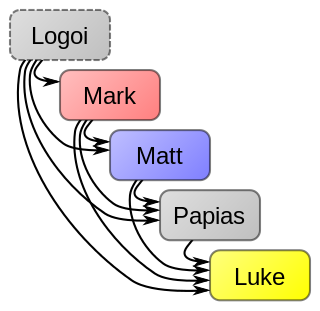
Advanced by Dennis R. MacDonald, the Q+/Papias hypothesis (Q+/PapH) offers an alternative solution to the synoptic problem. MacDonald prefers to call this expanded version of Q Logoi of Jesus, which is supposed to have been its original title.
The name John is prominent in the New Testament and occurs numerous times. Among Jews of this period, the name was one of the most popular, borne by about five percent of men. Thus, it has long been debated which Johns are to be identified with which.
Papia Sarwar is a Bangladeshi singer. She is an exponent of Rabindra Sangeet, the songs written and composed by Rabindranath Tagore. She earned Rabindra Award from Bangla Academy in 2013. She was awarded Bangla Academy Fellowship in 2015.
